
3GPP CUPS Explained | Control and User Plane Separation in Telecom Networks

Introduction: The Importance of CUPS in Modern Telecom
The landscape of mobile networks is changing to accommodate massive IoT, 5G services, and an ever-increasing demand for data. Traditional EPC (Evolved Packet Core) setups, where control and user plane functions are tightly intertwined, often lack both flexibility and efficiency.
To tackle these issues, 3GPP rolled out CUPS (Control and User Plane Separation). This new framework keeps control signaling separate from user data forwarding, which allows for independent scaling, easier deployment, and lower latency.
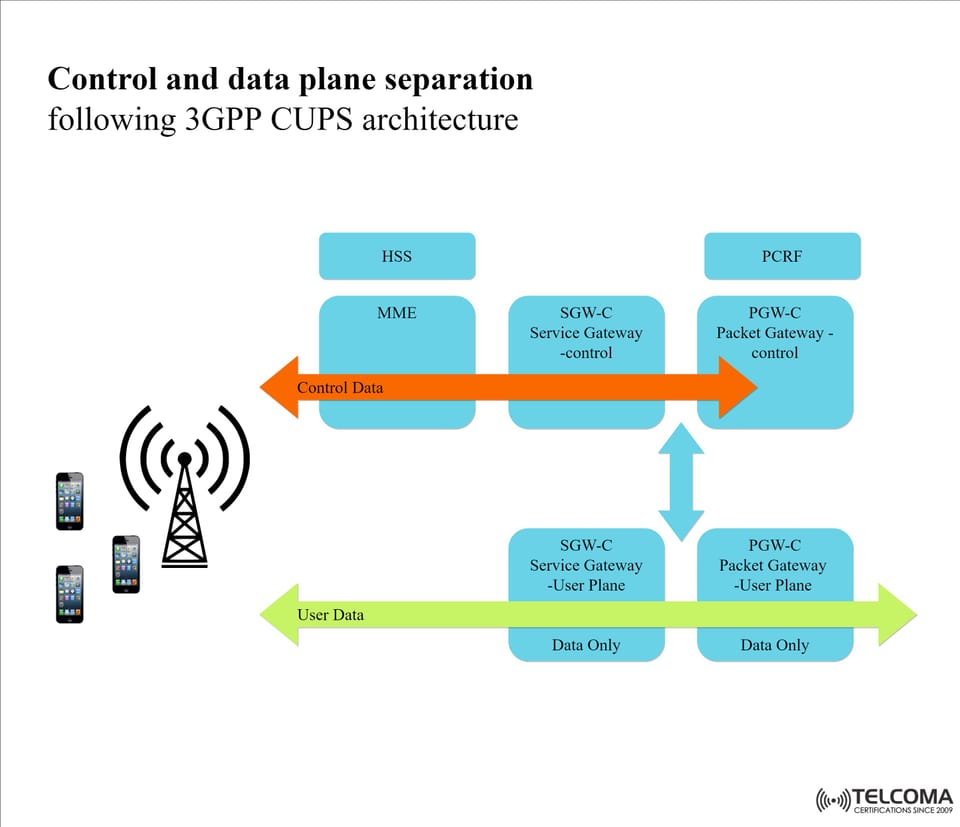
The diagram uploaded shows how control plane functions—like signaling, authentication, and policy enforcement—are distinct from user plane functions, which are all about actual data transfer. This separation makes the networks more modular and ready for the future.
Components of the CUPS Architecture
The diagram illustrates how various network components interact within the CUPS framework:
Control Plane Entities
MME (Mobility Management Entity): Oversees attach, detach, and mobility processes.
HSS (Home Subscriber Server): Keeps user subscription and authentication information.
SGW-C (Serving Gateway – Control Plane): Manages bearer management signaling.
PGW-C (Packet Gateway – Control Plane): Enforces policies, charging, and session control.
PCRF (Policy and Charging Rules Function): Sets QoS policies and charging rules.
User Plane Entities
SGW-U (Serving Gateway – User Plane): Forwards user data packets between eNodeB and PGW-U.
PGW-U (Packet Gateway – User Plane): Connects to external packet data networks, managing user data flow.
Data Flows
Control Data (Orange Path): Travels between MME, HSS, SGW-C, PGW-C, and PCRF.
User Data (Green Path): Flows from UE through SGW-U to PGW-U, independent of control signaling.
Benefits of Control and User Plane Separation
CUPS provides notable enhancements in telecom network design:
Independent Scaling:
Scale user plane resources (like bandwidth and throughput) without needing more control plane nodes.
Adjust the control plane separately for high signaling demands.
Edge Deployment:
User plane functions (UPF) can be placed nearer to users, minimizing latency.
The control plane can stay centralized for simpler management.
Cost Efficiency:
Streamlined resource allocation cuts down capital and operational costs.
Improved QoS:
Ensures low latency for critical applications (think IoT, AR/VR, real-time gaming).
Manages large data flows efficiently while keeping signaling overhead low.
Flexible Migration Path to 5G:
CUPS in EPC serves as a stepping stone toward the Service-Based Architecture (SBA) in 5G Core (5GC).
Practical Deployment Scenarios for CUPS
CUPS isn’t just a theory—it directly addresses the challenges operators face:
High-Data Areas:
Deploy SGW-U and PGW-U close to dense populations to reduce local traffic.
Keep SGW-C and PGW-C centralized for efficient signaling management.
IoT Scenarios:
Adjust control functions to manage millions of devices that send small packets.
User plane needs remain minimal.
Low-Latency Applications:
Position user plane nodes at the network edge (MEC – Multi-access Edge Computing).
Applications like AR/VR, online gaming, and autonomous vehicles benefit greatly from reduced latency.
Network Growth:
Operators can increase capacity by simply adding user plane gateways instead of deploying full SGW/PGW systems.
CUPS and the Next Step to 5G
CUPS is essential in linking 4G EPC with 5G Core (5GC).
In the 4G EPC model, SGW and PGW handle both control and user functions together.
With CUPS, these functions are separated, similar to the User Plane Function (UPF) separation in 5GC.
This makes transitioning smoother and allows operators to incorporate 5G functionalities like network slicing without overhauling their entire infrastructure.
Key Advantages for Operators
Flexibility: Place control and user planes where they make the most sense (central vs edge).
Efficiency: Make the most of network resources while saving costs.
Scalability: Effectively manage rising data traffic and IoT devices.
Future-Proofing: Smooth transition to the 5G Core and advanced services.
Technical Deep Dive: Understanding CUPS
CUPS is all about how the control plane (the signaling part) and the user plane (the data path) work together, even though they operate independently. Let’s break this down step by step.
Session Establishment:
When a user equipment (like a smartphone, IoT device, or tablet) connects to the network, the MME talks to the HSS to authenticate the user.
Once they're authenticated, the SGW-C and PGW-C create session contexts that dictate how user data should move.
Bearer Setup:
The control plane sets up bearers (which are logical paths) with certain quality of service (QoS) characteristics.
Then, SGW-U and PGW-U get the user plane tunnels ready accordingly.
User Data Flow:
After the bearers are set up, user data—like browsing activity, video streams, or messages from IoT devices—flows directly through SGW-U and PGW-U, skipping over the control elements.
The control plane just steps in when there are session updates, handovers, or policy adjustments needed.
Mobility Handling:
During handovers (like moving between different cells or areas), the control plane updates the session information.
The user plane reroutes data with minimal disruption.
This separation helps ensure that heavy user data traffic doesn’t bog down the control signaling path, which keeps networks running smoothly and responsively.
Real-World Applications of CUPS
CUPS is already in use across live networks globally, tackling specific challenges that operators face.
- Video Streaming and High-Volume Data
Challenge: Mobile networks are struggling with the skyrocketing growth of video traffic.
CUPS Solution: Position SGW-U and PGW-U closer to users (like in regional data centers) to handle data locally, minimizing backhaul congestion and boosting video quality.
Internet of Things (IoT)
Challenge: There are billions of IoT devices creating huge amounts of signaling traffic, usually with small amounts of data.
CUPS Solution: The control plane can be scaled to handle the signaling from these devices, while keeping user plane resources relatively light.
Public Safety Networks
Challenge: Emergency services need communication that’s ultra-reliable and has low latency.
CUPS Solution: By placing user plane gateways at the network's edge, data transfers can happen faster, while the control plane stays centralized for coordination.
Enterprise and Private Networks
Challenge: Enterprises setting up private LTE/5G networks need performance that’s customized to their needs.
CUPS Solution: Enterprises can set up User Plane Functions (UPFs) on-site to manage secure, low-latency data, while still depending on the operator's control plane for authentication and policy.
Conclusion
The Control and User Plane Separation (CUPS) defined by 3GPP marks a significant step in the evolution of mobile core networks. By decoupling the signaling (control plane) from user data forwarding (user plane), operators gain much-needed flexibility, scalability, and cost efficiency.