
3GPP Minimization of Drive Test (MDT) Explained: How Networks Optimize Performance

Understanding 3GPP’s Minimization of Drive Test (MDT): Enhancing Network Performance
Drive testing has been a key part of the process for optimizing mobile networks. Engineers used to drive around with advanced equipment to check signal strength, quality, and overall service performance. But it’s an expensive, labor-intensive task with a limited reach. To tackle these issues, the 3rd Generation Partnership Project (3GPP) rolled out Minimization of Drive Test (MDT), a solution that taps into data directly from user equipment (UE) to assess and improve mobile networks.
In this piece, we’re diving into what MDT is all about, how it functions, the role of 3GPP in shaping it, and why it’s becoming increasingly important with the rise of LTE and 5G.
What is 3GPP MDT?
Minimization of Drive Test (MDT) is a feature from 3GPP aimed at cutting down on the reliance on traditional manual drive testing by gathering network performance data from users’ devices. Instead of dispatching engineers to check connectivity in various areas, UEs automatically send back info on radio conditions, call events, and GPS locations to the network.
This data helps operators:
Fine-tune network performance.
Spot coverage gaps and interference issues.
Enhance the user experience.
Save time and cut operational costs.
Essentially, MDT allows operators to keep an eye on and optimize their networks constantly and at scale.
Why Minimize Drive Tests?
Traditional drive tests come with several shortcomings that MDT aims to fix:
Expensive: They need cars, specialized gear, and trained staff.
Time-intensive: Covering large areas can take ages.
Narrow focus: They only gather data from tested routes, missing a lot of the locations where users face connectivity problems.
Static snapshots: They only provide data at specific moments, not continuously.
In contrast, MDT turns every connected UE into a measurement tool by utilizing real user devices.
How 3GPP MDT Works (Step by Step)
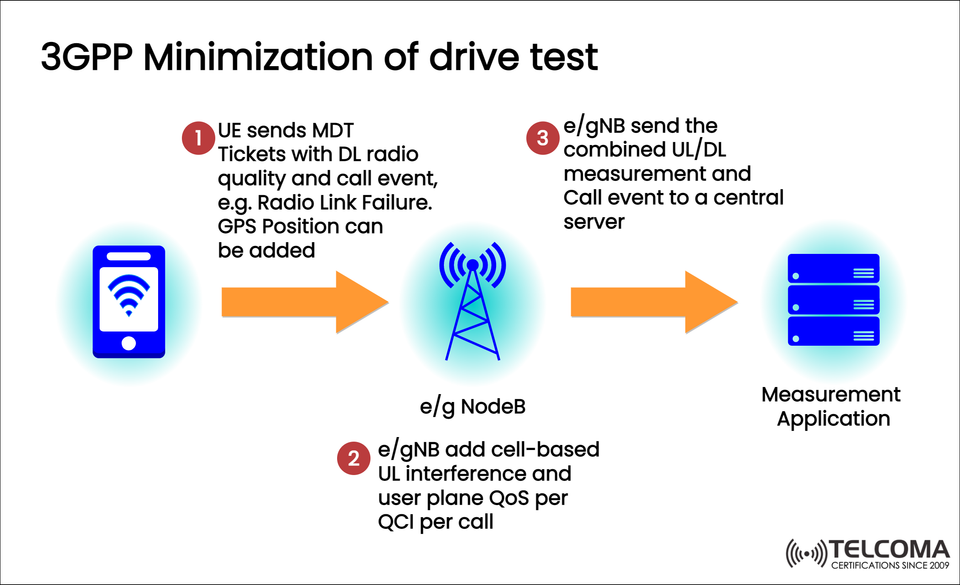
The accompanying image details the MDT process in three straightforward steps:
Step 1: UE Sends MDT Tickets
The UE (like a smartphone or IoT device) sends MDT tickets that include:
Downlink (DL) radio quality.
Call events, such as Radio Link Failure (RLF).
GPS location (optional), enabling accurate geo-tagging of issues.
Step 2: e/gNB Adds Interference and QoS Data
The e/gNB (evolved NodeB in LTE or gNodeB in 5G) supplements this data with:
Uplink (UL) interference measurements.
User plane QoS (Quality of Service) data per QCI (QoS Class Identifier) for each call.
This creates a comprehensive view of network performance on both the device and cell levels.
Step 3: Data Sent to Central Server
The combined UL/DL measurements and call events are sent to a central measurement application server.
Network operators can analyze this data to:
Identify problem areas.
Enhance coverage planning.
Adjust parameters for better performance.
This setup forms a continuous feedback loop connecting users, base stations, and network operators.
Types of MDT
3GPP outlines two main types of MDT:
- Immediate MDT (iMDT)
Reports measurements in real-time to the network.
Handy for situations needing a quick response (like sudden service drops).
- Logged MDT (lMDT)
Data is stored locally on the UE and uploaded later when the network asks for it.
This saves on signaling and battery life.
Great for long-term network analysis and when constant reporting isn’t necessary.
Benefits of 3GPP MDT
MDT brings a host of benefits compared to traditional methods:
Cost Savings: Cuts down on the need for physical drive tests and equipment.
Scalability: Lets operators capture network data over vast areas all at once.
Real-World Insights: Offers genuine user experience data from real environments (both indoors and outdoors, in rural and urban settings).
Ongoing Monitoring: Allows for 24/7 tracking of network performance.
Detailed Accuracy: GPS-powered reporting pinpoints the exact locations of coverage and interference issues.
Future-Proof: Seamlessly adapts to both LTE and 5G, aiding ongoing network development.
Key 3GPP Specifications for MDT
MDT is standardized by 3GPP in several releases:
Release 10: Introduced MDT for LTE networks.
Release 11–12: Enhanced MDT with logged reporting and richer data.
Release 15 onward: Extended MDT into 5G NR (New Radio), adding support for advanced QoS and spectrum use cases.
This evolution shows how MDT has advanced along with LTE and become a crucial tool for 5G operators.
MDT in LTE vs. 5G
Here’s a quick look at how they compare:
Feature LTE MDT5G MDT Standardization Introduced in Rel-10Extended in Rel-15+Measurement Scope RSRP, RSRQ, call events SSB measurements, beam-level QoS Use Cases Coverage optimization, RLF detection Network slicing, XR, private networks Reporting Logged & immediate Logged & immediate but more flexibility
Practical Use Cases of MDT
Telecom operators and vendors use MDT in lots of real-world situations:
Coverage Gap Detection: Finding areas with weak signals.
QoS Assurance: Making sure performance is up to par across QCI classes, which is essential for things like VoLTE and URLLC.
Interference Management: Spotting UL interference for improved spectrum use.
Network Planning: Aiding in spectrum refarming and 5G rollout.
Enterprise Solutions: Private 5G networks use MDT to ensure SLAs are met.
Challenges of MDT
While MDT is a strong tool, it comes with its own set of challenges:
Data Volume: Handling large amounts of UE data calls for advanced analytics.
Battery Impact: Logged MDT can drain UE batteries if not managed well.
Privacy Issues: Collecting GPS data must adhere to user privacy laws.
Signaling Load: Immediate MDT can lead to increased signaling traffic.
To counter these issues, operators will use smart data filtering, anonymization, and optimized reporting intervals.
MDT in the 5G Era
As we move into 5G, MDT is becoming even more crucial because:
The networks are more complex, featuring things like beamforming, mmWave, and network slicing.
Real-time QoS is essential for XR (Extended Reality), autonomous vehicles, and mission-critical IoT.
Operators need precise performance insights to fulfill on 5G SLAs.
By connecting MDT with AI/ML-driven analytics platforms, operators can spot trends, anticipate problems, and fine-tune networks on the fly.
Conclusion
The 3GPP Minimization of Drive Test (MDT) framework has completely changed how telecom operators can monitor and refine their networks. Moving beyond just expensive and limited manual drive tests, MDT gives networks UE-based, continuous, and scalable data collection.
In LTE, MDT enabled cost-effective optimization.
In 5G, it’s becoming crucial for supporting complex use cases, ensuring QoS, and boosting efficiency.
As networks continue to evolve towards 6G, MDT will remain a foundational element in performance monitoring—enhanced further by AI, edge computing, and real-time analytics. Embracing MDT is key for operators and telecom professionals aiming to create smarter, more resilient, and customer-focused networks.