
3GPP RAN Verticals up to Release 17: URLLC, RedCap, NTN, and Advanced 5G Innovations

Introduction: The Growing Scope of 5G RAN
The 3rd Generation Partnership Project (3GPP) has been at the forefront of setting global standards for mobile communication. It has transitioned from LTE to 5G New Radio (NR). With Releases 15 through 17, 3GPP has taken 5G beyond just providing broadband to consumers; it now also supports industrial automation, connected vehicles, satellite IoT, and mission-critical applications.
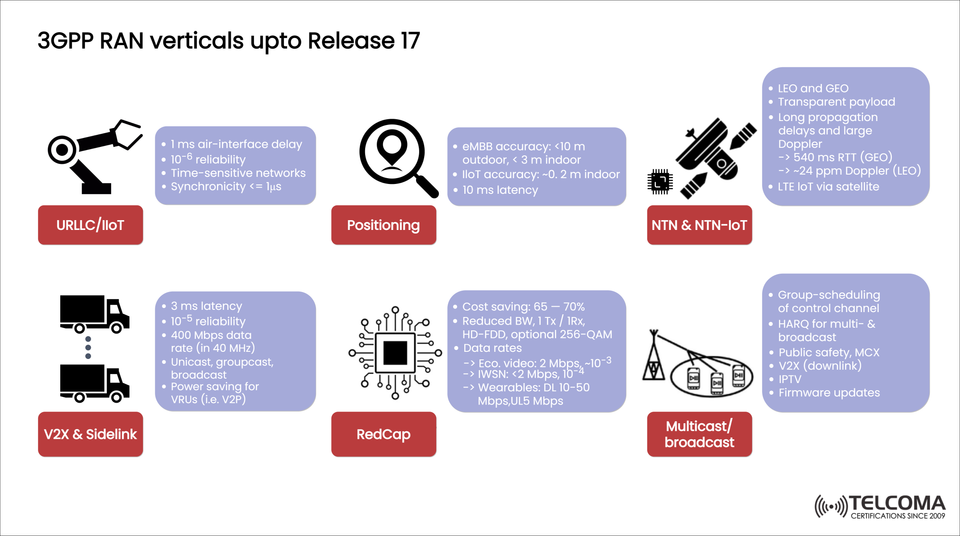
The image above from Telcoma gives a snapshot of the key RAN verticals that have been standardized up to 3GPP Release 17, which include:
URLLC / IIoT
Positioning
V2X and Sidelink
RedCap (Reduced Capability Devices)
NTN & NTN-IoT (Non-Terrestrial Networks)
Multicast/Broadcast Services
Each of these verticals marks an important leap forward in enhancing latency, reliability, energy efficiency, and coverage—all fundamental aspects that showcase 5G's flexibility.
URLLC and Industrial IoT (IIoT)
Ultra-Reliable Low-Latency Communication (URLLC)
A standout feature of 5G is definitely URLLC, which is built for applications where every millisecond counts.
Key Specifications (from the image):
Air-interface delay: ~1 ms
Reliability: 10⁻⁶ (99.9999%)
Time-sensitive networking (TSN) support
Synchronization: ≤ 1 µs
Applications
Industrial IoT (IIoT): Smart manufacturing, robotics, and factory automation.
Healthcare: Remote surgeries and medical device connectivity.
Energy and Utilities: Real-time grid monitoring and management.
Technical Highlights
It prioritizes deterministic communication with low-latency scheduling and grant-free uplink transmission.
It uses redundant paths and packet duplication to ensure high reliability.
TSN is supported for accurate timing in industrial setups.
This makes it possible for various sectors to adopt Industry 4.0 solutions with a level of control and predictability that we haven’t seen before.
Positioning Enhancements in 5G RAN
Accuracy in positioning is crucial for IoT, self-driving cars, and smart city applications. 3GPP Releases 16 and 17 unveiled advanced positioning frameworks within the RAN.
Key Metrics (from the image):
eMBB accuracy: < 10 m (outdoor), < 3 m (indoor)
IIoT accuracy: ~0.2 m (indoor)
Latency: ~10 ms
Positioning Methods
Downlink and Uplink Time Difference of Arrival (TDOA)
Angle of Arrival (AoA) and Angle of Departure (AoD)
Multi-RTT and PRSoF (Positioning Reference Signals)
Applications
Self-driving vehicles for lane-level accuracy.
Asset tracking in logistics and manufacturing.
Indoor navigation in airports, factories, and hospitals.
With 5G positioning, we’re talking centimeter-level accuracy, making it far better than traditional GPS, especially in indoor or congested urban settings.
V2X and Sidelink Communication
Vehicle-to-Everything (V2X)
3GPP rolled out V2X communications in LTE (Release 14) and expanded it in 5G NR Releases 16–17 with NR Sidelink, allowing direct communication between vehicles without needing a network.
Key Features (from the image):
Latency: ~3 ms
Reliability: 10⁻⁵
Data rate: ~400 Mbps (in 40 MHz)
Supports unicast, groupcast, and broadcast
Power saving for Vehicle-to-Pedestrian (V2P) links
Applications
Self-driving technology (V2V: Vehicle-to-Vehicle)
Traffic safety notifications (V2I: Vehicle-to-Infrastructure)
Pedestrian safety (V2P: Vehicle-to-Pedestrian)
V2X is a game-changer for real-time decision-making in vehicles, which is vital for avoiding collisions and managing traffic effectively.
RedCap: Reduced Capability NR Devices
Bridging IoT and Broadband
Launched in Release 17, RedCap (Reduced Capability) devices enable 5G connectivity for mid-range IoT devices, striking a balance between performance, cost, and energy efficiency.
Key Characteristics (from the image):
Cost savings: 65–70%
Reduced bandwidth: Single Tx/Rx chain
Modulation: Optional 256-QAM, HD-FDD
Data rates:
Eco video: ~2 Mbps, reliability ~10⁻³
IWSN: <2 Mbps, reliability ~10⁻⁴
Wearables: DL 10–50 Mbps, UL ~5 Mbps
Target Devices
Smart cameras
Wearables and healthcare gadgets
Industrial sensors
Smart meters
RedCap can be seen as a kind of 5G NR-Light, bringing affordable and energy-efficient connectivity to the ever-expanding massive IoT ecosystem.
NTN and NTN-IoT (Non-Terrestrial Networks)
Expanding 5G Coverage Beyond Earth
Non-Terrestrial Networks (NTN), as defined in 3GPP Releases 16 and 17, incorporate satellite systems into 5G to fill in connectivity gaps in remote and maritime areas.
Technical Highlights (from the image):
Supports LEO (Low Earth Orbit) and GEO (Geostationary) satellites
Transparent payload communication
Long propagation delays and high Doppler shifts
~540 ms Round Trip Time (RTT) for GEO
~24 ppm Doppler shift for LEO
Enables LTE IoT via satellite
Applications
Remote IoT sensor connections
Communication in maritime and aviation
Disaster recovery networks
Agricultural monitoring
NTN and NTN-IoT make sure there’s global 5G coverage, facilitating satellite-based IoT and broadband in regions that otherwise might be left out.
- Multicast and Broadcast Enhancements
Efficient Data Distribution Across Networks
With the surge in content streaming, public safety, and firmware updates, 3GPP has made improvements for Multicast/Broadcast Services in Releases 16–17.
Features (from the image):
Group scheduling for control channels
HARQ (Hybrid Automatic Repeat Request) for multi- and broadcast
Supports Public safety, MCX (Mission-Critical Communication), IPTV, V2X downlink, and Firmware updates
Use Cases
Public warning systems
Multimedia broadcast for emergency services
Software/firmware updates for millions of IoT devices
These enhancements ensure there's scalable and reliable delivery of large data sets to a wide range of users with minimal redundancy.
The Role of 3GPP Releases in Shaping RAN Evolution
Every 3GPP Release builds on the previous one to bring new capabilities into the 5G picture:
Release 15: The foundation for 5G NR (focused on eMBB)
Release 16: Boosted URLLC, V2X, Industrial IoT features
Release 17: Introduced RedCap, NTN, enhanced positioning, and broadcast upgrades
This ongoing expansion shows that 5G isn't just one technology—it’s a modular, scalable ecosystem that supports various sectors, from manufacturing and logistics to healthcare and aviation.
Why These RAN Verticals Matter for 5G’s Future
The merging of these verticals points to the upcoming phase of intelligent connectivity:
RedCap and URLLC will drive the Industrial Internet of Things (IIoT).
NTN and positioning will streamline global logistics and asset management.
Multicast and V2X will enhance safety, efficiency, and overall user experiences.
Each of these advancements reinforces the idea of 5G as the backbone for digital transformation across all areas of the economy.
Conclusion
The 3GPP RAN verticals up to Release 17 show just how much 5G technology has progressed—from supplying fast data to enabling mission-critical, industrial, and satellite applications.
Innovations like URLLC, RedCap, NTN, and advanced positioning have transformed 5G into a unified communication platform spanning air, land, and space.
As 3GPP aims for Release 18 and 6G, we can expect even more integration of AI, sensing, and energy-efficient designs, paving the way for a smarter and more autonomous communication system for our interconnected world.