
3GPP Reference Architecture for V2X: Complete Guide for Connected Vehicle Communication
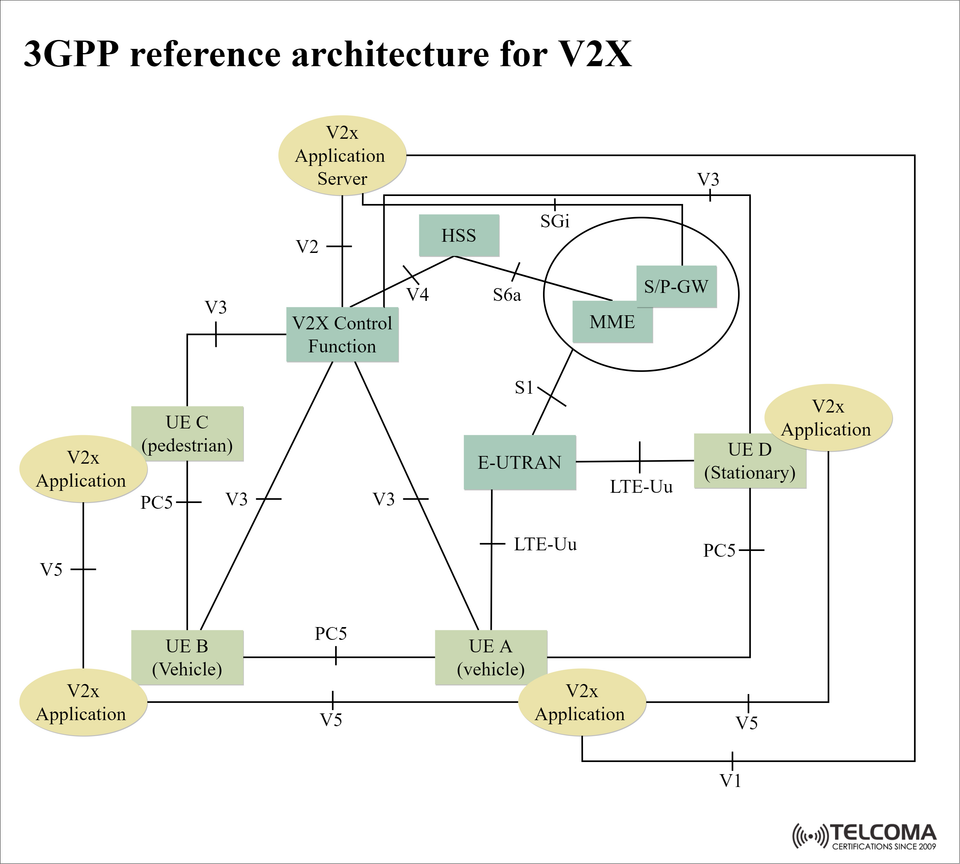

3GPP Reference Architecture for V2X Communication
Vehicle-to-Everything (V2X) communication is changing the way we think about transportation by allowing vehicles, pedestrians, infrastructure, and networks to share data in real time. The 3GPP reference architecture gives a standardized approach for rolling out V2X using LTE and 5G tech.
The diagram above illustrates how User Equipment (UE), network components, and interfaces work together to support reliable and low-latency communication in V2X systems.
Key Components in 3GPP V2X Architecture
User Equipment (UE)
The architecture accommodates various types of UEs:
UE A (Vehicle) – Connected cars communicate through PC5 and LTE-Uu.
UE B (Vehicle) – Another vehicle can use either direct or network-assisted communication.
UE C (Pedestrian) – Smartphones or wearables provide safety alerts for pedestrians.
UE D (Stationary) – Roadside units or traffic lights communicate with infrastructure.
V2X Control Function
This function serves as a central management point to:
Oversee the establishment and termination of V2X sessions.
Manage authorization and policy control.
Coordinate communication modes between direct and network-assisted options.
Core Network Components
E-UTRAN – The LTE radio access network that connects UEs via LTE-Uu.
MME (Mobility Management Entity) – Responsible for mobility, session management, and signaling.
S/P-GW (Serving/Packet Gateway) – Routes user data between LTE and external IP networks.
HSS (Home Subscriber Server) – Keeps subscriber info and authentication data.
Interfaces in V2X Communication
InterfacePurposePC5Direct communication between UEs without network involvement (e.g., vehicle-to-vehicle).LTE-UuCommunication between UE and E-UTRAN for network-assisted V2X.V1-V5Connects applications, servers, and control functions for V2X service delivery.S1Connects E-UTRAN to MME.S6aLinks MME to HSS for authentication and subscriber data.SGiInterface from S/P-GW to external networks like the V2X application server.V2, V3, V4Internal V2X-specific connections for control and application data exchange.
How the Architecture Works
Direct Communication (PC5): Vehicles and pedestrians can talk directly through the PC5 interface, skipping the LTE network for super low latency.
Network-Assisted Communication (LTE-Uu): For longer ranges and better coordination, messages can travel through the LTE network via E-UTRAN and core network components.
Application-Level Integration: V2X application servers handle and distribute data related to safety, traffic, and infotainment to the relevant UEs and infrastructure.
Benefits of 3GPP V2X Architecture
Low Latency: Essential for safety applications like collision avoidance.
Scalability: Can accommodate a growing number of connected vehicles and devices.
Interoperability: A standardized framework helps ensure compatibility across different vendors.
Multi-Mode Communication: Allows for smooth switching between direct and network-assisted communication modes.
Target SEO Keyword List You can weave these keywords into the blog post and related future articles:
3GPP V2X architecture
LTE V2X communication
V2X interfaces PC5 LTE-Uu
Vehicle-to-everything connectivity
V2X control function 3GPP
Connected vehicle architecture
5G V2X communication
C-V2X (Cellular Vehicle-to-Everything)
Direct V2X communication PC5
V2X application server
E-UTRAN V2X
LTE-V2X vs 5G-V2X
Mobility management entity in V2X
Autonomous driving communication network
Internal Linking Strategy If this post is part of a blog focused on telecom or connected vehicle technology, consider linking to related articles for better SEO:
From “V2X Control Function” section: Link to a detailed article on
The future of transportation relies on connected, intelligent, and autonomous systems, central to which is V2X communication enabled by the 3GPP V2X architecture. This architecture facilitates vehicle-to-everything connectivity through both direct PC5 communication and network-assisted LTE-Uu links, ensuring seamless and secure data exchange critical for smart cities and autonomous driving.
It incorporates various user equipment types, such as onboard units for vehicles and smartphones for pedestrians, alongside a centralized V2X control function to manage resource allocation and communication. The core network elements, including E-UTRAN and MME, support mobility and session management while providing vital communication interfaces for both direct and network-based interactions.
The advantages of this architecture include :
ultra-low latency,
scalability,
interoperability,
positioning it as future-ready,
especially for migration to 5G NR V2X.
I learned about the various types of V2X communication,
including Vehicle-to-Vehicle (V2V),
Vehicle-to-Pedestrian (V2P),
Vehicle-to-Infrastructure (V2I),
Vehicle-to-Network (V2N) services.
I discovered that user equipment types include connected vehicles, pedestrians with smartphones or wearables, and stationary units like traffic lights. I noted the different communication interfaces used, such as PC5 for low-latency safety messages and LTE-Uu for extended coverage. I also found out about core network components like E-UTRAN, MME, and the V2X Control Function that facilitate these communications. Finally, I realized the benefits of 3GPP V2X, including low latency, scalability, interoperability, multi-mode functionality, and readiness for 5G upgrades.
I need to embed the infographic just after the "V2X Communication Interfaces" section to reinforce the visual aspect, using an tag with appropriate alt text and file name while enabling lazy-loading. For promoting the infographic, I will post on social media platforms like LinkedIn with an engaging hook, create a Twitter thread detailing the architecture, and share in relevant Facebook groups or Reddit communities. I'll also make a Pinterest-friendly vertical version of the infographic and tag it with relevant keywords to increase visibility.
To generate backlinks, I plan to submit the infographic to various directories and offer an embed code for reuse on other sites. Additionally, I’ll enhance the blog post by adding a PDF download option, creating a short explainer video, and implementing FAQ Schema for better search result visibility.
Conclusion
The 3GPP reference architecture for V2X solidifies the groundwork for connected transport systems. By outlining UE roles, network components, and communication interfaces, it ensures reliable, secure, and scalable vehicle-to-everything connectivity. As 5G becomes more commonplace, this architecture is set to be vital for enabling autonomous driving, smart city initiatives, and safer roads.