
3GPP Release 15: 5G Non-Standalone (NSA) vs Standalone (SA) Architecture Options Explained
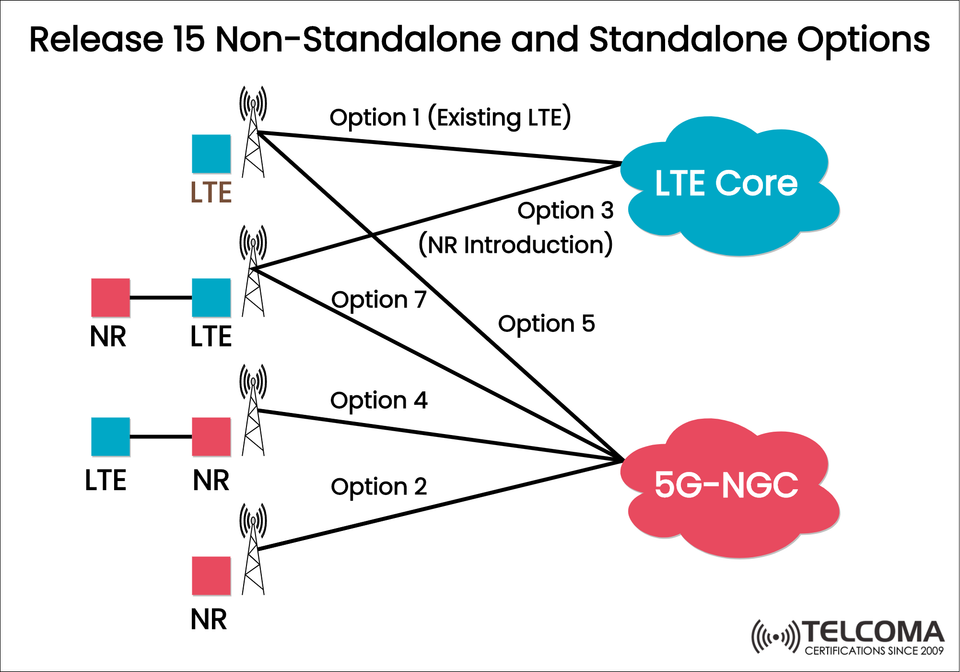

📡 Exploring Release 15 5G Deployment Modes: NSA versus SA Architectures
3GPP Release 15 set the stage for 5G networks. As part of the release of 5G specification, it also defined two primary deployment models: Non-Standalone (NSA) and Standalone (SA) deployment. These deployment options specify the interaction of the 5G New Radio (NR) with the LTE infrastructure and how it will operate with an operator's core network, thereby allowing operators a flexible and phased transition from 4G to 5G.
🧩 Key Vocabulary
NSA (Non-Standalone): 5G NR is added to an existing LTE anchor to create additional data capacity.
SA (Standalone): 5G NR and 5G Core (NGC) operate entirely independent of LTE.
LTE Core (EPC): Existing 4G core (LTE) infrastructure.
5G Core (NGC): Next generation core intended to achieve ultra-low latency and network slicing.
🗂️ Summary Box: 5G Deployment Options in Release 15
OptionDescription Radio Access Core Network Mode
1 Existing LTE LTE LTE Core LTE-only (Legacy)
2 NR connected to 5G Core NR 5G-NGC SA
3 LTE connected to LTE Core LTE + NR LTE Core NSA (early NR introduction)
4 LTE connected to 5G Core LTE 5G-NGC Migration step
5 NR connected to LTE Core NR LTE Core Not standardized
7 NR + LTE connected to 5G Core NR + LTE 5G-NGC Not standardized
Option A - Existing LTE
There is no 5G involved, and it is still in usage as we conduct a transitional period.
Option B - Standalone NR with 5G Core
When it is a completely 5G-native deployment, with NR access to 5G Core (NGC).
Then you can take advantage of everything a 5G has to offer, ultra-low latency, network slicing, and massive throughput.
This would actually be the end-game of the 5G evolution, fully 5G-native.
Option C - NSA with LTE Anchor (EN-DC)
When LTE is for control signaling and the data throughput is via 5G NR
The LTE Core (EPC) manages both radios.
This would have been the most common approach in initial 5G deployments.
Option D - LTE with 5G Core
Pretty much that the legacy LTE radios are capable of using the 5G Core.
This is a transitional or intermediate step when conducting migration.
The benefit here is that operators can manage and test 5G core functionalities without NR being deployed.
Option E - NR with LTE Core
Essentially, NR connects out to EPC (LTE Core).
This is not established or deployed widely, and, I believe, it is because of complexities associated with the transition and the way in which we have already discussed how LTE and 5G NR will function together.
Option F - Dual Connectivity to 5G Core
When NR and LTE are connected to the 5G Core.
This is a more advance SA deployment model where you can use NR along with LTE as a way to enhance coverage and performance.
🎯 Select Deployment Option
✅ Areas to Consider
Spectrum Availability: NSA allows for a quicker window on available mid-band and mmWave and doesn't abdicate LTE.
🔄 Migration Strategy: NSA to SA Transition Plan
Operators tend to start with Option 3 (NSA) and then move towards either Option 2 (SA) or Option 7 depending on their 5G Core deployment strategy and spectrum license.
📌 Potential Migration Steps:
Deploy NSA option (Option 3)
Upgrade Core to NGC
Implement SA (option 2)
Add Dual Connectivity (option 7)
📚 Conclusion: Designing a Future Ready 5G Network
3GPP Release 15 provides a flexible architecture that can transition with 4G LTE towards the full capabilities of 5G. It is important to understand the six different deployment options, but especially the trade-offs between NSA and SA modes for all telecom operators, vendors and enterprises taping into next generation networks.
Machine Justice: Mission Critical Applications (Industrial IoT, Smart Cities, Driverless Cars)
Many Tier 1 operators are beginning to migrate from NSA (Option 3) to SA (Option 2 and 7) and are able to utilize full capabilities of 5G performance includes:
Ultra-Reliable Low Latency Communications (URLLC)
Massive Machine-Type Communications (mMTC)
End-to-End Network Slicing
📞 Conclusion
Release 15 creates a solid foundation for transitioning from 4G to 5G. With a thorough understanding of the NSA and SA architecture options, network engineers and decision-makers will be able to:
🏷️ Suggested SEO Keywords
3GPP Release 15
5G Non-Standalone architecture
5G Standalone deployment
5G NSA vs SA
Option 3 5G
5G core network evolution
EN-DC architecture
LTE to 5G migration
NR deployment strategy
Dual connectivity in 5G
✍️ Content Repurposing Ideas
We wanted to share a couple ideas of how you can repurpose this blog content to get more reach on your content and engagement across your platforms
🎥 Video Script (YouTube / Training)
Create a 3-5 minute explainer video that
📢 Invite Community Engagement
Drive your readers toward conversation
✅ Questions To Ask At The End of Your Blog:
Are you deploying NSA or planning to deploy SA?
How will you choose which deployment option aligns best with your network aspirations?
What will be your biggest hurdle to moving to a standalone 5G core?
Leverage these prompts in:
Blog comment sections
LinkedIn posts
Technical community forums (e.g., Telecom Infra Project, GSMA, Reddit r/telecom)
🚀 What’s Next Post Release 15?
With Releases 16 and 17 providing ultra-reliable low latency communication (URLLC), non-terrestrial networks (NTN), and more mmWave, operators must also prepare the core and RAN architecture to support:
C-V2X (connected-vehicle to everything)
Private 5G networks for enterprises
Release 15 was just the start! As deployments become scaled and new use cases emerge it is important to select the properly architected foundational approach to support future scalability and flexibility.
✅ Final summary: Key Takeaways
Release 15 identified six core deployment Options; bridging LTE and 5G NR through NSA or SA.
NSA (Option 3) allowed for rapid adoption of 5G because it could leverage LTE cores.
SA (Option 2, 7) will provide immediate benefits like network slicing, as well as low-latency.
Operators need to align initial deployment options with allocated spectrum, core readiness, and service objectives.
A well-thought-out NSA-to-SA plan will ensure comparability postulate.