
3GPP Release 15 PSS Architecture Explained: SAND and DASH Integration for Efficient Media Streaming
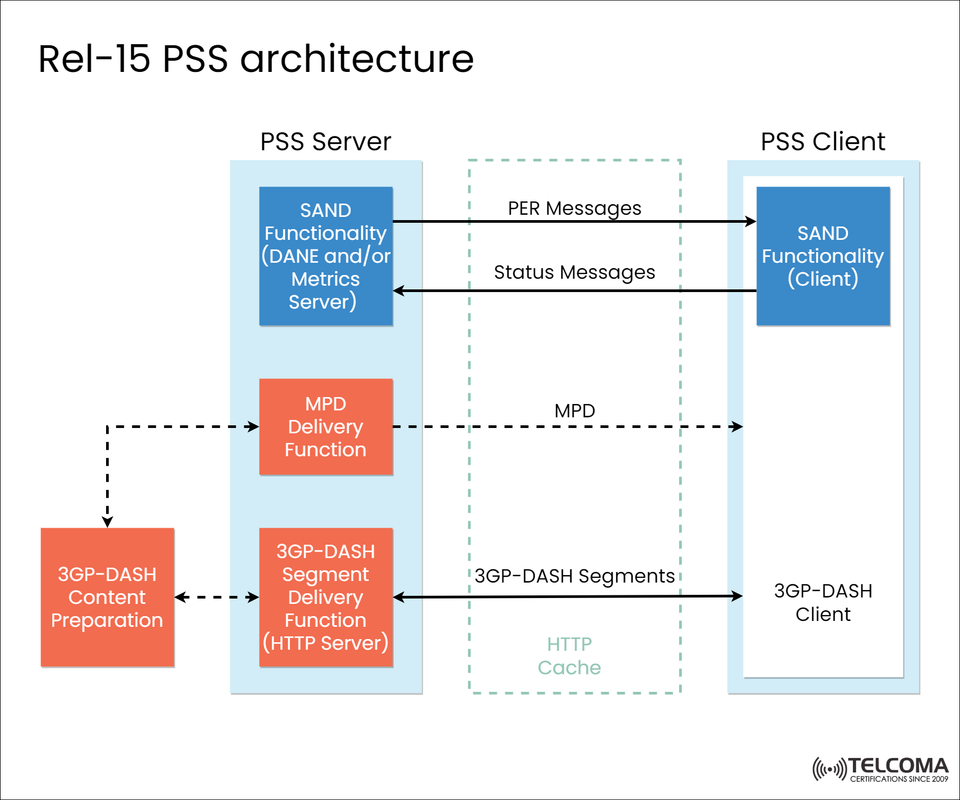

Getting to Know 3GPP Release 15 PSS Architecture for Adaptive Video Streaming
As video streaming takes the lead in mobile data usage, 3GPP Release 15 brought us a refined Progressive Streaming Service (PSS) architecture. This new setup builds on Dynamic Adaptive Streaming over HTTP (DASH) and adds in Server and Network Assisted DASH (SAND) features to make content delivery smarter and more efficient.
The diagram above shows how the PSS Server and Client components collaborate to enable high-quality, adaptive media streaming. This is a vital part of today's applications, including mobile video, VR streaming, and 5G multimedia services.
What Exactly Is PSS (Progressive Streaming Service)?
Progressive Streaming Service (PSS) is a multimedia framework put forward by 3GPP to provide smooth video streaming over mobile networks.
In Release 15, PSS grew to accommodate DASH and SAND, allowing:
Adaptive bitrate streaming (ABR) that adjusts to different network conditions.
Better content delivery efficiency thanks to caching and metrics sharing.
Enhanced Quality of Experience (QoE) for viewers.
The PSS system mainly consists of two elements:
PSS Server
PSS Client
Both of these work hand in hand through standardized interfaces to manage, deliver, and optimize streaming sessions.
Main Components of Rel-15 PSS Architecture
This architecture splits into two core areas — Server side and Client side — connected via HTTP communication.
A. PSS Server Components
The PSS Server handles content preparation, delivery, and performance monitoring. It features the following functions:
3GP-DASH Content Preparation
Here’s where video content gets encoded, segmented, and packaged into the 3GP-DASH format.
It prepares Media Presentation Description (MPD) files and media segments according to DASH standards.
Each video is broken into different quality levels to support adaptive streaming.
Function: This process allows for the creation of multi-bitrate content suitable for real-time streaming.
MPD Delivery Function
The MPD Delivery Function sends the MPD file to the client. The MPD acts like a “playlist” that details:
Available bitrates and resolutions.
URLs for the segments.
Timing and synchronization info.
Purpose: The client uses this MPD to decide which segments to fetch next, based on bandwidth availability and device capabilities.
- 3GP-DASH Segment Delivery Function (HTTP Server)
This function is in charge of delivering the actual DASH segments over HTTP. It works closely with HTTP Caches in the network to enhance performance and cut down latency.
Key Benefits:
Scalable delivery leveraging existing web infrastructure.
Efficient segment distribution aided by caching and CDNs.
- SAND Functionality (DANE and/or Metrics Server)
SAND (Server and Network Assisted DASH) is a new feature introduced in 3GPP Rel-15. It brings intelligence to the streaming process by allowing feedback loops between the client and the server/network.
SAND Subfunctions:
DANE (DASH-Aware Network Element): Optimizes and maintains awareness at the network level.
Metrics Server: Gathers performance info (like throughput, latency, playback quality, etc.) and sends recommendations to fine-tune streaming decisions.
Communication Channels:
PER Messages (Performance Reporting) — Client → Server
Status Messages — Server → Client
Together, these features help make adaptive streaming decisions based not just on client measurements but also on real-time network feedback.
B. PSS Client Components
On the client side, the architecture includes these essential modules:
3GP-DASH Client
The 3GP-DASH Client gets the MPD and media segments from the PSS server. It:
Chooses segments dynamically based on how the network is performing.
Switches between quality levels depending on conditions (bitrate adaptation).
Buffers video to minimize playback interruptions.
The HTTP Cache can also be used either locally or within the operator’s network to decrease delay and boost retrieval speed.
SAND Functionality (Client Side)
The SAND client module talks to the SAND server to exchange:
Performance metrics like bandwidth, latency, and occurences of rebuffering.
Control instructions for improved adaptive streaming.
This exchange ensures that video playback stays smooth even with network fluctuations.
The Role of SAND (Server and Network Assisted DASH)
SAND boosts DASH streaming by bringing in feedback mechanisms between the network and the client.
Key Features of SAND:
Bidirectional Communication: The client shares playback and network metrics, while the server sends back optimization messages.
Network Awareness: The DASH client can take into account congestion, link quality, and other network conditions.
Better QoE: Real-time optimization helps keep quality stable without buffering or sudden bitrate changes.
Types of Messages:
Message Type Direction Purpose PER Message Client → Server Performance report (throughput, latency, stall rate)Status Message Server → Client Network status or optimization advice
All these elements work together to enable intelligent bitrate adaptation and resource-aware streaming decisions.
Integrating with HTTP Caches
The architecture is designed to work with HTTP caches to ramp up scalability and lighten the load on the origin server.
Benefits of HTTP Caching:
Reduced latency and jitter.
Efficient use of bandwidth.
Scalability for millions of concurrent streams.
Works well with current web infrastructure.
Caching makes PSS an ideal choice for large-scale OTT streaming and operator-managed content delivery networks (CDNs).
Advantages of 3GPP Rel-15 PSS Architecture
Feature Advantage SAND Integration Real-time optimization using client-server feedback. Adaptive DASH Streaming Smooth playback across different network conditions. HTTP-Based Delivery Works nicely with web and CDN infrastructures. Quality of Experience (QoE)Less buffering and happier users.5G ReadyFits next-gen services like 4K, VR, and cloud gaming.
This all makes Rel-15 PSS a key player in 5G multimedia ecosystems, supporting both legacy LTE and modern NR networks.
Real-World Applications
5G Video Streaming: Effective adaptive streaming for mobile broadband.
Cloud Gaming: Instant video feedback with SAND-driven optimization.
XR/VR Applications: Efficient high-bandwidth delivery for immersive experiences.
Live Event Streaming: Dynamic bitrate selection ensures uninterrupted viewing during network fluctuations.
The Importance of Rel-15 PSS for the Future
As 5G networks become commonplace, challenges with bandwidth variability and latency will continue — especially for live video and XR applications.
The Rel-15 PSS framework tackles these issues by enabling network-assisted adaptive streaming, laying the groundwork for:
Ultra-low-latency video experiences.
Efficient use of resources.
A consistent user experience across various devices and networks.
Conclusion
The 3GPP Release 15 PSS Architecture marks an important advancement in adaptive streaming technology. By combining DASH for adaptive content delivery and SAND for network-assisted optimization, it sets up a strong, smart ecosystem for modern multimedia streaming.