
3GPP Release 17 Timeline & Features: Advancing 5G and Beyond

Introduction
The Third Generation Partnership Project (3GPP) is key in setting global standards for mobile communication technologies like 4G LTE, 5G NR, and what comes next. With every release, 3GPP builds on its previous work, adding features, fine-tuning existing ones, and opening doors for new use cases.
Release 17 (Rel-17) is particularly exciting, marking a significant step in the 5G evolution. It not only improves on features from Release 15 and Release 16 but also introduces notable advancements that enhance support for IoT, non-terrestrial networks (NTN), spectrum efficiency, and various industry applications.
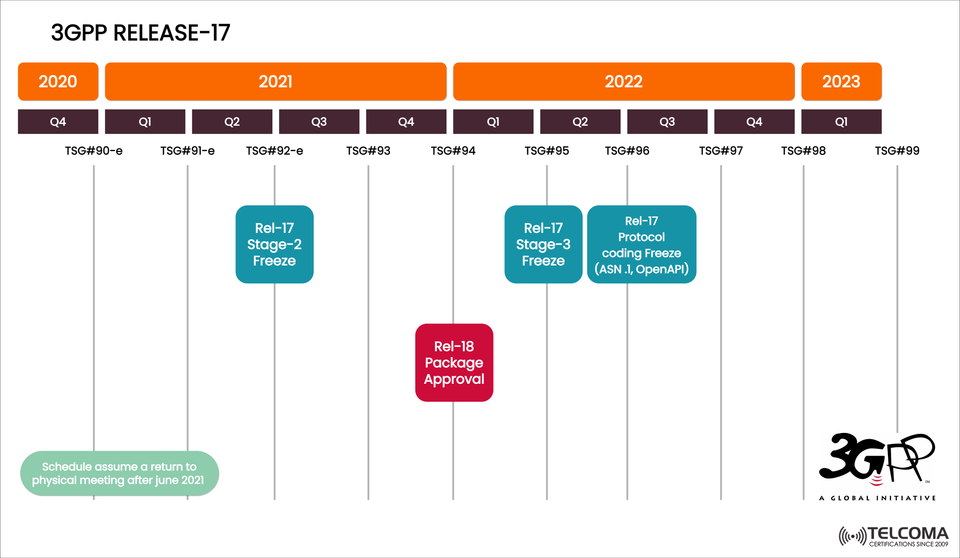
The provided timeline illustrates how 3GPP Release 17 evolved through different phases from 2020 to early 2023, coinciding with the approval of Release 18, which kicks off the 5G-Advanced era.
Understanding the 3GPP Release Process
Before diving into the details of Release 17, it’s helpful to grasp how the 3GPP standardization process works. Typically, each release goes through:
Stage 1: Where they figure out what service requirements need to be met.
Stage 2: Developing architecture and functional specifications to outline how features should be structured.
Stage 3: Focusing on protocol development and coding to detail the signaling and procedures.
Each of these stages ends with a “freeze,” meaning the specifications are set in stone so that vendors and operators can confidently start their implementations.
3GPP Release 17 Timeline
The chart highlights the main milestones of Release 17 from Q4 2020 to Q1 2023. Here’s a closer look at what happened during that time.
Q4 2020 – Q1 2021: Initial Phase
Work on Release 17 kicked off amid the pandemic.
Most meetings were virtual, which slowed down progress and stretched out timelines.
The plan was to return to in-person meetings after June 2021.
Q2 2021: Stage-2 Freeze
The Rel-17 Stage-2 Freeze happened during TSG#92-e.
This milestone locked in the architecture and functional specifications.
Key elements for 5G enhancements were established, including NR beyond 52.6 GHz, Non-Terrestrial Networks (NTN), and improvements for IoT.
Q1 2022: Stage-3 Freeze
The Rel-17 Stage-3 Freeze was reached at TSG#95.
This was a crucial moment as it finalized the protocol specifications.
Vendors could now start adding Rel-17 features to their devices and networks.
Q2 2022: Protocol Coding Freeze
The Rel-17 Protocol Coding Freeze (including ASN.1 and OpenAPI) took place at TSG#96.
This ensured all protocol coding and APIs were ready to go for deployment.
Essentially, this marked Release 17’s full readiness for the industry.
Q4 2021: Release 18 Package Approval
Interestingly, during TSG#94, 3GPP approved the package for Release 18.
This signified the start of 5G-Advanced standardization, aimed at even more sophisticated use cases.
Q1 2023: Wrap-up
By early 2023, Release 17 was officially wrapped up, with all specifications locked in and stable.
This laid the groundwork for the development of Release 18.
Key Features of 3GPP Release 17
Release 17 is often dubbed the “bridge release” between early 5G and 5G-Advanced, featuring a variety of enhancements across several areas:
- Enhanced IoT Support
Expanded capabilities for NB-IoT and LTE-M to support massive IoT deployments.
Improved device battery life and better spectrum efficiency.
Introduced Red Cap (Reduced Capability Devices), which makes affordable 5G devices possible for IoT and wearables.
- Non-Terrestrial Networks (NTN)
Integration of satellite-based communication with 5G NR.
This enables connectivity in remote or underserved areas.
It also sets the stage for satellite-to-smartphone services.
- Advanced Spectrum Usage
Support for operations beyond 52.6 GHz (mm Wave enhancements).
Better spectrum sharing and efficiency.
Improvements in carrier aggregation techniques.
- Positioning Enhancements
Achieved sub-meter accuracy in 5G positioning.
Supports time-sensitive applications like industrial automation, AR/VR, and autonomous navigation.
- MIMO and Network Enhancements
Enhanced massive MIMO and beamforming for increased capacity.
Optimized Dual Connectivity and Carrier Aggregation.
Improvements in network slicing and private networks.
- Energy Efficiency
Introduced mechanisms to cut down on UE power consumption.
Focused on energy-efficient network operations to align with green networking goals.
3GPP Release 17 vs Release 16
Aspect Release 16Release 17FocusIndustrial IoT, URLLC, V2X, 5G NR maturity IoT expansion, NTN, positioning, Red Cap Spectrum Below 52.6 GHz Beyond 52.6 GHz (extended mm Wave support)IoT Support NB-IoT and LTE-M Enhanced + Red Cap for wearables Non-Terrestrial Networks Not included Integrated (satellite + 5G NR)Positioning Meter-level accuracy Sub-meter accuracy Energy Efficiency Initial improvements Advanced UE and network energy-saving features
Why Release 17 Matters for the Telecom Industry
Global Standardization: Offers a unified framework for vendors and operators.
IoT Growth: Paves the way for billions of low-cost connected devices.
Satellite Integration: Expands 5G coverage beyond land-based limits.
Enhanced User Experience: Ensures better coverage, speed, and reliability.
Future-Readiness: Lays the groundwork for 5G-Advanced (Release 18) and eventually 6G.
Challenges Faced During Release 17
COVID-19 Impact: Virtual meetings made it tough to build consensus.
Complexity of Features: Adding NTN and RedCap needed extensive architectural changes.
Timeline Extension: The original schedule was delayed by about a year.
Despite these obstacles, Release 17 managed to deliver a solid set of enhancements.
Conclusion
3GPP Release 17 marks a transformational phase in 5G standardization. It tackles real-world demands like IoT scalability, global satellite coverage, advanced spectrum usage, and precise positioning.
The timeline—from Stage-2 Freeze in 2021 to final protocol coding in 2022 and the wrap-up in early 2023—highlights the collaborative effort from global stakeholders. With Release 18 already underway, we’re stepping into the 5G-Advanced era, pushing networks further towards intelligence, efficiency, and new applications.
For anyone in telecom or those interested in tech, Release 17 isn’t just a technical milestone—it’s the foundation for the next wave of digital transformation.