
3GPP Release 18 MR-DC Enhancements: Faster Connectivity and Seamless Mobility Explained

Enhancements in 3GPP Release 18 MR-DC: Boosting Dual Connectivity for Faster and Smarter Performance
3GPP Release 18 (Rel-18) is taking 5G-Advanced to new heights, fine-tuning existing features like Multi-Radio Dual Connectivity (MR-DC) to enhance network speed, reliability, and adaptability.
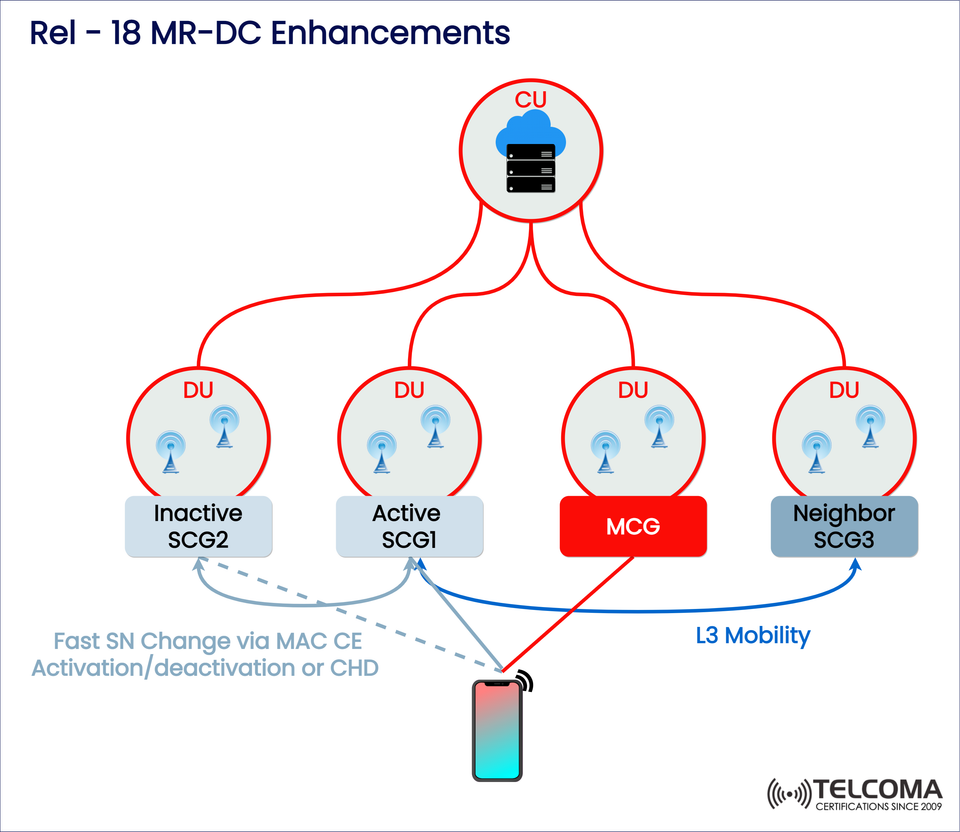
Telcoma Global's image shared here provides a visual breakdown of how the MR-DC enhancements in Rel-18 improve secondary node (SN) activation and mobility management. These upgrades are vital for optimizing user experience, reducing latency, and increasing throughput in busy 5G settings.
In this discussion, we’ll unravel the evolution of MR-DC in Release 18, spotlight the new enhancements, and explore their significance for 5G advancement and readiness for 6G.
Decoding the Image: Overview of the Rel-18 MR-DC Network
The uploaded diagram showcases the MR-DC architecture, featuring a Centralized Unit (CU) and multiple Distributed Units (DUs), each responsible for managing a range of radio cells.
Here’s a breakdown of the components:
CU (Central Unit): The system's nerve center, controlling signaling, management, and coordination of DUs.
DU (Distributed Unit): Takes care of the radio access layer (RLC, MAC, PHY) and is positioned closer to users for low-latency performance.
MCG (Master Cell Group): Main connection point for UE traffic and control signaling.
SCG1, SCG2, SCG3 (Secondary Cell Groups): Extra connections that enhance throughput or enable multi-connectivity options.
Inactive SCG2: Put on standby to conserve energy or resources but can quickly be switched back on as needed.
Neighbor SCG3: Another node available for mobility or potential new SN.
The user device (UE) connects to one DU (Active SCG1) while coordinating with the CU for swift secondary node switching and L3 mobility.
Fast Secondary Node (SN) Change
One significant innovation in Release 18 MR-DC is the Fast SN Change, which allows the UE to switch between secondary nodes quickly and with minimal disruptions.
How It Works:
The CU pre-sets various DUs as possible SN options.
The UE keeps an eye on link quality with both active and inactive SNs.
If it senses a drop in quality, the UE initiates a fast SN switch using MAC Control Elements (CE) or Conditional Handover Decision (CHD).
This happens without needing a full RRC reconfiguration, greatly cutting down switching delays.
Key Advantages:
Lower latency when switching nodes.
Less signaling overhead.
Seamless mobility for users in dense radio areas.
Greater reliability for URLLC (Ultra-Reliable Low-Latency Communication) applications.
Activation and Deactivation through MAC CE and CHD
Previously, activating or deactivating secondary nodes necessitated RRC signaling, a lengthy and resource-intensive process.
In Release 18, activating and deactivating becomes quicker and more efficient through MAC CE (Control Elements) or CHD (Conditional Handover Decisions).
How It Works:
MAC CE Activation: Enables real-time activation of secondary cells directly via MAC layer signaling, skipping the higher-layer overhead.
CHD Mechanism: Sets predefined conditions for activation or deactivation, allowing the UE to make autonomous decisions based on real-time inputs.
This enhancement cuts down on latency and allows for dynamic network reconfiguration, crucial for uses like autonomous vehicles, AR/VR, and mission-critical IoT.
Managing Inactive Secondary Nodes
Inactive SCGs (like SCG2 in the diagram) are part of an energy-savvy approach where certain nodes stay in standby mode until needed.
Benefits:
Energy savings for both UE and network.
Less interference from inactive nodes.
Quick reactivation for bursts of data or surge loads.
The network holds onto context information, allowing the UE to reactivate SCG2 in mere milliseconds using MAC CE signaling when demand for capacity or improved radio coverage arises.
Enhanced L3 Mobility Management
Also notable in Rel-18 is the improved L3 (Layer 3) mobility handling between master and secondary nodes.
Mechanism:
The CU coordinates multiple DUs for fluid mobility transitions.
When the UE transitions from one cell group to another (say, from SCG1 to SCG3), the L3 mobility function ensures that the session stays continuous.
This ensures users face zero service interruptions, even while switching between radio nodes across different frequencies or RATs (Radio Access Technologies).
MR-DC in Multi-RAT Environments (LTE + NR)
MR-DC is also applicable in multi-RAT settings, allowing a device to connect to both LTE (E-UTRA) and 5G NR (New Radio) simultaneously.
Typical Configurations:
EN-DC (E-UTRA-NR Dual Connectivity): LTE serves as the Master Node while NR acts as the Secondary Node.
NR-DC (NR-NR Dual Connectivity): Both Master and Secondary Nodes function under 5G NR.
Rel-18 Enhancements Enable:
Cross-RAT mobility optimization.
Interworking between FR1 and FR2 bands.
Dynamic switching for better performance balance and coverage continuity.
This adaptability guarantees users in mixed network setups enjoy consistently high performance, regardless of coverage fluctuations.
Advantages of Release 18 MR-DC Enhancements
Feature Benefit Fast SN Change Seamless switching and reduced latency MAC CE Activation Quicker control-plane updates Inactive SCG Management Energy-saving operationsL3 Mobility Smooth handovers between nodes Multi-RAT Optimization Improved LTE-NR coordination Dynamic Resource Allocation Enhanced load balancing and throughput
These combined upgrades make 5G networks more agile, effective, and scalable, especially for the burgeoning 5G-Advanced applications.
Practical Use Cases Enhanced by MR-DC
Autonomous Vehicles: Continuous V2X connectivity with swift handovers between roadside units.
Industrial Automation: Real-time control of robotic systems across various access points without interruptions.
AR/VR Applications: Ultra-low latency streaming through rapid SN switching in high-mobility scenarios.
Enhanced Mobile Broadband (eMBB): High data throughput via simultaneous links on multiple frequency bands.
Mission-Critical IoT: Reliable switching between active and standby secondary nodes ensures uninterrupted operations.
MR-DC and the Path to 6G
The MR-DC framework introduced in 5G and refined in Release 18 sets the groundwork for 6G heterogeneous connectivity.
Upcoming 6G systems will employ similar mechanisms to manage:
Multi-link aggregation across terahertz (THz) and sub-6 GHz bands.
AI-based node selection for proactive resource management.
Zero-touch mobility through independent CU-DU coordination.
In this way, MR-DC enhancements in Release 18 act as a strategic bridge from present-day multi-node 5G networks to the future of intelligent, self-optimizing 6G systems.
Conclusion
The enhancements in 3GPP Release 18 MR-DC represent a significant leap toward achieving genuine 5G-Advanced performance.
With features like fast secondary node switching, MAC CE-based activation, and better L3 mobility, MR-DC guarantees users uninterrupted connectivity, lower latency, and improved energy efficiency—even in the most challenging multi-node scenarios.