
3GPP SA1 Release 18 Part 2: STRS, PIN, and SACI_MCS Driving 5G-Advanced Innovation
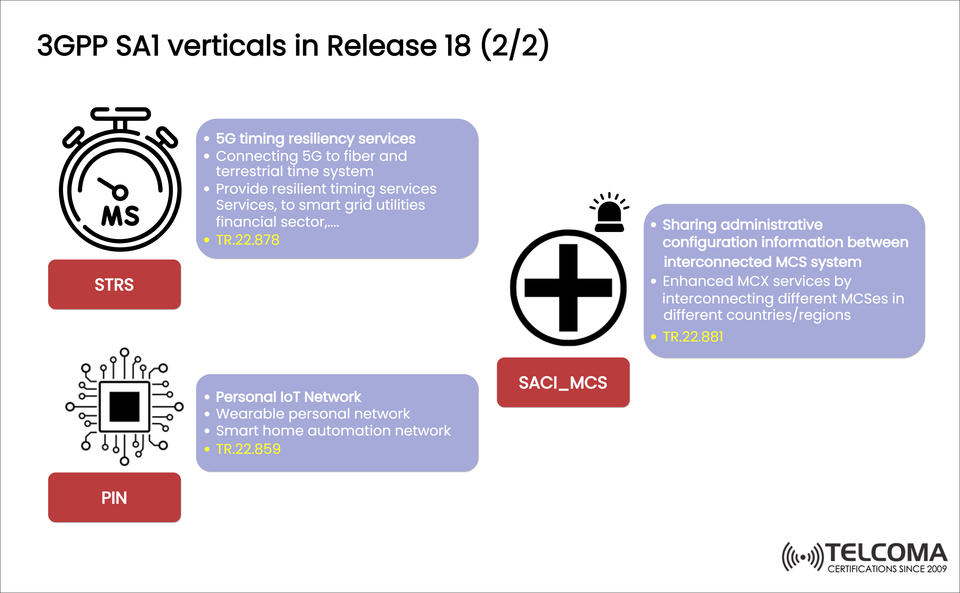

3GPP SA1 Verticals in Release 18 (Part 2): STRS, PIN, and SACI_MCS Explained
The 3rd Generation Partnership Project (3GPP) is at the forefront of 5G innovation, creating global standards that drive digital transformation across various sectors. In Release 18, which marks the official launch of 5G-Advanced, the focus shifts to new verticals that require ultra-reliable, intelligent, and energy-efficient connectivity.
Building on the verticals discussed in Part 1 — including 5GET, 5GSEI, and RAILSS — the second part of Release 18’s SA1 work unveils three equally significant areas:
STRS (5G Timing Resiliency Services)
PIN (Personal IoT Network)
SACI_MCS (Sharing Administrative Configuration Information between interconnected MCX systems)
These verticals underscore 3GPP’s ongoing commitment to making 5G more resilient, personal, and interoperable, which means networks will be not just faster but also smarter and more reliable.
STRS – 5G Timing Resiliency Services
Technical Report: TR 22.878
Focus: Strengthening synchronization and timing reliability across fiber, terrestrial, and 5G systems
Overview
Timing acts as the hidden backbone of all modern communication systems. Everything from financial transactions and power grids to cellular handovers relies on precise time synchronization. The STRS (5G Timing Resiliency Services) initiative aims to meet the pressing need for resilient and redundant timing services in a world that's increasingly reliant on digital infrastructure.
Key Objectives
Link 5G networks with fiber and terrestrial timing systems for better accuracy.
Provide reliable time synchronization for sectors like smart grids, utilities, and finance.
Define backup mechanisms to maintain timing continuity during outages or disruptions.
Use Cases
Sector STRS Application Benefit Smart Grid Synchronizing distributed power systems Prevents outages and boosts grid stability Finance Time stamping transactions with sub-millisecond accuracy Prevents fraud and ensures compliance Telecom Synchronizing 5G base stations Ensures low latency and smooth handovers
Technical Significance
Utilizes Precise Time Protocol (PTP) and GNSS-based backup systems.
Enhances timing fault tolerance and synchronization redundancy.
Supports 5G Time Sensitive Networking (TSN) for mission-critical applications.
In short, STRS guarantees that 5G networks stay perfectly in sync, ensuring reliability and precision across digital ecosystems.
PIN – Personal IoT Network
Technical Report: TR 22.859
Focus: Personal IoT connectivity for wearables, home automation, and individual digital ecosystems
Overview
The Personal IoT Network (PIN) vertical signifies 3GPP’s leap into the next phase of the Internet of Things (IoT), focusing more on individuals than businesses. As IoT transitions from industrial environments to personal spaces, 5G is changing how wearables, smart home gadgets, and health sensors interact in a seamless and secure way.
Key Objectives
Define 5G-enabled personal area networks that connect various user-owned devices.
Support wearables, health monitors, and augmented reality (AR) systems.
Enable smart home automation with device-to-device (D2D) communication and edge processing.
Ensure user privacy, data security, and ultra-low latency communication.
Core Applications
Wearable Ecosystems: Smartwatches, fitness trackers, and AR glasses communicating instantly through 5G.
Health Monitoring: Medical IoT devices securely transmitting vital health data.
Smart Homes: Linking lighting, HVAC, and security systems into a single smart 5G network.
Personal Edge Computing: Processing data locally for quicker responses and less cloud reliance.
Technical Enablers
URLLC (Ultra-Reliable Low Latency Communication) for immediate responses.
Network slicing to allocate resources for personal IoT traffic.
Edge AI integration for contextual decision-making (like adaptive lighting and temperature control).
PIN essentially turns 5G into a personal digital fabric, enhancing human experiences through smooth IoT connectivity while ensuring privacy and independence.
SACI_MCS – Sharing Administrative Configuration Information between Interconnected MCX Systems
Technical Report: TR 22.881
Focus: Boosting interoperability and administration among Mission-Critical Service (MCX) systems
Overview
Mission-Critical Communications (MCX) are vital for public safety, defense, emergency services, and disaster response. Historically, MCX systems have operated independently across different nations or organizations, complicating inter-agency teamwork.
The SACI_MCS (Sharing Administrative Configuration Information) vertical in Release 18 sets up a standardized way to link MCX systems across borders and organizations.
Key Objectives
Enable secure sharing of administrative configurations among connected MCX networks.
Support cross-border and multi-agency interoperability during emergencies or disasters.
Enhance Mission Critical Push-to-Talk (MCPTT), Data (MCData), and Video (MC Video) services among different Mobile Communication Systems (MCSes).
Use Cases
Scenario Description Benefit Cross-border emergency Fire or medical rescue across national boundaries Real-time coordination among agencies Multi-operator response Collaboration between public and private emergency networks Cuts down latency and information delays Disaster management Connecting temporary MCX setups Better response and situational awareness
Technical Advancements
Facilitates secure exchange of configuration data with 5G’s built-in encryption frameworks.
Guarantees consistent Quality of Service (QoS) between linked MCX systems.
Employs service interworking layers to bridge administrative gaps among operators.
What this achieves is a globally interoperable, secure, and resilient mission-critical communication ecosystem — a vital foundation for the next generation of public safety networks.
Comparative Overview of Release 18 (Part 2) Verticals
Vertical Focus Area Technical Report Key Benefits STRS Timing resiliency and synchronization TR 22.878Better timing reliability for telecom, grid, and finance PIN Personal IoT and smart home networks R 22.859Personalized, secure 5G IoT environments SACI_MCS Interconnected mission-critical services TR 22.881Cross-agency and cross-border communication
These three verticals together enhance 5G’s strengths in resilience, personalization, and interoperability — key pillars for a connected society.
How These Verticals Strengthen 5G-Advanced
Release 18 lays the groundwork for 5G-Advanced, focusing on intelligent automation, reliability, and broader industry coverage. Here’s how these verticals play a part:
STRS: Enhances the resilience and accuracy for timing-sensitive industries.
PIN: Brings 5G closer to users, promoting user-focused IoT ecosystems.
SACI_MCS: Guarantees cohesive, mission-critical communication across nations and industries.
Together, they push 5G beyond just connectivity — into a framework that promotes trust, reliability, and human-centered innovation.
The Strategic Vision Behind SA1 Work
The 3GPP SA1 group is tasked with laying out service requirements and defining use cases for future telecommunications. Adding STRS, PIN, and SACI_MCS to Release 18 reflects a strategic focus on service reliability, personalization, and global cooperation — principles that are crucial for the next step in the evolution of 5G.
Key Takeaways
SA1’s emphasis on timing, IoT, and MCX integration shows 5G's progression.
Each vertical aids in cross-industry standardization, minimizing fragmentation.
These efforts lay the groundwork for 6G use case development, stressing synchronization, automation, and human-machine integration.
Conclusion: A New Era of Reliable and Personalized 5G
With Release 18, 3GPP fortifies 5G’s base for the connected future. The introduction of STRS, PIN, and SACI_MCS represents a significant move toward making networks more resilient, secure, and inclusive.
STRS keeps industries in sync, powering everything from energy to finance.
PIN gives individuals the power to manage their IoT environments with accuracy and privacy.
SACI_MCS ensures worldwide collaboration for mission-critical communication.
These verticals together capture the essence of 5G-Advanced — it’s not just about a network update, but a technological evolution towards intelligence, reliability, and global unity.