
3GPP SA6 Architecture Explained: SEAL, Edge Computing, and CAPIF in 5G Vertical Applications

Introduction: Why 5G Vertical Application Enablers Matter
As 5G networks progress, various industries are tapping into ultra-low latency, massive connectivity, and network slicing to unlock advanced vertical applications—from connected vehicles (V2X) and unmanned aerial systems (UAS) to smart factories.
But to make these applications work seamlessly across devices, edge, and core networks, we need a standardized enabler framework.
This is where 3GPP SA6 (Service and System Aspects Working Group 6) becomes essential. SA6 establishes the Service Enabler Architecture Layer (SEAL), Edge Computing Enablers, and CAPIF (Common API Framework)—making sure that communication flows smoothly between the user equipment (UE), vertical servers, and the 5G Core Network.
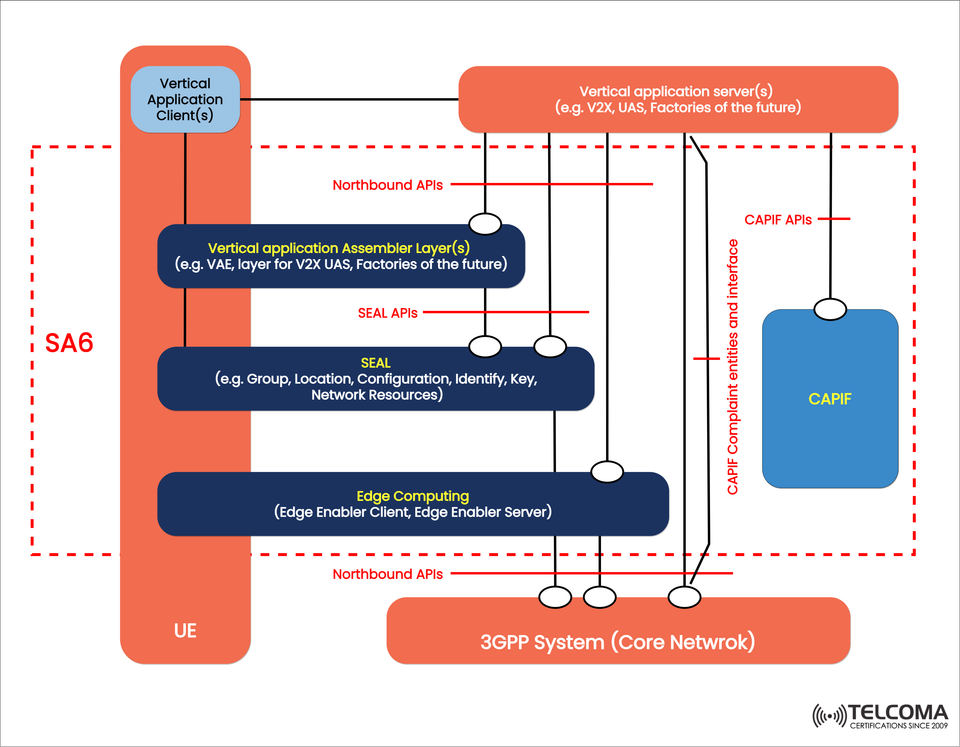
The image above (from Telcoma) shows how all these components connect through northbound APIs, SEAL APIs, and CAPIF-compliant interfaces, laying the groundwork for enabling vertical applications in 5G.
A Look at 3GPP SA6 Architecture
What Exactly is SA6?
3GPP SA6 defines the application layer enablers and frameworks that are vital for advanced vertical services over 3GPP systems.
This architecture offers:
Standardized APIs for vertical applications.
Integration with edge computing and network exposure functions.
A unified application layer tailored for vertical domains like V2X, UAS, and Industry 4.0.
The key components of the SA6 architecture include:
Vertical Application Client(s)
Vertical Application Server(s)
Vertical Application Assembler Layer (VAE)
SEAL (Service Enabler Architecture Layer)
Edge Computing Layer
CAPIF Framework
3GPP Core Network
Together, these elements ensure a consistent API-driven communication throughout the entire 5G ecosystem.
Main Components of the SA6 Architecture
a) Vertical Application Client(s)
These clients are found on User Equipment (UE) or devices like connected cars, drones, or industrial sensors. They interact with Vertical Application Servers to share application data—think vehicle telemetry, control signals, or IoT updates—through northbound APIs.
b) Vertical Application Server(s)
Situated within operator networks, edge clouds, or enterprise environments, these servers manage application logic for verticals that include:
V2X (Vehicle-to-Everything)
UAS (Unmanned Aerial Systems)
Factories of the Future (Smart Manufacturing)
They interact with the 3GPP core network through CAPIF APIs and connect with clients and assembler layers via northbound interfaces.
c) Vertical Application Assembler Layer (VAE)
The VAE serves as an intermediate orchestration layer. It combines SEAL and Edge enablers, supplying a customized API set tailored for specific vertical domains.
Examples include:
VAE for V2X (managing vehicle coordination and communication)
VAE for UAS (dealing with drone identity, tracking, and authorization)
VAE for Factories of the Future (orchestrating robot control, automation, and maintenance)
The VAE streamlines vertical service development by abstracting network complexity and providing high-level APIs.
d) SEAL (Service Enabler Architecture Layer)
SEAL is the core functional layer within the SA6 architecture. It delivers common service enablers that can be utilized across multiple vertical applications, including:
Group Management – Organizing devices or users into logical groups.
Location Management – Offering accurate device location data.
Configuration and Identity Management – Keeping device and service identity consistent.
Network Resource Exposure – Interacting with 3GPP network services via APIs.
SEAL APIs are standardized by 3GPP to ensure different vendors and operators can interoperate smoothly. They create the connection between the vertical applications and the underlying network capabilities.
e) Edge Computing Layer
Edge computing is crucial in 5G verticals, as it brings computational power closer to users, which allows for:
Ultra-low latency
Local data processing
Context-aware services
In SA6, the Edge Computing Enabler consists of:
Edge Enabler Client (EEC) – Located on UE or local devices.
Edge Enabler Server (EES) – Found at edge nodes or edge data centers.
These components work together through northbound APIs and can tap into SEAL and CAPIF functions for optimizing vertical application performance.
How SEAL, Edge, and CAPIF Collaborate
The interaction among SEAL, Edge Computing, and CAPIF creates a harmonized application enablement environment for 5G.
Vertical Application Clients on UE set off service requests via northbound APIs.
Requests go through the VAE and SEAL APIs, accessing features like group coordination or location.
Edge Computing Enablers handle time-sensitive tasks locally, which reduces latency.
CAPIF oversees all API exposure, authentication, and invocation between SEAL/Edge layers and the 3GPP Core Network.
Vertical Servers receive processed information and coordinate with network functions to provide optimized services.
This end-to-end architecture ensures service continuity, low latency, and secure access, meeting the varied demands of next-generation verticals.
Benefits of the SA6 Framework
For Network Operators
Easier integration of vertical applications.
Centralized API governance via CAPIF.
Efficient edge resource management.
For Developers
Access to standardized APIs across networks and vendors.
Simpler application orchestration using SEAL enablers.
More straightforward service deployment across UE, edge, and cloud.
For Industry Verticals
Lower latency and enhanced reliability.
Improved data privacy and localization thanks to edge computing.
Seamless network service exposure for automation and IoT.
Real-World Applications
Vertical Use Case Example Involved ComponentsV2XVehicle coordination, collision alerts VAE, SEAL APIs, Edge Computing UAS (Drone Networks)Drone identification and tracking SEAL Identity, CAPIF APIs Industry 4.0Predictive maintenance and robotics Edge Enabler, SEAL Configuration Public Safety Mission-critical group communication SEAL Group Management, CAPIF Smart Cities Sensor data integration SEAL + Edge APIs
These examples highlight how flexible SA6 can be in enabling a variety of 5G-driven industries.
The Importance of CAPIF Compliance in SA6
The image underscores CAPIF-compliant entities and interfaces that connect SEAL, Edge, and 3GPP Core functions.
CAPIF compliance ensures:
Unified API exposure across all enablers.
Security and trust between vertical applications and core networks.
Interoperability across various vendors and operators.
This compliance is vital for multi-operator service federation, roaming support, and cross-industry innovation.
Looking Ahead: The Future of SA6 and 6G-Ready Applications
As we move from 5G to 5G-Advanced and eventually 6G, SA6 will likely expand to include:
AI/ML-driven enablers for smarter network automation.
Dynamic edge orchestration for real-time computing.
Cross-domain API exposure for multi-access services.
Federated CAPIF for a global API ecosystem.
These developments will position SA6 as the foundation of intelligent, programmable networks for the future.
Conclusion
The 3GPP SA6 architecture is crucial for providing the application enablement framework for 5G verticals—linking UE, edge, and core through SEAL, Edge Computing, and CAPIF.
By standardizing APIs and facilitating CAPIF compliance, SA6 guarantees secure, scalable, and interoperable services across sectors like automotive, aerospace, and manufacturing.
In short, SA6 isn't just another 5G framework—it's the bedrock of the next wave of digital transformation, allowing vertical applications to innovate while maintaining telecom-grade reliability and security.