
3GPP Sidelink Evolution: UE Scheduling Another UE in 5G-Advanced Explained
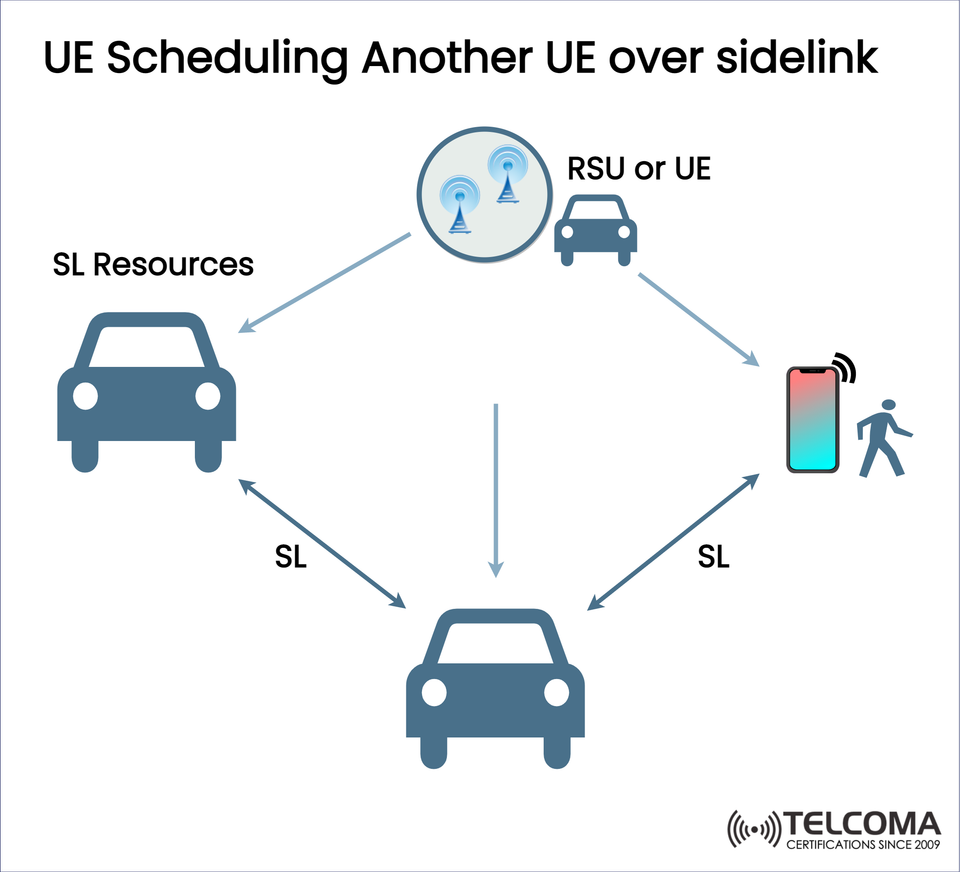

Scheduling One UE Over Sidelink in 5G-Advanced Networks
The sidelink (SL) feature in 5G is a game-changer for direct device-to-device (D2D) communication. With 3GPP Release 18, a significant improvement now allows one User Equipment (UE) to schedule another UE over sidelink, making communication more efficient without relying too much on the network.
The image provided by Telcoma Global visually captures this concept, demonstrating how UEs, vehicles, roadside units (RSUs), and smartphones can exchange sidelink resources directly, enabling low-latency coordination and smart connectivity.
What is Sidelink in 5G Networks?
Sidelink (SL) is a communication method that allows direct transmission between two or more UEs without sending data through a base station (gNB).
Originally crafted for Device-to-Device (D2D) communication in LTE, sidelink has evolved in 5G NR (New Radio) to accommodate:
Vehicle-to-Everything (V2X) communications
Public safety services (like mission-critical push-to-talk)
Industrial IoT and Proximity Services (ProSe)
With sidelink, devices can talk directly over the PC5 interface, skipping the traditional Uu interface used between UE and gNB. This leads to ultra-low latency and greater reliability, which are key for applications that require quick responses.
The Idea: UE Scheduling Another UE
The innovation highlighted in the image is “UE Scheduling Another UE” — a concept brought forth in 5G-Advanced (3GPP Release 18).
Traditionally, the gNB (base station) takes charge of resource allocation for sidelink communication. But in more decentralized or less connected situations, the network can struggle to manage UEs effectively — especially during V2X or emergency situations.
To tackle this, 5G-Advanced allows one UE to act as a scheduler for others, dynamically handling Sidelink Resources (SL Resources).
How It Works (As Shown in the Image)
The image illustrates:
Vehicles (cars) and a pedestrian UE (smartphone) communicating directly via Sidelink (SL).
A Roadside Unit (RSU) or UE helps manage sidelink resources.
One UE schedules another UE, allocating SL resources for smooth data transfer and coordination.
This decentralized scheduling method ensures that devices can still communicate effectively, even in out-of-coverage or weak-coverage scenarios.
Types of Sidelink Scheduling in 5G
There are three main sidelink scheduling methods defined in 3GPP specifications:
Type Scheduling Entity Description Typical Use Case Network-scheduled SLgNB Network allocates SL resources. Urban V2X with strong coverage UE Autonomous SL Each UEUEs choose SL resources on their own. Out-of-coverage V2XUE-Scheduled SL (Rel-18)One UE schedules others A selected UE assigns SL resources to peers. Cluster-based V2X, public safety
The third approach — UE-scheduled sidelink — merges the advantages of both centralized and autonomous scheduling, allowing for effective coordination without the need for constant network control.
Technical Setup of UE Scheduling
In a UE-scheduled sidelink system, a scheduling UE carries out several functions:
Resource Sensing: The UE detects available SL resources (time-frequency slots).
Resource Assignment: It distributes these resources to other UEs (sidelink peers).
Signaling via Sidelink Control Information (SCI): The scheduling UE sends control messages to inform peers about the resources assigned.
SL Data Transmission: The scheduled UEs use their assigned resources for transmitting data.
Feedback & Coordination: The system may involve HARQ feedback and dynamic resource reallocation to manage interference.
This setup is especially beneficial for V2V (Vehicle-to-Vehicle) or V2P (Vehicle-to-Pedestrian) scenarios, where quick responses, reliability, and some level of autonomy are crucial.
Advantages of UE Scheduling Another UE
The introduction of UE-based sidelink scheduling brings several technical and operational benefits:
a) Greater Network Independence
UEs can coordinate even without constant gNB supervision.
This is perfect for remote or less connected regions.
b) Lower Latency
Direct communication cuts out the need for round-trip signaling through the network.
This is vital for real-time applications like collision avoidance in V2X.
c) Better Resource Utilization
Dynamic SL resource assignments help cut down on interference and boost spectrum efficiency.
d) Cluster-based Communication
One UE can function as a cluster head, managing communication for nearby UEs (like cars, drones, or IoT sensors).
e) Reliability for Critical Services
This is essential for public safety networks, disaster recovery, and autonomous driving, especially where coverage may be spotty.
UE-Scheduled Sidelink in V2X (Vehicle-to-Everything)
One of the most significant applications of this feature is within 5G NR V2X — allowing vehicles to communicate directly with each other, pedestrians, and RSUs.
Example Use Case (from the Image):
A vehicle UE receives SL resources from an RSU or another UE.
This UE then allocates sidelink slots to nearby vehicles and pedestrians.
Information like speed, braking status, or traffic alerts gets shared instantly via SL.
Benefits in the V2X Context:
Better road safety from low-latency alerts.
Traffic optimization through direct communication between cars.
Reduced congestion thanks to decentralized coordination.
Continuous communication in tunnels or rural areas where gNB coverage falls short.
Real-World Applications of UE Scheduling Over Sidelink
a) Autonomous Vehicles
Vehicles can directly coordinate with each other to:
Share obstacle data
Communicate lane-change intentions
Enable cooperative maneuvers
b) Smart Cities
Pedestrian UEs (smartphones, wearables) can share information with nearby vehicles for safety alerts or helping at crosswalks.
c) Disaster Recovery
When cellular infrastructure fails, sidelink keeps first responders connected.
d) Drone and Industrial IoT Networks
Drones or robots can communicate independently using sidelink scheduling for formation control and resource optimization.
Advantages of UE Scheduling in 5G-Advanced
Feature Impact UE-based resource scheduling Lowers reliance on the network Distributed coordination Enables operation in areas with poor coverage Fast response Enhances reliability and reduces latencyV2X optimization Improves safety and traffic management Public safety support Keeps communication going during emergencies
The Path to 6G
As we move toward 6G research, sidelink-based UE scheduling will advance towards even more autonomy and intelligence. Expected improvements include:
AI-driven resource scheduling for better coordination
Multi-hop sidelink relaying
Connection with non-terrestrial networks (NTN) for extended coverage
Context-aware communication suited for mixed mobility settings
This evolution will pave the way for self-organizing networks, capable of managing billions of interconnected devices without a centralized control system.
Conclusion
The concept of “UE Scheduling Another UE Over Sidelink” represents a big leap in the development of 5G-Advanced.
By allowing devices to autonomously handle resource allocation, 3GPP has taken a significant step toward decentralized, smart connectivity — crucial for V2X, IoT, and critical communication.
This advancement boosts latency and reliability while laying the groundwork for the autonomous, hyper-connected future envisioned in 6G.