
3GPP UAS Reference Architecture Explained: Enabling Connected Drones through 5G Networks

Understanding the 3GPP UAS Reference Architecture: Integrating 5G with Drones
Drones, or Unmanned Aerial Vehicles (UAVs), have come a long way from being just fun gadgets for enthusiasts. Now, they're essential in various industries like logistics, surveillance, agriculture, and emergency services. To safely operate alongside each other, these drones need reliable connectivity, secure data sharing, and real-time coordination with airspace management systems.
The 3rd Generation Partnership Project (3GPP), which sets the global standards for mobile communications, has developed the UAS (Unmanned Aerial System) Reference Architecture. This framework outlines how UAVs connect through cellular networks and work with UAS Traffic Management (UTM) systems.
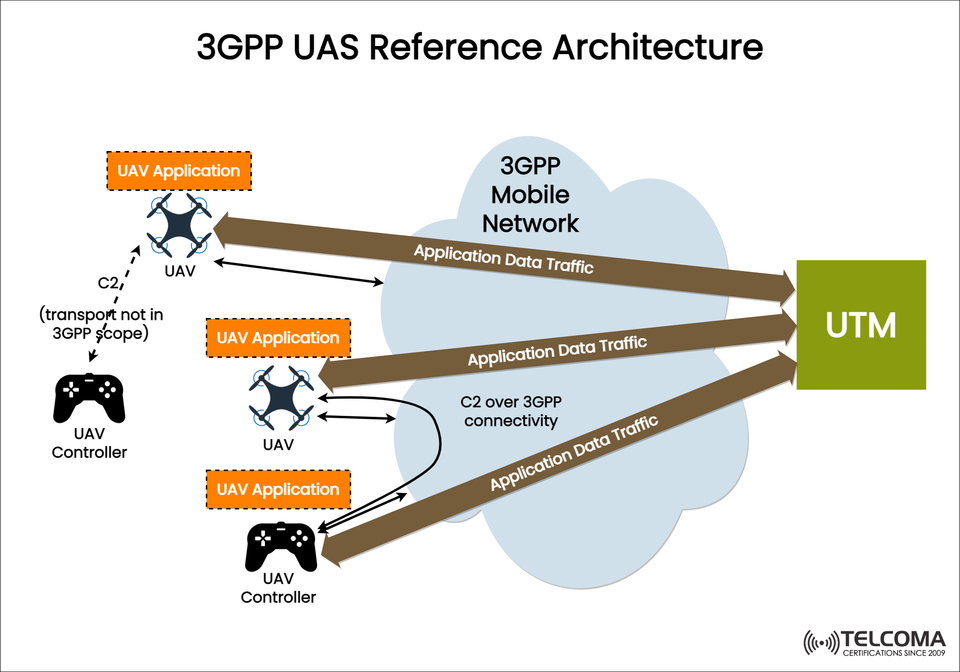
The diagram above (courtesy of Telcoma) provides a clear illustration of this architecture, showcasing the interactions between UAVs, controllers, and UTM through the 3GPP mobile network. Let’s unpack each part, explore the communication pathways, and see how this setup allows for safe and efficient UAV operations.
What’s the 3GPP UAS Reference Architecture?
The 3GPP UAS Reference Architecture lays out a standardized way to connect UAVs (drones) to mobile networks, like 4G LTE and 5G NR.
Here’s what it aims to do:
Enable Command and Control (C2) communications over cellular networks.
Make it easier to transfer Application Data Traffic between UAVs and remote systems.
Support seamless integration with UTM systems for flight approvals, tracking, and safety management.
By clarifying these communication pathways, 3GPP guarantees that UAV operations are secure, scalable, and compatible across various network providers and drone types.
Key Components in the 3GPP UAS Architecture
Let’s break down the main components from the diagram:
Component Role in the Architecture UAV (Unmanned Aerial Vehicle)The drone itself, equipped with a 3GPP-compatible communication module (LTE/5G).UAV Controller (Pilot)The operator or ground system sending command-and-control (C2) directives to the UAV.UAV Application The software interface or cloud platform that manages UAV operations, telemetry, and payload data.3GPP Mobile Network Provides the radio access and core network functions that enable UAV connectivity, authentication, and data transport. UTM (UAS Traffic Management)A centralized system that oversees drone flight paths, airspace approvals, and compliance with safety regulations.
Communication Flows in the Architecture
The accompanying image shows two main types of communication within the 3GPP UAS framework:
a. Command and Control (C2) Communications
The C2 link lets UAV controllers send live commands (like navigation, altitude, and speed changes) while receiving telemetry data in return.
There are two forms of C2 connectivity:
C2 (non-3GPP) — A traditional direct link between the UAV and controller (like radio or Wi-Fi).
Not governed by 3GPP standards.
Limited in range and scalability.
C2 over 3GPP Connectivity — C2 commands are sent through the mobile network.
Allows for long-range, secure, and network-managed control.
Uses cellular connections for UAV-to-controller communication.
b. Application Data Traffic
Application data includes mission-specific information (like video feeds, sensor data, and flight logs).
This data travels through the 3GPP mobile network between the UAV and UAV Application Servers or the UTM system.
The 3GPP network guarantees:
Quality of Service (QoS)
Security
Low latency for real-time operations
The Role of the 3GPP Mobile Network
The 3GPP Mobile Network is the backbone of connected UAV operations, facilitating:
a. Secure Connectivity
Implements SIM-based authentication for UAVs.
Ensures encrypted communication via LTE or 5G connections.
b. Mobility Management
Aids UAV handovers between cells as they navigate large areas.
Keeps connectivity steady during high-speed or long-distance missions.
c. QoS and Latency Control
5G NR offers ultra-reliable low latency communication (URLLC), which is crucial for real-time UAV control.
Network slicing provides dedicated resources for critical drone operations.
d. Network-Assisted Identification and Tracking
UAVs can be registered in the network, identified by unique IDs (like IMSI, UAS ID).
Allows compliance with regulations and tracking by authorities through UTM systems.
The UTM (UAS Traffic Management) System’s Role
The UTM system oversees UAV operations within controlled airspaces, similar to air traffic control (ATC), but specifically for drones.
UTM functions include:
Flight Authorization: Approving UAV flight plans before takeoff.
Tracking and Monitoring: Keeping tabs on UAV locations through the 3GPP network.
Geofencing: Making sure UAVs stay in designated airspace.
Incident Management: Coordinating responses during communication breakdowns or emergencies.
Within the architecture:
Application Data Traffic between UAVs and UTM flows through the 3GPP Mobile Network, ensuring secure and verified information exchange.
This provides real-time situational awareness for both regulators and operators.
Advantages of Using 3GPP Networks for UAVs
Linking UAVs with 3GPP networks brings various benefits:
a. Extended Range and Coverage
Unlike older short-range connections (like Wi-Fi or radio), 4G and 5G deliver nationwide coverage, making beyond visual line of sight (BVLOS) operations possible.
b. Reliability and Low Latency
5G’s URLLC capabilities offer ultra-reliable, low-latency communication—key for precise drone control.
c. Secure and Managed Connectivity
3GPP authentication, encryption, and network slicing deliver enterprise-grade security for UAV missions.
d. Scalability
You can connect and manage thousands of UAVs at once using the 3GPP core network.
e. Integration with Existing Telecom Infrastructure
Providers can use current cellular networks to create UAV-as-a-Service (UaaS) platforms without building new infrastructure.
Scenario Examples
Use Case3GPP Functionality Used Benefits Delivery Drones5G network slicing for dedicated UAV traffic Reliable route tracking and control Disaster Response UAVs URLLC for real-time video Immediate situational awareness Agricultural Drones Massive IoT (m MTC) support Efficient monitoring of large farms Urban Air Mobility Multi-cell handover Continuous connectivity across city areas
3GPP Standardization Efforts
3GPP’s efforts in UAV communication kicked off with Release 15, evolving through Release 17 and Release 18.
Notable Contributions Include:
UAV Identification and Tracking (TS 23.256)
UAS Service Requirements (TS 22.125)
3GPP-UAS Communication over NR and LTE (TS 23.255)
These standards ensure global interoperability, helping UAV manufacturers, operators, and network providers align under a unified approach.
Challenges and Future Enhancements
Although 3GPP-based UAV connectivity holds great potential, there are still challenges:
Air-to-Ground Channel Modeling: Optimizing radio links for drones at altitude.
Spectrum Management: Allocating frequencies for large-scale UAV operations.
Handover Optimization: Ensuring smooth cell transitions at high speeds.
Cybersecurity: Safeguarding UAV systems against hacking or spoofing.
Future 3GPP releases (like Release 19 and beyond) aim to enhance:
AI-driven UAV traffic management
Advanced positioning (cm-level accuracy)
Edge computing for real-time data analytics
Conclusion
The 3GPP UAS Reference Architecture is a key element for the connected drone ecosystem, supporting secure, scalable, and smart UAV operations over 4G and 5G networks.
By standardizing how drones connect, share data, and interact with UTM systems, 3GPP helps ensure that UAVs can operate safely in regulated airspace, bringing transformative benefits to various industries.
From real-time delivery services to emergency responses and surveillance, this architecture is paving the way for a future where drones are an essential, network-managed part of our connected lives.