
4G RAN vs 5G RAN: Understanding the CU-DU Split in Next-Generation Networks
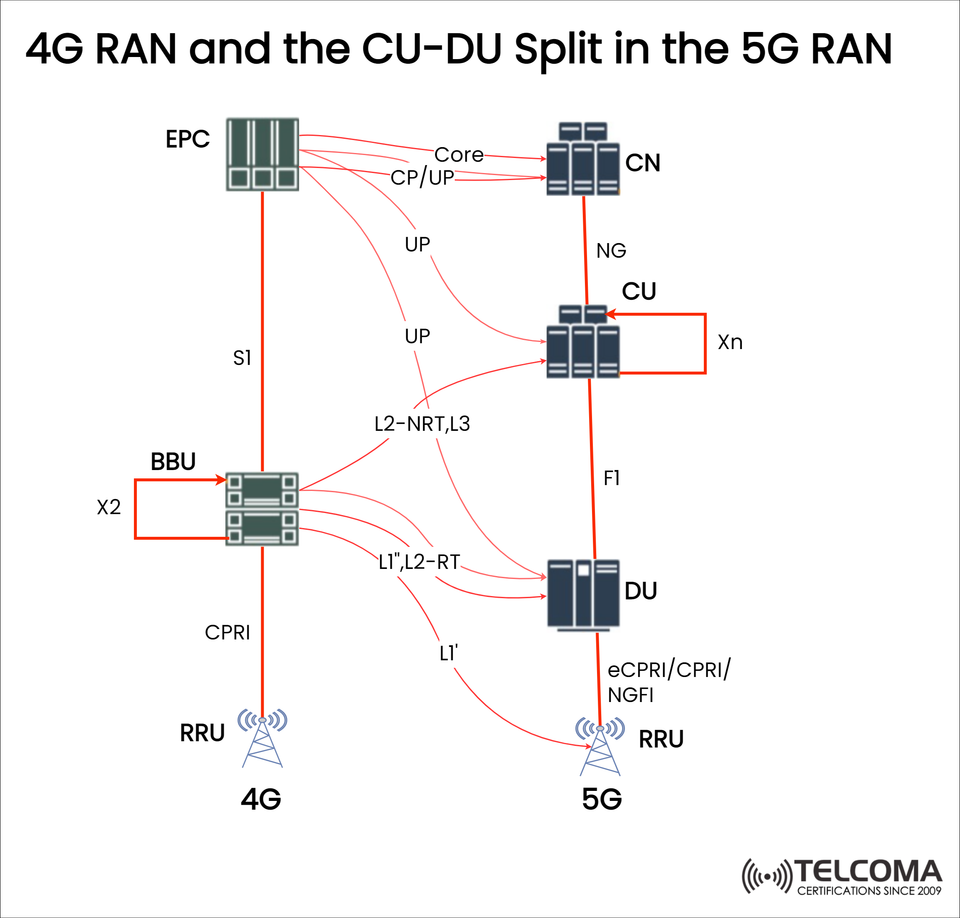

4G RAN and the CU-DU Split in the 5G RAN
The shift from 4G LTE to 5G NR isn't just about boosting speeds or cutting latency—it’s a major architectural change. One of the standout features of the 5G Radio Access Network (RAN) is the division of the baseband into Centralized Units (CUs) and Distributed Units (DUs), which is a significant move away from the 4G model that primarily depended on the Baseband Unit (BBU).
The diagram uploaded illustrates this architectural change, comparing 4G RAN to the 5G CU-DU split and showing how various interfaces (S1, X2, F1, NG, eCPRI, CPRI) are interconnected. This article simplifies the concepts, sheds light on the reasons for the CU-DU split, and discusses how it brings about flexibility, scalability, and the ability for cloud-native deployments.
From 4G RAN to 5G RAN: A Brief Overview
4G RAN Architecture (LTE)
In 4G LTE networks:
The Baseband Unit (BBU) manages baseband signal processing.
The Remote Radio Unit (RRU) deals with radio frequency processing and is located near the antenna.
The BBU connects to the EPC (Evolved Packet Core) via the S1 interface, while neighboring BBUs are linked through the X2 interface.
CPRI (Common Public Radio Interface) connects the BBU to the RRU.
This architecture worked well for LTE, but it had its drawbacks:
Limited adaptability for virtualization and cloudification.
High latency sensitivity in fronthaul links (BBU ↔ RRU).
Challenges with scaling to accommodate massive IoT devices and network slicing in 5G.
5G RAN and the CU-DU Split
To address these issues, 3GPP outlined the functional split of the baseband into:
CU (Centralized Unit): * Manages higher-layer protocols (Layer 3 and non-real-time Layer 2). * Oversees control plane and user plane separation. * Connects to the 5G Core (5GC) via the NG interface. * Communicates with other CUs through the Xn interface.
DU (Distributed Unit): * Handles real-time functions (Layer 1 and real-time Layer 2). * Located closer to the radio sites for low-latency operations. * Links to the CU via the F1 interface. * Connects to the RRU using eCPRI/CPRI/NGFI.
This separation enables operators to place CUs in data centers (cloud-native) while keeping DUs nearer to users for latency-sensitive tasks.
Why the CU-DU Split Matters in 5G
The CU-DU split isn’t just a technical rearrangement—it’s key to realizing the full potential of 5G networks.
Key Advantages:
Cloud-Native RAN Deployments * CUs can be virtualized in centralized cloud data centers. * Promotes O-RAN initiatives and supports multi-vendor interoperability.
Scalability and Flexibility * DUs can be easily scaled for urban coverage. * Centralized pooling of CUs reduces costs and optimizes resource use.
Latency Optimization * Real-time processing is handled at the DU, close to users. * Essential for URLLC (Ultra-Reliable Low Latency Communication).
Efficient Spectrum Utilization * Enables advanced features like dynamic spectrum sharing.
Supports Network Slicing * CU manages logical separation for varying services (eMBB, URLLC, mMTC).
Comparing 4G RAN vs 5G CU-DU Split
Aspect 4G RAN (BBU-RRU) 5G RAN (CU-DU-RRU)
Core Connection EPC via S1 5GC via NG
Baseband Handling Centralized BBU Split into CU (cloud) & DU (edge)
Interfaces S1, X2, CPRI NG, Xn, F1, eCPRI/NGFI
Latency Higher (BBU centralized) Optimized (DU near RRU)
Scalability Limited Highly scalable, cloud-native
Virtualization Minimal Supports vRAN and O-RAN
Use Cases Broadband eMBB, URLLC, mMTC, slicing
This side-by-side comparison clearly demonstrates how the 5G CU-DU architecture resolves the issues faced by LTE RAN.
Interfaces in CU-DU Split Explained
The diagram points out several key interfaces involved in the transition from 4G to 5G:
S1 (4G): Connects BBU to EPC.
X2 (4G): Connects BBUs for handover coordination.
NG (5G): Links CU to the 5G Core.
Xn (5G): Interface between CUs for mobility management.
F1 (5G): Connects CU and DU, handling both control and user plane.
eCPRI/NGFI (5G): Binds DU to RRU with improved efficiency.
These interfaces form the core of 5G RAN adaptability.
CU-DU Split and Open RAN (O-RAN)
The CU-DU separation is crucial for the O-RAN architecture. By defining open and standardized interfaces (like F1), operators can use equipment from different vendors without being locked into a single proprietary solution.
The O-RAN Alliance is built on this principle to support interoperability.
Cloud-based CU pools can work alongside DU deployments from various vendors.
This setup reduces CAPEX and OPEX while encouraging innovation.
Real-World Deployments
Around the globe, operators are implementing CU-DU split architectures:
Verizon & AT&T (USA): Using virtualized CUs in centralized data centers.
NTT Docomo (Japan): A pioneer in O-RAN CU-DU split deployments.
Vodafone (Europe): Experimenting with multi-vendor DU + CU configurations under O-RAN.
Reliance Jio (India): Creating a cloud-native 5G RAN with CU-DU separation.
These real-world instances show that the CU-DU split isn’t just a concept anymore—it’s actively shaping commercial 5G rollouts globally.
Challenges in CU-DU Split Adoption
Even though the architecture is powerful, it comes with its own set of challenges:
Fronthaul Latency Constraints: The DU ↔ RRU link needs ultra-low latency fiber.
Complex Network Management: More interfaces mean the need for advanced orchestration tools.
Vendor Interoperability: While O-RAN promotes openness, integrating equipment from different vendors can be tricky.
CAPEX for New Infrastructure: Upgrading fronthaul can be pricey, especially in developing areas.
Operators need to balance performance, cost, and complexity when transitioning to CU-DU models.
Conclusion
The CU-DU split in 5G RAN marks a significant shift from the 4G BBU-RRU architecture. By decoupling real-time and non-real-time functions, operators gain flexibility, scalability, and cloud-native capabilities.
4G RAN (BBU-RRU): Centralized, less adaptable, limited for future services.
5G RAN (CU-DU): Distributed, scalable, designed for eMBB, URLLC, mMTC, and network slicing.
For telecom professionals, understanding the CU-DU split means rethinking network planning, investing in fronthaul, and adopting cloud-native practices. For tech enthusiasts, it signals a major leap from the mobile broadband of 4G LTE to the intelligent, multi-service networks of 5G.
Ultimately, the CU-DU split lays the groundwork for 5G’s promises—creating a network that’s not just quicker, but smarter, more scalable, and ready for the future.