
5G 3GPP Releases (Rel-15 to Rel-18): Use Cases and Feature Evolution Explained
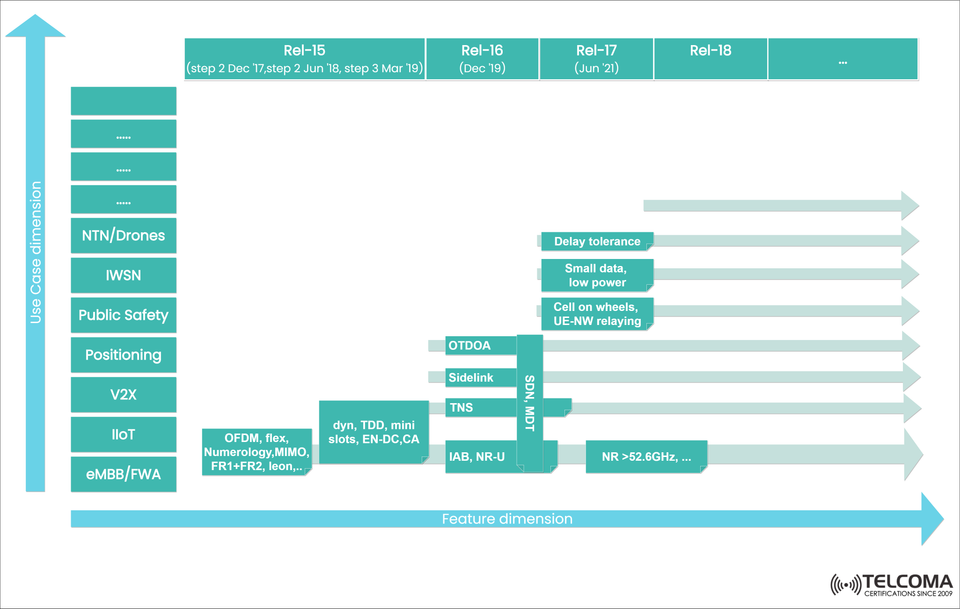

Evolution of 5G Through 3GPP Releases: From Rel-15 to Rel-18 and Beyond
A collection of specified releases from the 3rd Generation Partnership Project (3GPP) continues to develop the 5G ecosystem by describing enhancements to the network during use cases and technical details. The chart shows a clear and directed visualization of the sequence of use cases, (eMBB, V2X, positioning, drones, IIoT, etc.) from Release 15 through Release 18 and beyond.
We will examine the vertical use case dimension and the horizontal feature development dimension so that you can better examine what is happening with the 5G ecosystem as you proceed to examine use cases and features.
📅 Visualization of 3GPP Releases Timeline
Release Date Overview
Rel-15 Step 2 (Dec 2017) to Step 3 (Mar 2019) Baseline 5G NR (Non-Standalone & Standalone)
Rel-16 Dec 2019 Enhanced URLLC, V2X phase 1, industrial use cases
Rel-17 June 2021 Expanded capabilities (NTN, drones, IIoT, advanced positioning)
Rel-18 Ongoing 5G Advanced, higher spectrum (>52.6GHz), AI/ML
🧭 Use Case Dimension - Vertical Expansion of 5G
- eMBB/FWA (Enhanced Mobile Broadband/Fixed Wireless Access)
Foundation of 5G Rel-15
Communicate high data rates using OFDM, MIMO, FR1/FR2
Extended with dynamic TDD, carrier aggregation in Rel-16+.
- IIoT (Industrial Internet of Things)
Being in Rel-16 onwards
Provides High-Reliability, Low-Latency Communication (URLLC)
Key part of Smart Factories and Automation in Real Time
- V2X (Vehicle-to-Everything)
Brought in Rel-16 via sidelink
New psychical requirements (eg, TNS (Time-sensitive Networking)
- Positioning
OTDOA and sidelink brought in Rel-16 onwards
Ultraprecise positioning is very important for robotics, AR/VR and autonomous systems
- Public Safety and IWSN (Industrial Wireless Sensor Networks)
Focus on mission-critical use cases
"Cell on wheels" and "UE-NW relaying" introduced in Rel-17
- NTN (Non-Terrestrial Networks) and Drones
Introduced in Rel-17 and expanded in Rel-18 onwards
Equivalent to delay-tolerant, low-power, high-altitude applications
⚙️ Feature Dimension: Horizontal Expansion of Capabilities
Release Key Feature Developments
Rel-15 OFDM waveform
Flexible numerology
MIMO and beamforming
Frequencies Ranges 1&2, (FR1 <6GHz, FR2 >24GHz)
| Rel-16 | Dynamic TDD
Mini-slots
Dual connectivity (EN-DC)
Carrier Aggregation
| Rel-17 | Integrated Access & Backhaul (IAB)
NR in unlicensed bands (NR-U)
TNS and Sidelink for V2X
OTDOA for better positioning
SDN/NDT (Network deterministic timing)
| Rel-18 and beyond | NR above 52.6GHz
Further support for drones/NTN
Delay tolerant comms
AI/ML based network optimisation
🚀 What we can expect in Release 18 and beyond
We are just starting Release 18, which is the beginning of 5G Advanced. Release 18 focus:
Expanded NR spectrum (greater than 52.6GHz)
AI-native architecture.
Next-gen sidelink for UAV and robotics.
Increased support for small data for constraint IoT devices.
UE relaying to maximize coverage and minimize dead zones.
Energy efficiency and sustainability.
🧠 What does this mean for People in Telecom?
As the network evolves and releases grow in capacity, each new release requires:
Phased Network Upgrades: Hardware and software must evolve to support the capabilities of each release.
New testing: V2X, sidelink, and NTN are going to add complexities to the testing environment.
Spectrum Planning: This is especially important with FR2 (as we approach >52GHz NR now) - which is the biggest challenge to develop.
Edge Preparation: There is going to be an increased focus on positioning. IIoT use cases will require ultra-low-latency with edge deployed cores.
🧩 Use Case Type to Features Table (Quick Reference)
Use Case Supporting Features/Release
eMBB/FWA OFDM, MIMO, CA (Rel-15, 16)
IIoT URLLC, TNS, SDN (Rel-16+)
V2X Sidelink, TNS (Rel-16+)
Positioning OTDOA, sidelink (Rel-16+)
Drones/NTN NR-U, IAB, Delay Tolerance (Rel-17+)
Public Safety UE relaying, small data (Rel-17+)
🏁 Conclusion
The 3GPP releases from Rel-15 to Rel-18 and beyond, have a trajectory of progressive approaches, which can demonstrate the exponential growth of 5G use cases and technical sophistication by enabling high-speed mobile broadband for access to drones, public safety and massive IoT.
📘 Tactical Recommendations for Deployment Teams
As releases from 3GPP evolve, deployment teams will need to synchronize their infrastructure roadmaps, testing strategies, and relationships in order to remain on the cutting edge. Here are some ways to do this:
- Plan for Multi-phased Rollouts
Each release acts as a building block for the next release, a phased deployment strategy will allow teams to transition with minimal disruptions:
Phase 1: Start with the Rel-15 or Rel-16 features (i.e., eMBB, URLLC).
Phase 2: Add in the Rel-17 features (i.e., NTN, IIoT, V2X) in trial or proof of concept (POC) modes.
Phase 3: Be ready for the Rel-18+ features for deployments with testbeds and capable of supporting higher frequencies and AI integration.
- Rethink Your Spectrum Strategy
As Rel-17 and 18 add NR > 52.6GHz and unlicensed spectrum (NR-U), operators should:
Review the spectrum availability and licensing schemes in their deployment locations.
Also upgrade their RAN hardware and antenna systems to be able to work in or adapt to frequency range 2 (FR2) and above.
- Invest in Testing and Validation Equipment
The new features associated with sidelink, integrated access backhaul (IAB), TNS and OTDOA, require new testing circuits and validation equipment:
Use digital twins and emulators for various drone or NTN scenarios.
Test positioning accuracy and latency in real-world environments.
- Enable Ecosystem Readiness
New use cases (e.g., cell-on-wheels, UE-NW relaying, and public safety comms) will require teams to collaborate and integrate both intemally, cross-domain (other groups like public safety), and cross-vendor (i.e., multiple vendors may be contributing):
Do multi-vendor events/POCs early on.
Establish standards for API or proxy interfaces early to enable orchestration and automation.
🧪 Use Case Rediness Checklist (Rel-15 to Rel-18)
Use Case Must-Have Features Suggested Release
eMBB / FWA FR1, MIMO, Numerology, CA Rel-15, 16
IIoT URLLC, SDN, TNS Rel-16, 17
V2X Sidelink, TNS Rel-16 onward
Positioning OTDOA, sidelink based tracking Rel-16 onward
Public Safety UE relaying, small data support Rel-17
NTN / Drones Delay tolerance, NR-U, IAB Rel-17, 18