
5G Access Technologies for IoT: NB-IoT, LTE-M, LTE, NR, and Dynamic Spectrum Sharing

Introduction
The Internet of Things (IoT) is growing quickly, linking up billions of devices across various fields like healthcare, manufacturing, logistics, and smart cities. However, not all IoT devices have the same needs. Some require ultra-low latency and high bandwidth, while others focus on energy efficiency and wide-area coverage.
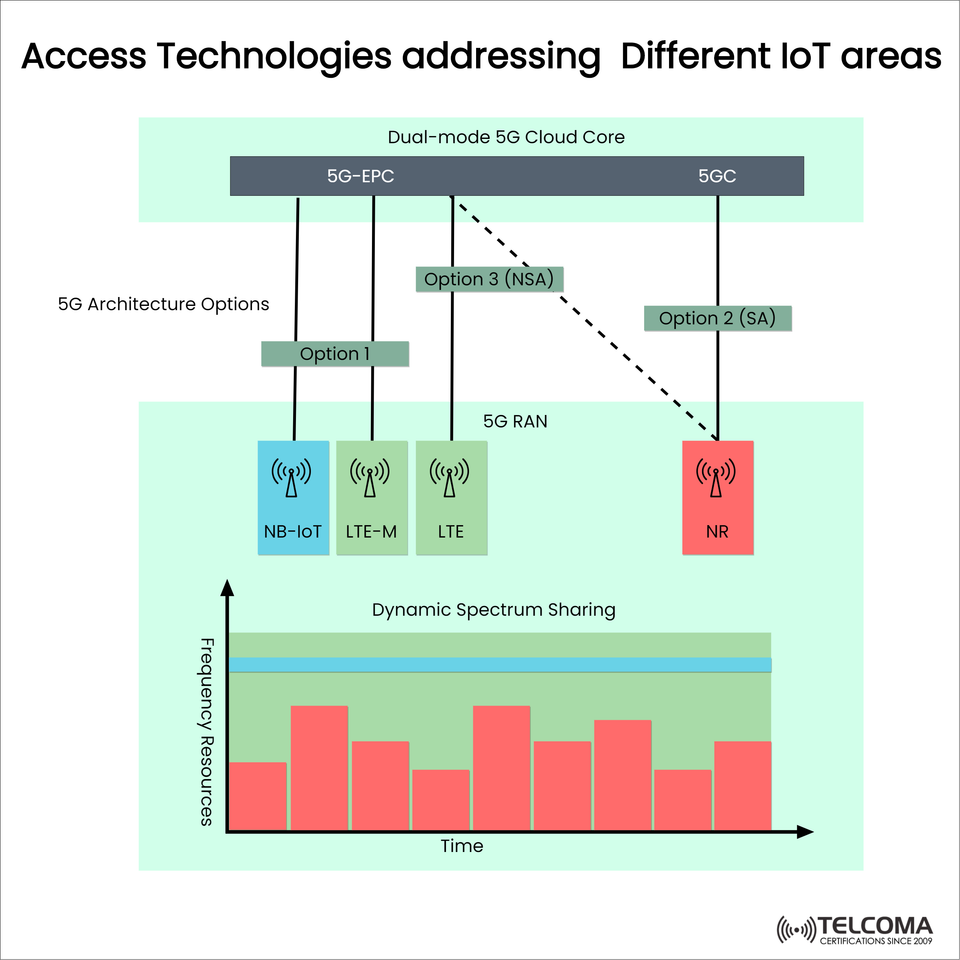
The image above shows how 5G access technologies—NB-IoT, LTE-M, LTE, and New Radio (NR)—cater to different IoT areas. By using dual-mode 5G cores, different architecture options, and dynamic spectrum sharing, networks can provide tailored connectivity for a wide range of IoT applications.
Understanding 5G Access Technologies for IoT
5G isn’t just one technology; it represents an ecosystem that accommodates various radio access technologies (RATs). Each RAT meets specific IoT requirements:
NB-IoT (Narrowband IoT): * Designed for massive IoT (mMTC). * Works well with low-power, wide-area (LPWA) devices. * Great for sensors, meters, and smart agriculture.
LTE-M (LTE for Machines): * Strikes a balance between coverage and mobility. * Handles low to medium data rates. * Suitable for wearables, asset tracking, and connected healthcare.
LTE (Long Term Evolution): * Offers broadband IoT support. * Features higher data rates and solid coverage. * Best for video-capable IoT or enterprise setups.
NR (New Radio – 5G): * Built for high-performance IoT. * Delivers ultra-low latency, high throughput, and reliability. * Enables applications like autonomous vehicles, smart factories, and AR/VR.
5G Core and Architecture Options
The diagram shows how both 5G cores (5GC) and evolved packet cores (EPC) can exist together in a dual-mode 5G cloud core. Depending on where they are in the rollout process, operators can choose various architecture options:
Option 1: NB-IoT / LTE-M / LTE with EPC
Legacy EPC continues to handle IoT traffic.
Provides continuity for existing LTE-based IoT setups.
Cost-efficient for operators with established LTE networks.
Option 2: Non-Standalone (NSA) with LTE + NR
5G NR works alongside LTE, using EPC.
LTE serves as the control anchor while NR enhances performance.
Common in early 5G rollouts to ensure a smooth transition.
Option 3: Standalone (SA) with NR and 5GC
Fully embraces 5G with the 5G Core.
Unlocks capabilities like network slicing, edge computing, and ultra-reliable low-latency communications (URLLC).
Ideal for advanced IoT applications such as autonomous systems.
Dynamic Spectrum Sharing (DSS)
A key player for IoT in 5G networks is Dynamic Spectrum Sharing (DSS). Rather than splitting frequency bands between LTE or 5G, DSS dynamically allocates spectrum resources based on real-time needs.
Benefits of DSS:
Flexible Resource Allocation: Makes sure spectrum is used optimally between LTE and NR.
Seamless Migration: Operators can gradually roll out 5G without needing to refarm spectrum.
Cost Efficiency: Cuts down on the need for new spectrum licenses.
Improved User Experience: Guarantees a smooth experience for both older LTE devices and new 5G-enabled IoT devices.
How Access Technologies Serve Different IoT Areas
Here’s how each access technology links up with different IoT domains:
IoT Area Access Technology Key Advantages Example Use Cases Massive IoT NB-IoT, LTE-M Low power, wide coverage, low cost Smart meters, agriculture, sensors Mobile IoT LTE-M, LTE Mobility, medium data rates Asset tracking, wearables Broadband IoT LTE, NR High data rates, video support Smart surveillance, connected cars Critical IoT NR (5G SA)URLLC, network slicing, high reliability Autonomous vehicles, smart factories
Why Dual-Mode 5G Cores Matter
Supporting both EPC and 5GC in a dual-mode architecture helps operators:
Protect investments in existing LTE IoT setups.
Introduce 5G services smoothly without interrupting current users.
Enable a gradual shift to full standalone 5G.
Support various IoT ecosystems with different needs.
This hybrid model ensures that networks are flexible, scalable, and ready for the future.
Challenges in IoT Access Technologies
Despite its strengths, this architecture presents some challenges:
Spectrum Efficiency: Balancing NB-IoT, LTE-M, LTE, and NR on shared spectrum needs smart resource management.
Device Fragmentation: IoT devices come in many shapes and sizes; ensuring they all work together is key.
Security: The rise of massive IoT expands the attack surface, necessitating advanced 5G security measures.
Operational Complexity: Managing dual cores and multiple RATs adds to the network management workload.
Future Outlook: Toward a Unified IoT Ecosystem
As networks continue to evolve, we can look forward to:
Standalone 5G taking center stage in high-performance IoT.
Widespread adoption of network slicing to customize connectivity for different industries.
Integration with edge computing for ultra-low latency IoT applications.
Smooth spectrum harmonization driven by AI-enhanced DSS.
By 2030, IoT will heavily depend on 5G NR with SA architectures, but NB-IoT and LTE-M will still play a vital role in supporting massive low-power IoT applications.
Comparing 5G Architecture Options for IoT
The 5G landscape offers several deployment choices to support various IoT applications, each one weighing cost, performance, and migration strategy. Here's a closer look:
Architecture Option | Core Network Used | Access Technologies Supported | Advantages | Limitations
Option 1 (EPC with NB-IoT/LTE-M/LTE) | EPC (Evolved Packet Core) | NB-IoT, LTE-M, LTE- | Makes use of existing LTE infrastructure
Cost-effective for large-scale IoT
Seamless support for older IoT technologies
Limited access to full 5G features
Lacks native support for URLLC or slicing
Option 2 (SA – NR with 5GC) | 5GC (5G Core) | 5G NR | Unlocks all 5G capabilities (URLLC, slicing, MEC)
Perfect for critical IoT and advanced uses
Designed for future needs
Requires a significant investment
Migration can be complex for older LTE IoT devices
Option 3 (NSA – LTE + NR) | EPC with LTE anchor | LTE + 5G NR | Speeds up 5G deployment
Uses LTE as a control anchor
Better performance compared to just LTE
Depends on LTE coverage
Still misses out on full 5G core benefits
This breakdown shows why many operators tend to start with Option 1 or Option 3 before moving on to Option 2 (Standalone) for better long-term scalability.
Conclusion
The development of 5G access technologies ensures IoT's growth across various sectors. With NB-IoT, LTE-M, LTE, and NR functioning under dual-mode 5G cores and bolstered by dynamic spectrum sharing, operators can provide the right connectivity for every IoT scenario.
For those in telecom, understanding these access technologies is essential for creating networks that balance performance, efficiency, and scalability.
In the end, the combination of adaptable architecture options, DSS, and dual-core strategies positions 5G as the most flexible platform for IoT, bridging today's connectivity needs with the innovations of tomorrow.