
5G AMF Interactions Explained: Step-by-Step 5G Standalone Access Registration Flow

Understanding AMF Interactions in 5G Standalone Access Registration
The Access and Mobility Management Function (AMF) is a key part of the 5G Core (5GC) setup. It takes care of things like registration, connection, mobility, and access processes between the User Equipment (UE) and the core network.
In 5G Standalone (SA) mode, the UE connects straight to the 5G network through a gNB (Next Generation Node B), and doesn't rely on LTE or EPC components. One of the most vital tasks in this mode is the 5G Access Registration — this is the process that creates the initial connection and context for the UE within the 5G Core.
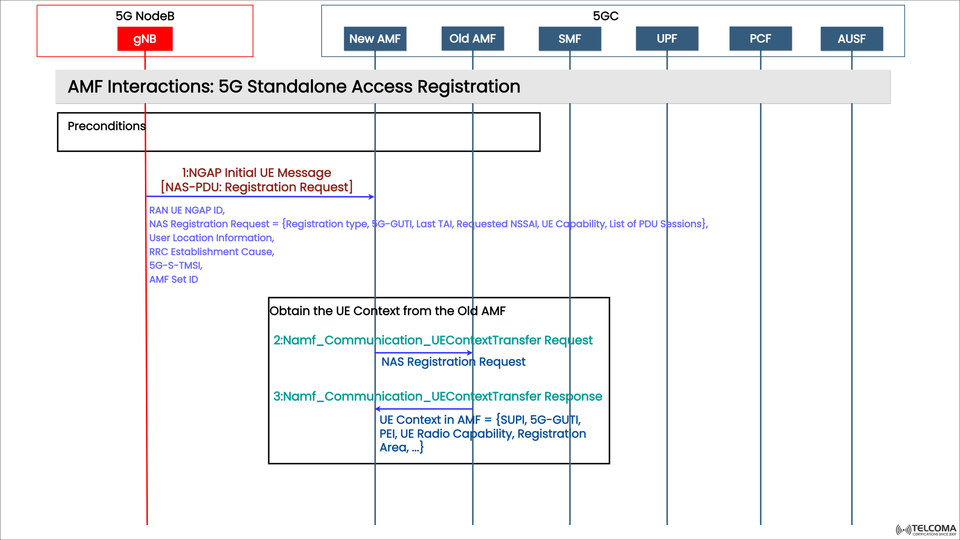
The image above shows how the gNB, New AMF, and Old AMF interact during the first stages of the 5G SA Registration, outlining the signaling and messages exchanged as specified by 3GPP TS 23.502.
Let’s take a closer look at each step.
Overview: What is 5G Access Registration?
The 5G Standalone Access Registration kicks off the moment a UE powers on or enters a new 5G network area.
This process allows the network to:
Authenticate and register the UE.
Set up security contexts.
Fetch UE context if it was previously registered with a different AMF.
Enable PDU sessions and allocate network resources.
In simpler terms, it’s how your device says, “Hello, I’m here and ready to connect” to the 5G network.
Network Entities Involved
Entity Role in Registration UE (User Equipment)The device starting the registration process. gNB (5G Node B)The radio access node that relays NAS and NGAP messages between the UE and AMF. New AMF The AMF instance currently handling the UE during this registration cycle. Old AMF The previously serving AMF if the UE moves or re-registers. SMF (Session Management Function)Takes care of session setup post-registration. UPF (User Plane Function)Routes user data once sessions are active. PCF (Policy Control Function)Manages QoS and policy enforcement. AUSF (Authentication Server Function)Authenticates the UE during the registration phase.
Preconditions for Registration
Before diving into the registration process:
The UE needs to be powered on and ready to kick off the NAS Registration Request.
The gNB must have an NGAP connection established with the AMF.
The network slice and PLMN should be available for the registration.
These conditions guarantee smooth signaling once the UE begins communication.
Step-by-Step Explanation of the 5G AMF Interaction Flow
Step 1: NGAP Initial UE Message (NAS Registration Request)
Direction: gNB → New AMF
The process begins when the UE sends a NAS Registration Request wrapped in an NGAP Initial UE Message to the AMF via the gNB.
Purpose:
This message is the UE’s formal way of asking to register with the 5G Core. It helps the network identify the device, authenticate it, and re-establish its context.
Message Content:
RAN UE NGAP ID – An ID assigned by gNB to the UE.
NAS Registration Request includes:
Registration Type: This could be initial registration, mobility update, or periodic update.
5G-GUTI: This is the Globally Unique Temporary UE Identity.
Last TAI (Tracking Area Identity): Tells us where the UE was last located.
Requested NSSAI (Network Slice Selection Assistance Information): Specifies which network slices are needed.
UE Capability: Information about supported radio and service features.
List of PDU Sessions: If the UE has any active sessions that it wants to resume.
User Location Information – Current cell and tracking area of the UE.
RRC Establishment Cause – Explains why the RRC connection was set up (like for a mobile-originated call).
5G-S-TMSI – A short-term mobile identity.
AMF Set ID – Identifies possible AMF instances.
Key Insight:
The gNB acts as a transparent relay — it doesn’t interpret NAS messages, just encapsulates and forwards them to the AMF via NGAP.
Step 2: Obtain UE Context from the Old AMF
If the UE was registered before in the same or a different network slice, the New AMF has to get that context from the Old AMF to keep the session going smoothly.
Message 2: Nam f_ Communication _ UE Context Transfer Request
Direction: New AMF → Old AMF
The New AMF sends a request to the Old AMF asking for the UE’s stored context, which can include:
UE’s Subscription Permanent Identifier (SUPI)
5G-GUTI
PEI (Permanent Equipment Identifier)
UE Radio Capabilities
Registration area details
Any active PDU sessions or network slices
Purpose:
This helps restore the UE’s state, ensuring continuity in the service during inter-AMF movement or re-registration.
Step 3: UE Context Transfer Response
Direction: Old AMF → New AMF
The Old AMF replies with a Nam f_ Communication _ UE Context Transfer Response, providing:
UE Context Data = {SUPI, 5G-GUTI, PEI, UE Radio Capability, Registration Area, PDU Session Info, etc.}
Purpose:
This allows the New AMF to reconstruct the UE’s profile and avoid unnecessary authentication if the UE was already known to the network.
Once this step is done, the New AMF has complete knowledge of the UE’s capabilities, subscription, and previous sessions and is set to carry on with the registration.
Significance of the AMF Context Transfer
This context transfer mechanism is essential for 5G mobility and keeping services going. Without it, every registration would feel like a brand new access, leading to:
Slower response times,
Unneeded authentication processes, and
Potential loss of active PDU sessions.
By grabbing the UE’s context, the AMF allows for smooth re-registration — especially during handovers from one AMF region to another or between network slices.
Message Summary Table
Step Message Name Direction Purpose Key Parameters1NGAP Initial UE Message (NAS Registration Request)gNB → New AMF Starts the 5G registration RAN UE NGAP ID, NSSAI, 5G-GUTI2Namf_Communication_UEContextTransfer Request New AMF → Old AMF Requests UE’s earlier context Registration Request3Namf_Communication_UEContextTransfer Response Old AMF → New AMF Supplies UE’s stored info SUPI, PEI, Radio Capabilities
Key Concepts Explained
a) NGAP (Next Generation Application Protocol)
NGAP is the protocol interface between gNB and AMF, ensuring:
Secure transmission of NAS messages.
Mobility management and UE identification.
Allocation of resources and handling UE context.
b) NAS (Non-Access Stratum)
NAS operates between the UE and AMF, managing registration, session handling, and mobility — without depending on the radio access tech.
c) AMF Context
The AMF context includes:
Subscriber identity and subscription details.
Security parameters.
UE capabilities and mobility data. This context is crucial for ensuring continuity between AMFs or PLMNs.
Practical Example
Picture a UE moving from one area to another under a different AMF set.
The New AMF doesn’t know the UE yet, but it gets an NGAP Initial UE Message with the 5G-GUTI from the old network.
Instead of starting the authentication process over, the New AMF can request the context from the Old AMF, which provides all the necessary info.
Then, the UE can smoothly continue its registration — keeping service sessions like ongoing calls or data streams intact and uninterrupted.
Why AMF Context Retrieval Matters in 5G Networks
Cuts Down Latency: By fetching context, it avoids redundant signaling and speeds up registration.
Secures Mobility Continuity: Helps ensure smooth transitions for UE between AMF regions.
Optimizes Network Resources: Reduces the load on AUSF and UDM by reusing valid authentication info.
Enhances User Experience: Aids in seamless transitions during roaming or inter-slice mobility.
Common Issues in AMF Interaction Flow
Engineers often run into problems like:
Missing or corrupt 5G-GUTI: This can stop the new AMF from recognizing the old context.
Context Transfer Failures: Can happen due to mismatched AMF Set IDs or routing issues.
NGAP Setup Problems: Caused by transport or SCTP configuration hiccups.
NAS Message Drops: Often due to incorrect encapsulation at the gNB.
Troubleshooting Tip: Always check NGAP traces, AMF logs, and Namf communication responses during your analysis.
Conclusion
The AMF Interactions during 5G Standalone Access Registration are among the most foundational and yet sophisticated processes in the 5G Core. Through a series of defined NGAP and Nam f_ Communication messages, the AMF ensures that each UE gets registered, authenticated, and aligned with network services correctly.
By transferring UE context between both old and new AMFs, the 5G network achieves smooth mobility, faster access, and greater reliability — all essential elements of a genuine 5G experience.