
5G Application Categories Explained – eMBB, mMTC, and URLLC in Telecom
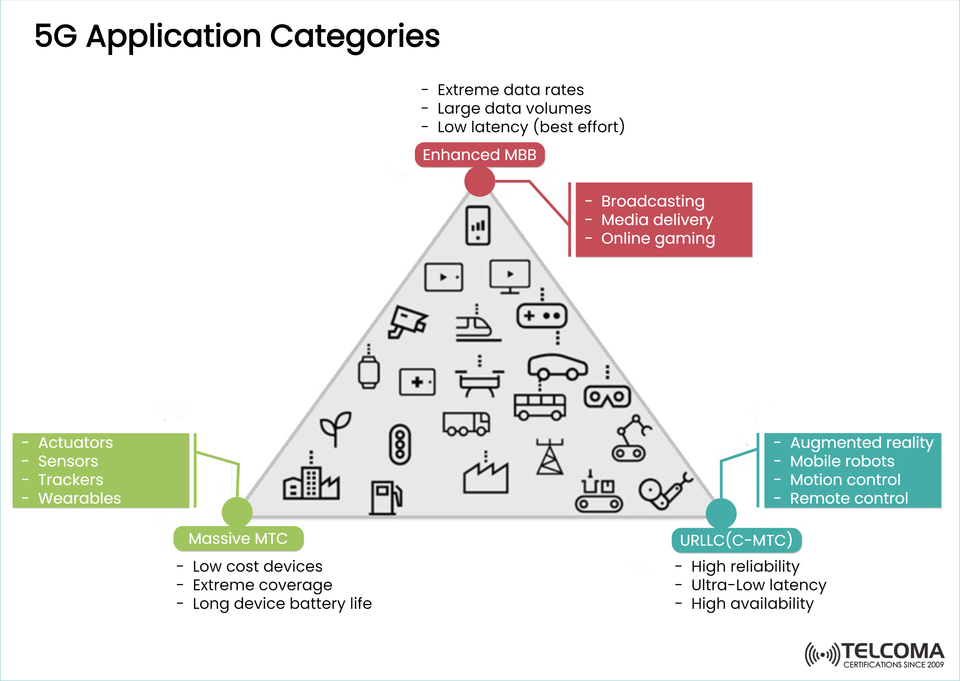

Categories of 5G Applications – Understanding eMBB, mMTC, and URLLC for Telecom Pros
5G technology isn’t just about lightning-fast internet—it’s a foundation for a wide range of specialized applications. The International Telecommunication Union (ITU) outlines three main categories of 5G applications:
Enhanced Mobile Broadband (eMBB)
Massive Machine-Type Communications (mMTC)
Ultra-Reliable Low Latency Communications (URLLC)
These categories represent unique service profiles, each tailored to specific performance needs. Grasping these concepts is vital for telecom engineers, network planners, and tech enthusiasts who want to make the most out of 5G technology.
Enhanced Mobile Broadband (eMBB)
Definition: This category is all about high data rates, large amounts of data transfer, and moderately low latency for both consumer and enterprise applications.
Key Technical Features:
Very High Data Rates: Ideal conditions can see peak speeds up to 10 Gbps.
Large Data Throughput: Perfect for high-bandwidth tasks like UHD video streaming and virtual reality.
Low Latency (Best Effort): Latency is improved from 4G but isn't as low as what URLLC offers.
Spectrum Utilization: Mainly utilizes mid-band (sub-6 GHz) and mmWave frequencies to boost capacity.
Example Applications:
Broadcasting: Streaming high-definition live events with little to no buffering.
Media Delivery: Supporting 4K/8K video streaming, cloud gaming, and AR/VR content delivery.
Online Gaming: Providing smooth multiplayer experiences with minimal lag.
Why eMBB is Important for Operators:
For many mobile network operators (MNOs), eMBB is the first and most apparent use case for 5G, as it directly influences customer satisfaction and competitive standing.
Massive Machine-Type Communications (mMTC)
Definition: mMTC focuses on inexpensive, low-power devices that need intermittent connectivity over wide areas. This category is crucial for IoT (Internet of Things) setups.
Key Technical Features:
Affordable Devices: Cost-effective chipsets for sensors and tracking devices.
Wide Coverage: Can connect devices even in remote rural locations.
Long Battery Life: Devices designed to run on batteries for years.
High Connection Density: Supports up to 1 million devices per km².
Example Devices:
Actuators: Remote control of mechanical systems.
Sensors: Monitoring environmental, industrial, and agricultural conditions.
Trackers: Keeping tabs on assets for logistics and supply chains.
Wearables: Devices like smartwatches and fitness monitors.
Example Applications:
Smart cities featuring thousands of interconnected devices.
Agricultural automation using soil and weather sensors.
Industrial monitoring for predictive maintenance.
Why mMTC Matters:
It's the backbone of IoT ecosystems, enabling large-scale deployments at a fraction of the operational cost. This category will likely lead to billions of connected devices over the next decade.
Ultra-Reliable Low Latency Communications (URLLC)
Definition: URLLC is designed for mission-critical services that require incredibly low latency and high reliability.
Key Technical Features:
High Reliability: Achieving 99.999% service availability.
Ultra-Low Latency: End-to-end latency of 1 ms or less.
High Availability: Consistent service even during heavy network use.
Prioritized Traffic Management: Ensures critical data gets delivered first.
Example Applications:
Augmented Reality (AR): Real-time rendering for fields like industrial training or healthcare.
Mobile Robotics: Coordinating autonomous robots in manufacturing and logistics.
Motion Control: Remote operation of precise machinery.
Remote Control: Real-time management of drones or vehicles for emergency responses.
Why URLLC is Game-Changing:
It makes applications impossible on 4G a reality, such as remote surgeries, coordinating autonomous vehicles, and immediate industrial automation—where every millisecond counts.
Quick Overview of 5G Application Categories
Feature eMBB mMTCURLLC Primary Goal High-speed broad band Large-scale IoT Mission-critical communications Peak Data Rate Up to 10 Gbps Low (kbps)Moderate (Mbps)Latency~10–20 ms Tolerant (seconds)≤1 ms Connection Density Thousands/km²Up to 1 million/km²ModerateReliabilityHighModerateVery high (99.999%)Example Use Cases Streaming, gaming Smart sensors, tracking Remote surgery, autonomous vehicles
How These Categories Work Together in 5G Networks
Modern 5G networks utilize network slicing to create virtual networks tailored to each application category. For example:
An eMBB slice for fast consumer internet.
An mMTC slice for IoT devices with lower bandwidth needs.
An URLLC slice for critical operations.
This method ensures efficient resource management and service-level guarantees, while different traffic types don’t interfere with one another.
Real-World Deployment Examples
eMBB: South Korea is focusing its 5G deployments on UHD video and cloud gaming for users.
mMTC: In Europe, NB-IoT and LTE-M networks are being used for smart metering and agriculture.
URLLC: 5G-enabled port automation in China is managing cranes and vehicles with sub-millisecond latency.
Challenges and Considerations for Operators
While 5G brings a host of opportunities, rolling out all three categories demands:
Spectrum Strategy: Finding the right balance between low-band (coverage) and high-band (capacity).
Infrastructure Investment: Upgrading backhaul and edge computing systems.
Regulatory Compliance: Meeting safety regulations for critical applications.
Device Ecosystem Development: Ensuring there's a good supply of compatible devices and modules.
Wrap-Up
The three 5G application categories—eMBB, mMTC, and URLLC—are foundational to next-gen telecom services:
eMBB offers ultra-fast broadband for consumers and businesses.
mMTC fuels the Internet of Things with massive connectivity.
URLLC enables real-time, highly reliable applications that weren’t feasible on mobile networks before.
For telecom professionals, getting a handle on these categories is key to designing networks that can cater to varied performance needs and unlock new business prospects. As 5G technology evolves, the interplay between these categories will shape how industries, cities, and societies connect in the future.
The Shift from 4G to 5G Application Categories
To really understand the different categories of 5G applications, it helps to look back at how mobile networks have evolved over the years:
3G brought mobile internet to the masses, mainly enabling browsing and messaging.
4G LTE took things further, making high-quality video streaming and app services commonplace.
5G is now focusing on offering customized network capabilities, catering to various application needs beyond just speed.
This evolution signals that telecom networks aren’t just a one-size-fits-all solution anymore—they’re becoming programmable and adaptable, meeting the needs of consumers as well as essential industries.
Key Technologies Supporting 5G Application Categories
Several technologies are at play that make eMBB, mMTC, and URLLC feasible:
Massive MIMO (Multiple Input Multiple Output)
Boosts capacity and efficiency by using large antenna arrays.
It's crucial for meeting the high-speed demands of eMBB.
mmWave Spectrum
Provides a vast bandwidth for ultra-fast data rates.
Mainly used in eMBB but can also support URLLC in localized settings.