
5G Architecture Evolution: NSA to NSA/SA Convergence for Multi-Service Networks
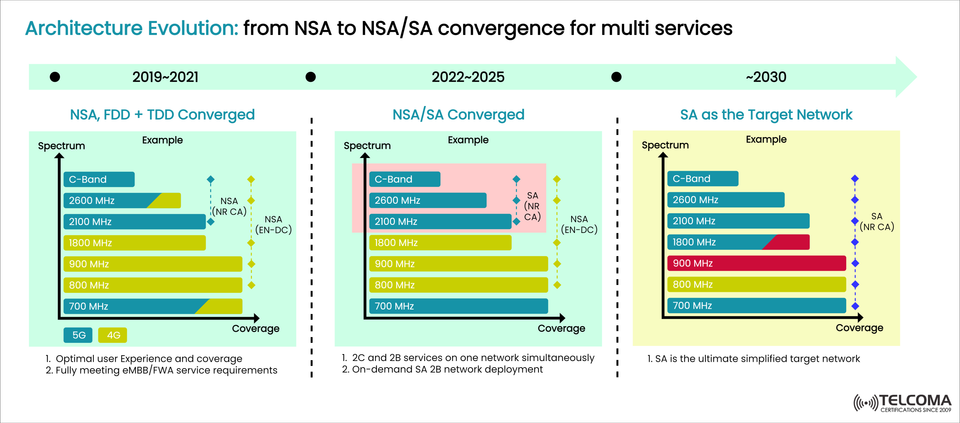

Rolling out 5G isn’t just about getting faster speeds; it's about reshaping how networks work to handle various services, optimize the use of spectrum, and make everything easier to deploy. The evolution of 5G architecture kicks off with Non-Standalone (NSA), transitions to NSA/SA convergence, and aims for the Standalone (SA) setup as the final goal.
The diagram attached gives a clear view of this evolution timeline from 2019 to 2030, showing how the spectrum layers and coverage capabilities advance to support enhanced Mobile Broadband (eMBB), Fixed Wireless Access (FWA), and the ultra-reliable services of the future.
In this blog post, we’ll dive into the three key phases of 5G architecture evolution:
NSA with FDD + TDD convergence (2019–2021)
NSA/SA convergence (2022–2025)
SA as the ultimate target (2030 and beyond)
Phase 1: NSA, FDD + TDD Converged (2019–2021)
The initial phase of 5G deployment focused on the Non-Standalone (NSA) architecture, which relies on existing 4G LTE infrastructure for providing 5G connectivity.
Key Highlights:
Spectrum Utilization:
Bands like 700 MHz, 800 MHz, 900 MHz, 1800 MHz, 2100 MHz, 2600 MHz, and C-band were utilized.
Both Frequency Division Duplex (FDD) and Time Division Duplex (TDD) were combined for better spectrum usage.
Deployment Example:
NSA was achieved via EN-DC (E-UTRAN New Radio – Dual Connectivity).
NSA also used NR CA (Carrier Aggregation) for boosted throughput.
Benefits:
Quicker rollout by using existing LTE cores.
Enhanced user experience and coverage.
Fully equipped to meet eMBB and FWA service requirements.
During this phase, telecom operators aimed to optimize spectrum availability by blending 4G and 5G resources, allowing for early service adoption without needing to completely revamp existing infrastructure.
Phase 2: NSA/SA Convergence (2022–2025)
Next up is the convergence of NSA and SA networks. This hybrid phase makes it easier for telecom operators to transition without service interruptions.
Spectrum Management in NSA/SA Convergence:
The spectrum remains similar, from 700 MHz to C-band.
Simultaneous NSA and SA deployment keeps things compatible while gearing up for future 5G services.
Key Features:
Dual Capability:
2C and 2B services (covering consumer and business use cases) can run on the same network.
Services like network slicing and private 5G become viable for enterprise needs.
On-Demand SA Deployment:
Instead of a sudden switch, SA networks are rolled out as needed, helping to optimize investment.
Coverage and Service Quality:
Enhanced flexibility to balance coverage (low-frequency bands) and capacity (high-frequency bands).
Operators can explore advanced 5G capabilities while still leveraging NSA for broader reach.
Why NSA/SA Convergence Matters:
Enables multi-service delivery, including eMBB, URLLC (Ultra-Reliable Low-Latency Communications), and mMTC (massive Machine-Type Communications).
Opens pathways for operators to profit from 5G investments with enterprise offerings before fully transitioning to SA.
Phase 3: SA as the Target Network (~2030)
Looking ahead to 2030, Standalone (SA) 5G is anticipated to be the ultimate goal architecture. Unlike NSA, SA networks function independently of 4G LTE, featuring a dedicated 5G Core (5GC).
Spectrum Utilization in SA:
Broad use of the 700 MHz to C-band spectrum.
Improved integration of mid-band (2100–2600 MHz) and low-band spectrum (700–900 MHz) for reliable coverage.
Introduction of new bands (like 900 MHz for SA coverage) adds flexibility to the network.
Benefits of SA Architecture:
Simplified Network:
No longer tied to 4G LTE, creating a pure 5G environment.
Easier management and orchestration.
Full 5G Capabilities:
Network slicing on a larger scale for various industries.
Ultra-low latency to support autonomous systems, remote healthcare, and real-time IoT applications.
Readiness for mission-critical services and massive IoT applications.
Optimized Coverage and Capacity:
SA (NR CA) allows for the best use of spectrum concerning both coverage and capacity.
Telecom operators can find a sweet spot between urban high-demand areas and rural coverage.
Long-Term Vision:
SA stands for the ultimate streamlined network architecture.
By around 2030, operators are expected to pivot toward SA as the standard, facilitating advanced services across sectors like manufacturing, logistics, healthcare, and smart cities.
Comparison of 5G Architecture Phases
Aspect NSA (2019–2021)NSA/SA Converged (2022–2025)SA (2030 onwards)Core Dependency4G LTE Core Hybrid (LTE + 5GC)Pure 5GC (Standalone)Spectrum700–C-band (FDD + TDD)700–C-band (shared)700–C-band + new bands Deployment Model EN-DC, NR CA On-demand SA + NSA support SA with NR CA Coverage Optimized via LTE fall back Balanced coverage and flexibility Full 5G coverage Services Supported eMBB, FWA eMBB, mMTC, URLL CA l l 5G services at scale Network Complexity Higher (dual reliance)Medium (transition state)Simplified and future-ready
Why NSA Was an Important First Step
The NSA (Non-Standalone) architecture might seem like a temporary solution, but it really played a key role in getting 5G off the ground.
Faster Time-to-Market: By reusing the existing 4G EPC (Evolved Packet Core) instead of investing in a new 5GC right away, operators saved time.
Lower CAPEX: These early 5G rollouts were more cost-effective, which sped up market penetration.
Dual Connectivity Advantage: Thanks to EN-DC (E-UTRAN Dual Connectivity), devices could connect to both LTE and 5G NR at the same time, ensuring reliable performance.
Service Continuity: Even when 5G wasn't widely available, LTE served as a reliable anchor network.
NSA/SA Convergence: Connecting Two Worlds
The NSA/SA convergence stage represents the most significant turning point in the 5G journey. It gives operators the chance to gradually roll out advanced services while still depending on the existing LTE framework.
Key Operator Strategies During NSA/SA Convergence:
Spectrum Refarming: Low and mid-bands (700–2600 MHz) are shared dynamically between LTE and NR.
Private 5G Networks: Businesses are beginning to adopt standalone slices on SA while operators keep NSA for broader market users.
On-Demand Migration: Operators will roll out SA selectively—starting with urban centers, enterprise locations, and critical areas first.
Dual Support Devices: Most 5G smartphones that hit the market after 2022 are built to work with both NSA and SA modes.
Conclusion
The shift from NSA to SA in 5G architecture is a gradual, strategic evolution meant to meet the rising demands for services. For those in telecom and tech circles, grasping this progression really matters. It showcases not just the technical advancements in 5G architecture but also how operators are strategically managing coverage, costs, and service delivery to fully capitalize on the potential of next-generation 5G networks.