
5G Architecture Explained: Key Functions, Interfaces, and Data Flow

What is 5G Architecture?
The architecture of 5G represents the latest evolution in mobile networks , separating the control and user plane, enabling network slicing and supporting edge computing and cloud native. 5G also offers a service-based architecture (SBA) to offer better flexibility and scalability.
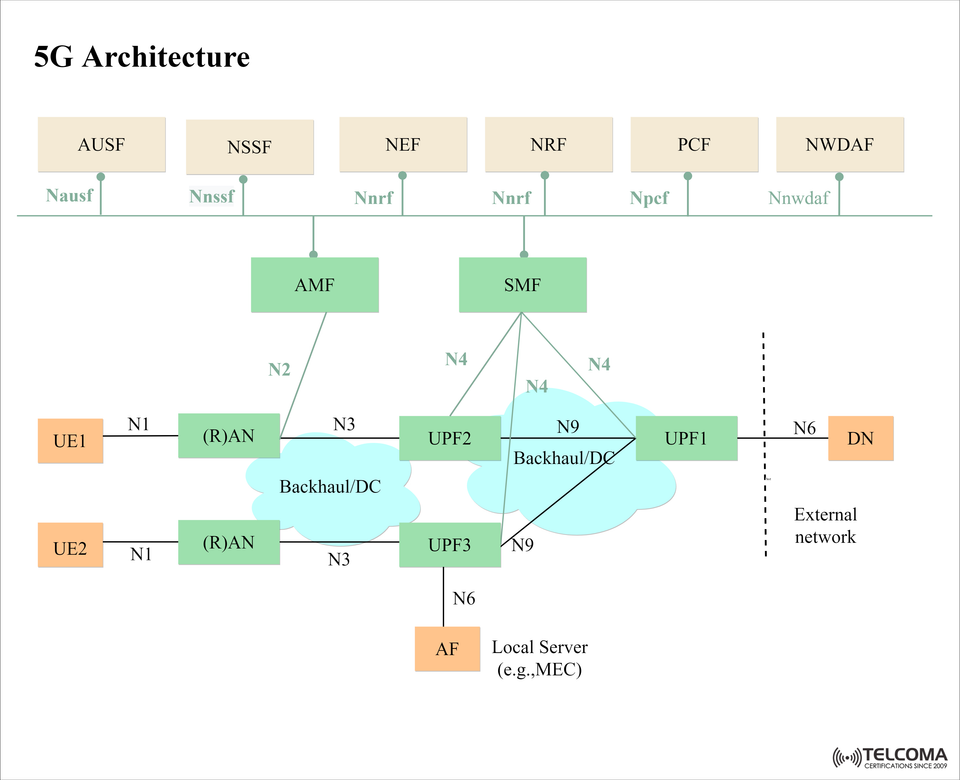
The uploaded diagram depicts a good overall view of the various 5G network elements and their interfaces, and the flow of data.
🔧Building Blocks of 5G Core Architecture:
- User Equipment (UE)
UE refers to devices such as smartphones or IoT modules that establish a connection to the 5G network.
Interfaces: N1 connects User Equipment to Access and Mobility Network
2. Radio Access Network ((R)AN)
This represents the radio interface to core network from the UE.
Interfaces:
N1 with (R)AN
N2 with AMF
N3 with UPF
- Access and Mobility Management Function (AMF)
The service function that handles the registration (and re-registration), mobility, connection and disconnection.
Interfaces:
N2 with (R)AN
AMF service connections to SMF, AUSF, and NSSF
4. Session Management Function (SMF)
The service function that handles the establishment of sessions, handling of IP address allocation.
Interfaces:
N4 with UPFs
SMF service connections to PCF, NRF, and AMF
5. User Plane Function (UPF)
A Service Function that routes and forwards user traffic. There are multiple UPFs such as:
UPF1 (connection to external network - DN)
UPF2, UPF3 that perform intermediate processing and continuity extension that supports MEC
Interfaces:
N3 with (R)AN
N4 with SMF
N6 with
🌐 Service-Based Network Functions (NFs)
Network Function Role Interface
AUSF Authentication server Nausf
NSSF Network Slice Selection Nnssf
NEF Network Exposure Function Nnef
NRF NF Repository Function Nnrf
PCF Policy Control Function Npcf
NWDAF Data Analytics Function Nnwda
📶 Interface Summary
Interface Connects Purpose
N1 UE ↔ (R)AN Signaling between UE and network
N2 (R)AN ↔ AMF Control signaling
N3 (R)AN ↔ UPF User plane data traffic
N4 SMF ↔ UPF Control for data session management
N6 UPF ↔ DN or AF Connects to internet or edge compute
N9 UPF ↔ UPF Inter-UPF data forwarding
🏁 Conclusion
5G architecture is designed for flexibility, scalability, and high performance. The clear separation of the control and user planes and support for distributed deployments (like MEC) helps furnish 5G architecture with the much-needed flexibility to achieve ultra-low latency and high throughput. With essential components such as the AMF, SMF, UPFs, as well as other NFs, the 5G system is able to support an entirely new array of use cases, such as IoT, enhanced mobile broadband (eMBB), and ultra-reliable low-latency communications (URLLC).
Whether you are a telecommunications engineer, network architect, or just a 5G enthusiast, understanding this architecture is important for becoming familiar with the future of connectivity.
Practical Uses of 5G Architecture
The architecture of 5G enables a wide range of use cases across various industries from an architectural ans a modular and service-based perspective. Let’s look at a few:
- Enhanced Mobile Broadband (eMBB)
Realistic data rates for immersive 4K/8K video streaming and AR/VR use cases. From an architectural perspective, the level of efficiency achieved by the PCF and NSSF to direct traffic based on perceived requirements (e.g., allocation of critical resources) is something of beauty. - Massive Machine-Type Communications (mMTC)
Scalable support for internet-connected sensors and other IoT devices using efficient signaling from the AMF and a lightweight user plane with the user plane functions (UPF). - Ultra-Reliable Low Latency Communications (URLLC)
Implementing mission-critical services (e.g., autonomous driving & remote surgery) is achieved through mechanisms like Multi-access Edge Computing (MEC) deployment (see UPF3 + Application Function (AF)) and low-latency support with interfaces such as N6. - Private and Sliced Networks
Organizations can maintain their own unique 5G networks enabled by NSSF and also utilize the NEF to provide network slice management and exposure.
Key Features and Benefits of 5G Core Architecture
Service-Based Architecture (SBA): Provides the basis for modularity, service portfolio deployment without impact to other services, upgrades to existing services, and scalability based on dynamic use.
Control and User Plane separation: provides any number of options in network topologies and provides better capabilities for performance tuning for users.
Support for MEC: Processing of data is performed closer to the edge or user to reduce latency and enhance responsiveness.
Interoperability & Open Interfaces: Many of the interfaces from N1 to Nnwdaf are precisely defined and encourage vendor-agnostic implementations.
🚀 Foresight for 5G Network Architecture
As we transition to 5G-Advanced and 6G, the architecture presented above will further evolve.
-on the basis of W3 market, AI/ML driven automation and NWDAF as the engine for critical decision making.
-the phrase cloud-native network functions (CNF) will supplant the term virtualization network functions (VNF).
-simplification, bring together RAN-Core-Edge by having common orchestration platform for true end-to-end workflow.
-enhanced security models by combining analytics with threat intelligence and security function.
💭 Closing Remarks
5G architecture represents a whole new paradigm of how mobile networks are designed, deployed, and operated - it’s a radically different approach. 5G connectivity is open, flexible, and intelligent, and has the potential to be the catalyst for connectivity and innovation across industries.
Whether you are designing network topologies, working on deployment of MEC, or are learning how to leverage 5G components (i.e. UDM, AMF, SMF, UPF, and others), it is important to understand the interactions of these different functional elements.
📊 Summary Table of Important Components in 5G Core Architecture
Component Full Name Function
UE User Equipment Mobile devices that access a network
(R)AN (Radio) Access Network Provides connection from UEs to core
AMF Access and Mobility Management Provides UE registration, connection, mobility management
SMF Session Management Function Manage sessions with UEs, allocate IP address, select UPFs
UPF User Plane Function Route user data to either external networks or MEC
AF.
🔚 Conclusion
Across generations of mobile technology, the core architecture of 5G finally demonstrates a fundamental shift. As a modular system accompanied by functions such as the access management function AMF, the session management function SMF and the user plane function UPF, intelligent services, including network data analytics function NWDAF and NEF, the architecture allows for flexibility, speed and future-readiness capabilities. As industries are rapidly ramping up the uptake of smart applications, from autonomous vehicles to Industry 4.0 applications, understanding the architecture of 5G is an important topic to consider for any telecom professional or technology enthusiast alike.