
5G Architecture for Low-Band and High-Band Integration: Enhancing Coverage and Capacity
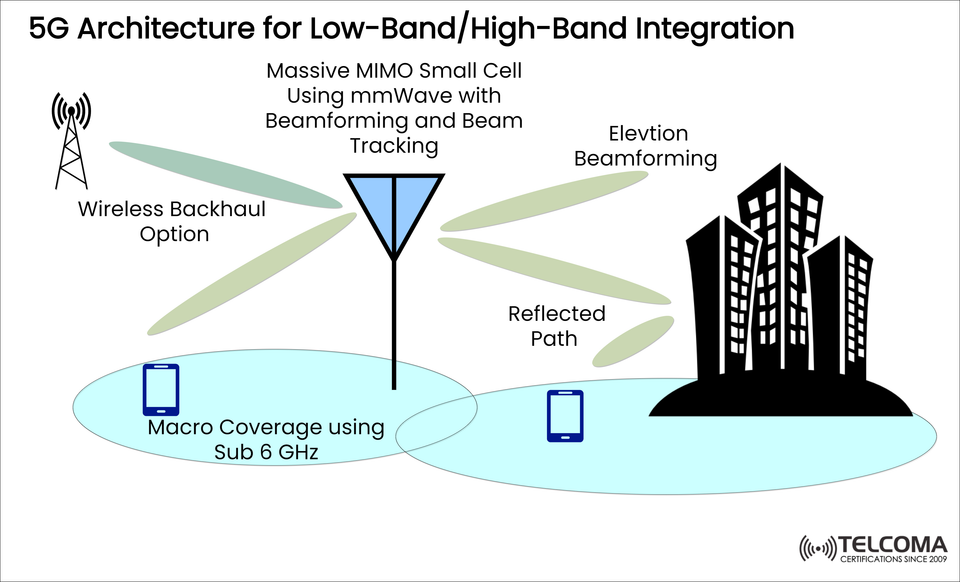

5G Architecture for Low-Band/High-Band Integration As 5G continues to progress, it is architecture has to deal with two competing requirements - coverage (broad reach) and speed (high data rates). Coverage is accomplished with low-band (Sub-6 GHz) while speed is achieved from high-band (mmWave). Low-band (Sub-6 GHz) and high-band (mmWave) will be integrated into a single 5G network allowing both broad reach and high-speed data rates. The graphic that is uploaded from Telcoma illustrates a multi-layered 5G architecture to demonstrate how 5G combines reach and speed, using two different frequencies and two different technologies.
📡 Understanding Role of Low-Band and High-Band in 5G
🔷 Low-Band (Sub-6 GHz):
• Used in association with macro coverage
• Must allow coverage for large geographic areas such as rural and suburban
• Longer range and better in-building penetration, walls, etc
• Lower frequency = lower data rate but broader reach0
🔶 High-Band (mmWave):
• Used with Massive MIMO small cells
• Provides multi-gigabit speed and very low latency
• Used only where there is a high density of device connections, densely populated urban environments; stadiums; airports
• High-band requires beamforming and beam tracking
• Limited range, extremely low ability to penetrate buildings or obstructions
📡 High Radiant Architecture Summary
The graphic depicts this connection between macro and small cell layers and how these layers:
Use mmWave frequencies to carry large amounts of data
Uses beamforming and beam tracking technology to efficiently direct energy toward user devices
- Elevation Beamforming
Alters the vertical angle of transmission
Works well for reaching into taller buildings with signal - Wireless Backhaul Options
Expands connectivity options between small cells and the core network
Great for situations where fiber does not exist or is too expensive - Reflected Path Optimization
In the mmWave world, signals often bounce off buildings
Reflected paths can be leveraged by using beam tracking to fully utilize connectivity even in NLoS situations - Macro Cell Layer
Sub-6 GHz
Provides coverage to blanket mobile users
Provides anchor signal for control-plane communication in non-standalone (NSA)
🧠 Why Integration is Important for 5G Deployments
Integrating low-band and high-band can provide the most efficient wi-fi capabilities for 5G networks that features: Low-Band (Sub-6 GHz) High-Band (mmWave)
Coverage Range Wide Limited
Penetration Through Obstacles Strong Weak
Data Rate Moderate Very High
Latency Moderate Ultra-low
Deployment Environment Rural/Suburban Urban/High-density setting
📈 Value of Integration:
A seamless experience for the user regardless of the environment
A highly efficient way to utilize a spectrum for a cost-efficient coverage
Building high-speed connections when, and where, it matters most - 📚 Further Reading and Resources
For more information on how 5G is changing the architecture and performance of networks today, or to get insight into these topics consider the following:
5G Core Network (5GC) vs LTE EPC
Learn about how the 5G core offers a service-based architecture (SBA) that supports dynamic slicing, ultra-low latency, and cloud-native services.
Beamforming and Beam Tracking Techniques
Look into how beamforming controls directional signals to improve reliability and efficiency in high-band mmWave deployments.
5G Deployment Options (NSA vs SA)
Familiarize yourself with the 3GPP deployment options: Option 2, 3, 4, 5, and 7 - each with its own specific tradeoffs to consider when integrating the radio and core.
mmWave Challenges and Solutions
Review the coverage constraints, contemplate device support, and how intelligent cell densification and backhaul design help mitigate these coverage issues.
🛠️ Key Takeaways for Telecom Workers
Hybrid spectrum use is essential
There is no ideal band, lowband is good for reach, highband is good for speeds, therefore hybrid guarantees both.
Massive MIMO + Beamforming = mmWave Deployment Success.
Advanced antennas enable high-frequency reliability.
Wireless Backhaul = Flexible Deployment.
In hard to reach urban areas , or more rural central business districts, wireless backhaul is a functional alternative to fiber where it would be unreliable.
Architecture is use case specific.
Smart cities, AR, VR, etc all require custom 5G set-up as a function of geography, density, and demand.
✨ Final Thoughts
The harmonization of low-band and high-band architecture is not just a technological requirement, but a strategic building block for the future of interconnectedness worldwide. The expansion of 5G continues to become a major stepping stone towards the continued integration of low-band and high-band architecture, allowing no one to be left behind in the rural hills or the skyscrapers of major cities.
It is on these principles of strength and resilience that the telecom engineers, network planners, and future-ready operators remain empowered to leverage this dual-layer architecture to deliver resilient, high-speed, scalable 5G networks.
🔍 Recap: Importance of Low-Band & High-Band 5G Architecture
The illustration we have examined is a simple, but useful example of how 5G's low-band and high-band spectrums successfully combine to address the weaknesses of both types of spectrum:
Feature Low-Band (Sub 6 GHz) High-Band (mmWave)
Coverage Wide, also rural Very limited, urban & dense areas are only market
Speed Moderate (~100 Mbps to 1 Gbp) Very high (> 1Gbp)
Latency Low Ultra-low
Penetration Strong (buildings, walls) Weak (requires line of site or reflection)
Use Cases IoT, simplest add broadband Augmented reality/Virtual reality, smart cities and industrial automation
By reserving both spectrum, telecom operators can meet coverage and speed requirements with both broad coverage, high data capacity, robust user experience.
🏁 Conclusion
Low-band/high-band integration in 5G architecture is not just an engineering challenge, it is central to a future-proof deployment design paradigm. It provides a well-balanced assessment of reliability, residential performance, reach, and relevance for real-time communications in all environments.
As 5G is deployed around the world, practitioners with the understanding of this hybrid model will lead the industry to a smarter, faster future.