
5G Automation: The Foundation of Intelligent and Scalable Telecom Networks
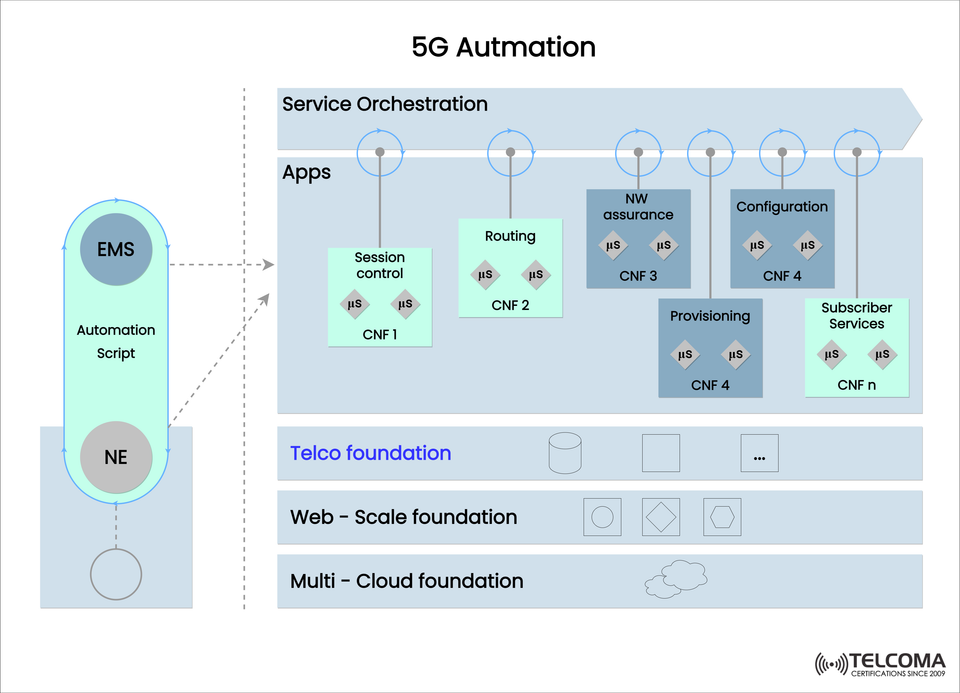

5G Automation: A Key Element of Smart and Scalable Telecom Networks
As 5G networks continue to develop, automation is becoming essential for their design, rollout, and management. Unlike earlier generations, 5G relies on cloud-native designs, microservices, and AI-driven orchestration, allowing for real-time adjustments and improved operational efficiency.
The diagram uploaded below illustrates the 5G automation architecture, highlighting how automation scripts, orchestration layers, and cloud-native functions (CNFs) interact within multi-cloud and telecom settings.
This layered approach to automation is what empowers 5G to deliver zero-touch provisioning, network slicing, and self-healing operations — all defining features of the next-gen telecom world.
Understanding 5G Automation Architecture
At its essence, 5G automation coordinates various layers of telecom infrastructure — from network elements to applications and service orchestration — all through a unified, programmable method.
Let’s take a closer look at the different layers depicted in the image:
Network Element (NE) and Element Management System (EMS)
At the foundation, Network Elements (NEs) consist of the hardware or software components responsible for executing telecom functions like:
Base stations
Core network entities (such as gNodeB, AMF, SMF)
Virtualized network functions (VNFs)
The Element Management System (EMS) oversees these elements using automation scripts to handle tasks such as:
Configuration and provisioning
Performance monitoring
Fault management
Automatic recovery
By automating repetitive tasks, the EMS significantly cuts down on the need for manual intervention, paving the way for zero-touch operations in 5G environments.
Service Orchestration Layer
At the top is the Service Orchestration Layer — this is essentially the “brain” of 5G automation. It controls, tracks, and manages all network services, ensuring optimal resource use across both physical and virtual infrastructures.
Some of its main functions are:
End-to-End Orchestration: Automates the creation, modification, and deletion of services across various domains.
Closed-Loop Assurance: Constantly checks KPIs and triggers automatic responses to keep service quality high.
Policy-Based Management: Uses AI/ML models to apply predefined policies for decision-making.
This layer interacts dynamically with underlying applications (CNFs), ensuring new services can be deployed and scaled in seconds.
Applications and Cloud-Native Network Functions (CNFs)
The Applications layer features modular components known as Cloud-Native Network Functions (CNFs). These functions replace traditional, bulky network functions with containerized microservices that can be deployed, scaled, and managed independently.
The Foundational Layers of 5G Automation
The groundwork for 5G automation relies on three essential infrastructure layers:
a. Telco Foundation
This layer provides the telecom-specific infrastructure, blending traditional network components with virtualized and software-defined frameworks. It encompasses:
Network Function Virtualization Infrastructure (NFVI)
Service Function Chaining (SFC)
Data Plane Acceleration (DPDK/SR-IOV)
The telco foundation guarantees high availability, predictable latency, and adherence to SLAs — all critical for mission-critical 5G applications.
b. Web-Scale Foundation
This layer adopts cloud-native design principles widely used by major cloud providers like AWS, Azure, and Google Cloud. It includes:
Container orchestration via Kubernetes
CI/CD pipelines for swift deployment
DevOps and GitOps workflows
By implementing web-scale automation in telecom settings, operators can achieve agility and flexibility akin to cloud computing.
c. Multi-Cloud Foundation
The multi-cloud foundation enables the deployment of network functions and services across various cloud environments, whether that’s public, private, or edge. It ensures:
Cloud independence (avoiding vendor lock-in)
Dynamic workload distribution
Geo-redundancy and resilience
Multi-cloud orchestration is vital for facilitating distributed 5G architectures that connect core to edge networks.
How 5G Automation Works: Step-by-Step
Here’s a straightforward workflow outlining how automation functions across the architecture:
Automation Script Initiation – Scripts within the EMS kickstart automated tasks (like configuring NEs or gathering KPIs).
Service Orchestration Activation – The orchestration layer identifies the service intent (such as launching a new slice or scaling CNFs).
CNF Deployment – The orchestrator rolls out containerized functions (like routing or session control) across telco and multi-cloud layers.
Monitoring and Feedback – Network assurance CNFs continually check service performance.
Closed-Loop Automation – If any issues arise, orchestration prompts corrective actions automatically, ensuring the network self-heals.
This cycle is continuous, paving the way for autonomous network operations (ANO) — a central aspect of 5G advancement.
Benefits of 5G Automation
The benefits of embracing 5G automation go beyond just efficiency; they reshape how telecom operators design and provide services:
- Operational Efficiency
Cuts manual intervention by roughly 80%.
Enables zero-touch provisioning and automated scaling.
- Improved Service Agility
Quickly deploy new 5G services or network slices.
Facilitates real-time policy enforcement and adaptable resource allocation.
- Enhanced Network Reliability
Continuous monitoring via CNF assurance functions.
Self-healing and fault isolation mechanisms reduce downtime.
- Cost Optimization
Lowers operational expenses (OPEX) by automating routine tasks.
Optimizes resource usage across hybrid cloud environments.
- Future-Ready Scalability
Accommodates millions of connected devices.
Supports AI-driven orchestration for proactive network management.
5G Automation Use Cases
Automation is crucial for various real-world telecom applications, such as:
Network Slicing Automation: Dynamic creation and management of network slices for different sectors (like IoT, automotive, healthcare).
Edge Computing Integration: Automated orchestration of workloads within central and edge data centers.
Assurance and Analytics: Closed-loop monitoring predicting failures before they occur.
Subscriber Lifecycle Management: Automated onboarding, billing, and customizing services.
Challenges in 5G Automation
While automation holds great promise, telecom providers face challenges like:
Integration Complexity: Coordinating with multiple vendors and legacy systems.
Skill Gaps: Needs expertise in DevOps, AI/ML, and cloud-native technologies.
Security and Compliance: Ensuring automation doesn’t compromise network security or data privacy.
Data Overload: Managing telemetry data from countless connected nodes.
Addressing these challenges calls for standardized frameworks (like ETSI MANO and TM Forum’s Open Digital Architecture) and AI-driven orchestration platforms.
Conclusion
5G automation is transforming the way telecom networks are designed, deployed, and managed. By integrating automation scripts, service orchestration, CNFs, and multi-cloud frameworks, operators can achieve unparalleled agility, scalability, and reliability.
As the industry moves toward AI-enabled autonomous networks, automation will be the foundation for real-time service delivery, network slicing, and ultra-reliable low-latency communication (URLLC).