
5G Control Plane Explained: Connection Between UE, 5G-AN, AMF, and SMF
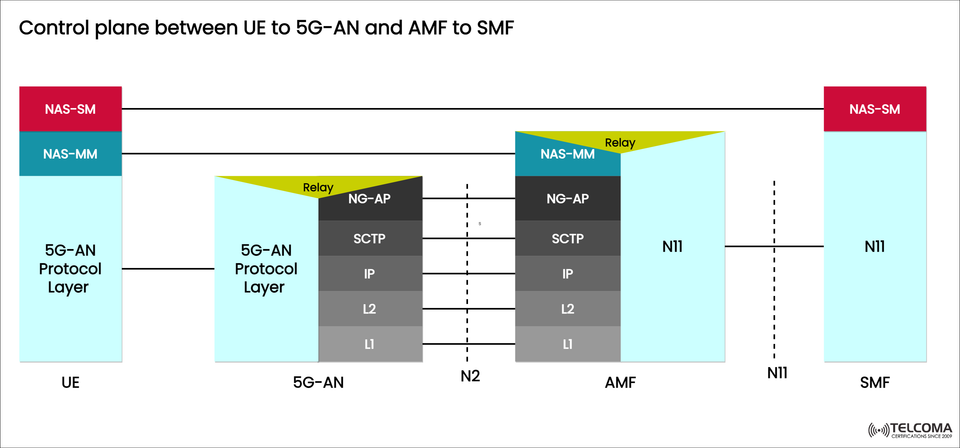

Understanding the 5G Control Plane: From UE to 5G-AN and AMF to SMF
The 5G Control Plane is crucial for managing communications within 5G networks. It takes care of signaling, mobility, session management, and authentication, making sure user devices (UE) can connect securely, move around, and access services.
The diagram above offers a clear picture of how the control plane links User Equipment (UE) to the 5G Access Network (5G-AN), then extends through the Access and Mobility Management Function (AMF) down to the Session Management Function (SMF) in the 5G Core (5GC).
Let’s take a closer look at this structure and see how these components work together to enable smooth connectivity.
What is the 5G Control Plane?
The Control Plane (C-plane) is what handles signaling and control messages that dictate how data sessions are created, maintained, and ended in the network.
This is different from the User Plane (U-plane), which is where actual user data (like video or voice) travels. The control plane manages functions such as:
User registration and authentication
Session setup and adjustments
Mobility management
Policy enforcement
Connection release
In 5G, these functions are modularized and virtualized, which gives it a lot more flexibility and scalability compared to the somewhat rigid 4G EPC (Evolved Packet Core).
Overview of the Control Plane Components
The control plane path, as illustrated in the image, includes several important components:
Component Full Name Role in Control Plane
UE User Equipment Initiates control signaling for access and session management.
5G-AN 5G Access Network (e.g., gNB) Relays signaling between UE and 5G Core (AMF).
AMF Access and Mobility Management Function Manages registration, authentication, mobility, and connection oversight.
SMF Session Management Function Manages PDU sessions, IP allocation, and policy control.
These components talk to each other through standard interfaces like N2 and N11, utilizing specific protocols to ensure reliable signaling.
Step-by-Step Signaling Flow in the Control Plane
Let’s trace the signaling journey across the network according to the diagram.
a. Between UE and 5G-AN (Radio Interface)
The User Equipment (UE) kicks things off by sending Non-Access Stratum (NAS) messages to establish a connection.
The 5G Access Network (5G-AN)—usually the gNB (Next-Generation NodeB)—forwards these NAS messages to the AMF.
Protocols Involved:
NAS-MM (Mobility Management): Takes care of registration, authentication, and mobility tasks.
NAS-SM (Session Management): Handles PDU session creation and closure.
5G-AN Protocol Layer: Covers lower layers responsible for transmitting control plane data wirelessly.
b. Between 5G-AN and AMF (N2 Interface)
The N2 interface connects the 5G-AN to the AMF, relaying signaling info using higher-layer protocols.
Key Layers and Protocols:
NG-AP (Next Generation Application Protocol):
Dictates signaling between gNB and AMF.
Used for UE context setup, handovers, and managing bearers.
SCTP (Stream Control Transmission Protocol):
Ensures reliable transport of NG-AP messages between gNB and AMF.
IP / L2 / L1 Layers:
These provide routing, link, and physical transmission capabilities for control messages.
Functionality:
The AMF works as a control relay, receiving NAS messages from the UE via the gNB and sending them to the right network function, like the SMF.
c. Between AMF and SMF (N11 Interface)
The N11 interface links the AMF with the Session Management Function (SMF), allowing for session creation and policy enforcement.
Roles:
The AMF relays NAS-SM messages from the UE to the SMF through N11.
The SMF sets up user plane paths, assigns IP addresses, and coordinates with the UPF (User Plane Function).
Protocols and Functions:
Service-Based Interface (SBI): This utilizes HTTP/2 over TCP/IP for service requests.
Nsmf_PDU Session Service: Outlines procedures for PDU session setup, changes, and terminations.
In essence, the AMF and SMF work together to keep both mobility and session management running smoothly.
Key Protocols in the 5G Control Plane
Each layer in the diagram features specific protocols that serve different purposes. Here’s a quick rundown:
Protocol Layer Function
NAS (SM/MM) UE–AMF Manages session and mobility management signaling.
NG-AP gNB–AMF Specifies signaling procedures between RAN and Core.
SCTP Transport Reliable message transport for NG-AP.
IP Network Routes control packets inside the 5G Core.
L2/L1 Data Link & Physical Tasked with framing, error control, and physical transmission.
Relay Function:
Both the 5G-AN and AMF act as relays for NAS messages, ensuring that signaling from the UE is securely sent on to the SMF.
NAS Signaling Explained
The NAS (Non-Access Stratum) is key in the 5G Control Plane. It’s the protocol layer above the Access Stratum (AS), directly linking the UE with the AMF, bypassing the RAN for seamless end-to-end signaling.
Types of NAS Signaling:
NAS-MM (Mobility Management):
Handles registration, authentication, and mobility events.
Manages connections and security setups.
NAS-SM (Session Management):
Establishes and oversees PDU sessions (data tunnels).
Coordinates QoS policies via the SMF.
NAS signaling guarantees the UE stays secure, authenticated, and connected whether roaming or switching access nodes.
Advantages of the 5G Control Plane Architecture
The new 5G control plane design brings a range of technical and operational perks:
Service-Based Architecture (SBA): Modular, API-driven setup for flexibility.
Scalability: The ability to scale AMF, SMF, and UPF independently.
Cloud-native Deployment: Supports NFV and containerization.
Separation of Concerns: Clear boundaries between mobility and session management.
Enhanced Security: End-to-end NAS encryption and integrity protection.
Support for Network Slicing: Dynamic resource and QoS level allocation.
These benefits make 5G’s control plane not just faster but smarter and more adaptable than what came before.
Real-World Applications of the 5G Control Plane
The solid signaling and control setup of 5G makes it possible to:
Adjust QoS for real-time apps like AR/VR and gaming in the cloud.
Manage mobility for self-driving cars and drones.
Ensure smooth transitions between macro, small cells, and Wi-Fi networks.
Employ network slicing for businesses and IoT services.
In a nutshell, the control plane is the intelligence layer that keeps 5G networks flexible, secure, and efficient.
Conclusion
The 5G Control Plane—from UE through 5G-AN to AMF and SMF—is the command center for today’s mobile networks. By using NAS signaling, NG-AP, and SBA-based interfaces (N2, N11), it enables flexible, secure, and intelligent communication management.
For telecom professionals, grasping this control plane framework is key to enhancing network performance, implementing slicing, and ensuring a smooth user experience in the 5G world.