
5G Control Plane Protocol Stack: Functions, Layers, and Architecture

Introduction: The Role of the Control Plane in 5G
In 5G networks, the communication flow between user devices and the core is split into two main planes:
User Plane (UP): This carries user data like internet traffic, video calls, and voice packets.
Control Plane (CP): This part takes care of signaling, mobility, authentication, session management, and resource allocation.
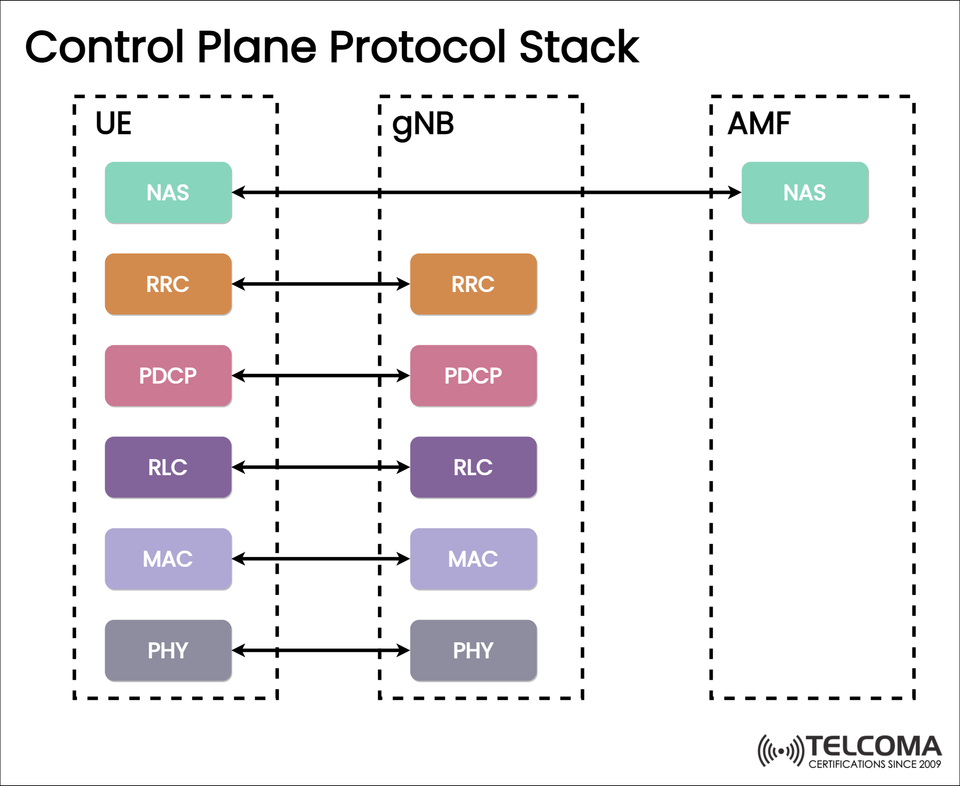
The diagram uploaded shows the 5G control plane protocol stack, highlighting the interactions between the UE (User Equipment), gNB (5G base station), and AMF (Access and Mobility Management Function).
For network engineers, understanding this protocol stack is key since it lays the groundwork for effective signaling, session setup, and smooth mobility within the 5G framework.
Overview of the Control Plane Protocol Stack
The control plane protocol stack is made up of several layers of protocols, each with its own duties.
From the diagram, we can see the following layers:
NAS (Non-Access Stratum)
RRC (Radio Resource Control)
PDCP (Packet Data Convergence Protocol)
RLC (Radio Link Control)
MAC (Medium Access Control)
PHY (Physical Layer)
Let’s break down what each of these does in the control plane of 5G.
Control Plane Entities
- User Equipment (UE)
This is the end-user device—like a smartphone, IoT gadget, or AR/VR headset—that kicks off signaling and data transfer. It communicates with the gNB through a radio interface using control plane protocols.
- gNB (Next Generation Node B)
The 5G base station serves as the link between the UE and the 5G Core. It processes control messages, manages radio resources, and ensures that mobility is uninterrupted.
- AMF (Access and Mobility Management Function)
This component of the 5G Core takes care of:
Authentication and security
o Mobility management
o Registration and connection handling
o Terminating NAS signaling
Control Plane Protocol Layers and Their Functions
- NAS (Non-Access Stratum)
Location: This runs between the UE and AMF, going around the gNB.
Function: It’s in charge of high-level signaling related to:
Registration * Authentication * Mobility management * Session management signaling
NAS functions independently from the radio technology in use, allowing smooth operations across LTE, 5G, and Wi-Fi.
- RRC (Radio Resource Control)
Location: This layer is found between the UE and gNB.
Function:
It establishes and maintains RRC connections. * It manages radio bearers. * It broadcasts system information. * It aids in mobility (for handover decisions).
Importance: RRC serves as the control channel manager, making sure the radio spectrum is used effectively and managing the states of the UE (Idle, Connected, Inactive).
- PDCP (Packet Data Convergence Protocol)
Location: Present in both the UE and gNB.
Functions in Control Plane:
It provides security by encrypting and protecting RRC/NAS messages. * It compresses headers for more efficient signaling transfer.
Note: In the control plane, PDCP mainly focuses on securing RRC signaling.
- RLC (Radio Link Control)
Location: This is between the UE and gNB.
Function: It ensures that signaling messages are reliably delivered by employing:
Segmentation and reassembly of packets. * Error correction through Automatic Repeat Request (ARQ). * In-sequence delivery of control messages.
- MAC (Medium Access Control)
Location: Between UE and gNB.
Function:
It multiplexes control data from RLC into transport blocks. * It schedules resources for control messages. * It handles Hybrid Automatic Repeat Request (HARQ) for retransmissions.
Key Role: It ensures radio resource allocation is effective for signaling traffic.
- PHY (Physical Layer)
Location: This is the lowest layer between the UE and gNB.
Function:
It transmits signaling bits over the air using OFDM. * It deals with coding, modulation, and error detection.
Importance: It provides the physical radio channel for control signaling.
How the Control Plane Protocol Stack Works in 5G
The communication process follows a structured flow of signaling:
UE starts the connection → NAS signaling begins from the UE to the AMF, passing through the gNB.
RRC layer manages radio link setup between the UE and gNB.
PDCP secures messages through encryption and integrity checks.
RLC and MAC ensure reliable delivery through retransmissions and scheduling.
PHY transmits control bits over radio waves.
AMF processes NAS signaling for registration, authentication, and mobility.
This layered design guarantees strong, secure, and reliable signaling, even in fast-moving environments like urban 5G setups.
Comparison: Control Plane vs User Plane in 5G
Feature Control Plane User Plane Purpose Signaling, session, and mobility management User data transfer (internet, video)Key Protocols NAS, RRC, PDCP, RLC, MAC, PHYSDAP, PDCP, RLC, MAC, PHY Endpoints UE ↔ gNB ↔ AMFUE ↔ gNB ↔ UPF Latency Sensitivity Moderate Very high (e.g., AR/VR, gaming)Traffic Volume Low High
Real-World Importance of the Control Plane
The control plane protocol stack is vital for enabling:
Seamless Mobility: Ensures users can move between cells without losing connections.
Secure Authentication: Safeguards user identity and signaling data.
Network Slicing: Allows dynamic allocation of control signaling for various services.
IoT Device Management: Optimizes lightweight signaling for a vast number of IoT devices.
Challenges in Control Plane Protocol Management
Despite being essential, the control plane brings some challenges:
Signaling Overhead: Excessive signaling can happen in dense IoT settings.
Security Vulnerabilities: It’s a potential target for DoS attacks on NAS or RRC layers.
Handover Signaling Delays: In fast-moving situations (like trains), there can be latency.
Energy Consumption: Frequent signaling can drain UE batteries.
Future Evolution of the Control Plane in 5G and Beyond
As networks transition toward 5G Advanced and 6G, the control plane is set to evolve with:
AI-driven signaling optimization to cut down on overhead.
Lightweight protocols for a massive IoT.
Better security frameworks for authentication.
Seamless multi-access integration (5G, Wi-Fi 7, satellite).
Conclusion
The control plane protocol stack in 5G networks is crucial for managing signaling and mobility. As the diagram shows, layers like NAS, RRC, PDCP, RLC, MAC, and PHY collaborate across the UE, gNB, and AMF to guarantee reliable communication, authentication, and smooth mobility.
By grasping how each layer operates, telecom professionals can design, optimize, and secure 5G networks that meet the tough demands of today’s applications. As 5G continues to grow worldwide, understanding the control plane protocol stack will be essential for creating efficient, secure, and future-ready networks.