
5G Core Isolation: Understanding AMF, SMF, and UPF Separation for Reliable Networks

Introduction: The Importance of Isolation in 5G Core
As 5G becomes essential for digital transformation, its core network architecture is crucial for both performance and reliability. Unlike earlier generations, the 5G Core (5GC) is service-based and virtualized, which means network functions can be spread out, scaled, and optimized on their own.
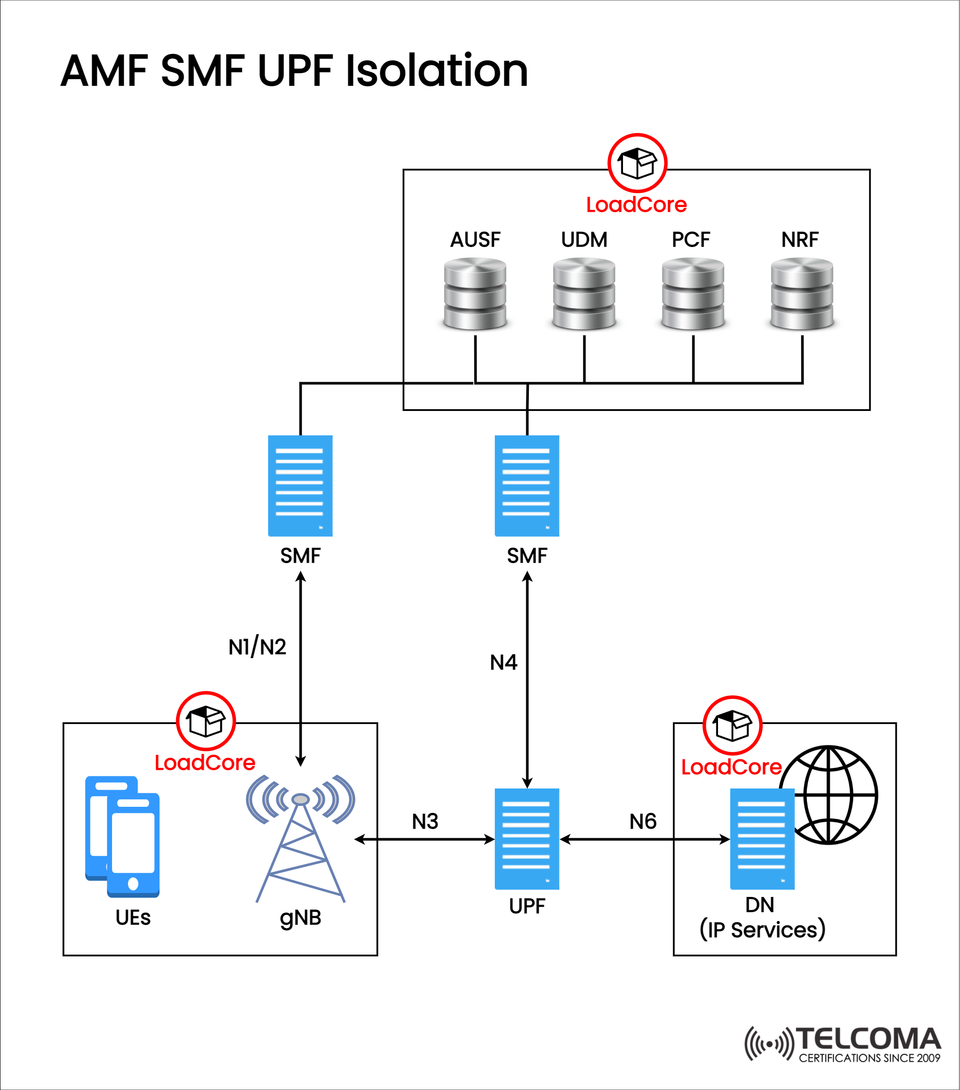
A major concept in this setup is the isolation of AMF (Access and Mobility Management Function), SMF (Session Management Function), and UPF (User Plane Function). The diagram included shows how these components are separated, demonstrating that isolation allows for greater flexibility, security, and efficiency.
For those in the telecom industry, getting a grip on this architecture is vital for designing, deploying, and troubleshooting 5G networks. Let’s dive into each component and look at why AMF-SMF-UPF isolation is so important.
- Overview of AMF, SMF, and UPF in 5G Core
Access and Mobility Management Function (AMF)
Manages registration, connection, and mobility for UEs (user equipment).
Handles signaling messages (N1/N2 interface) among UEs, gNB (base station), and the core.
Passes session-related tasks to SMF.
Session Management Function (SMF)
Takes care of session creation, modification, and termination.
Assigns IP addresses to UEs.
Oversees the UPF through the N4 interface.
Enforces QoS policies and manages data paths.
User Plane Function (UPF)
Handles the actual user data packets.
Anchors mobility by directing traffic to and from the data network (DN).
Offers traffic steering, packet inspection, and policy enforcement.
Together, these three functions are the core of 5G’s separation between control and user planes, marking a significant improvement over the 4G EPC (Evolved Packet Core).
Why Isolation Matters
In traditional mobile networks, the control and user planes were closely linked, which restricted flexibility.
With 5G, the separation of AMF, SMF, and UPF allows each function to:
Scale independently: For heavy data services, you can boost UPF capacity without affecting AMF or SMF.
Improve security: If one function is compromised, the others can stay safe.
Support distributed deployments: You can position UPFs closer to the edge to reduce latency while keeping AMF/SMF centralized.
Make troubleshooting easier: Defined boundaries allow for quick fault isolation.
Breaking Down the Diagram: AMF-SMF-UPF Isolation
The included diagram illustrates how these functions work together:
UEs and gNB (Radio Access Network): * Connect to the core using N1/N2 interfaces with AMF and SMF. * Manage mobility and signaling before transferring data sessions to the SMF.
SMF (Control Layer): * Links with UPF using the N4 interface. * Interacts with other core functions like AUSF (Authentication Server Function), UDM (Unified Data Management), PCF (Policy Control Function), and NRF (Network Repository Function).
UPF (User Plane): * Links to gNB through N3 and connects to the data network (DN) through N6. * Manages the real data path for internet or enterprise applications.
Data Network (DN): * Offers IP services, external internet access, or specific enterprise services.
The diagram also includes Load Core elements, which represent testing solutions used to simulate traffic and ensure network functions perform correctly in a separate environment.
Advantages of AMF-SMF-UPF Isolation
a) Performance and Scalability
High throughput applications (like eMBB or video streaming) need significant UPF scaling.
By isolating UPF, operators can add more user plane resources without increasing AMF/SMF workload.
b) Security and Fault Tolerance
If the UPF faces issues (like malicious traffic), it won’t directly affect AMF or SMF.
AMF signaling can continue independently, minimizing service disruption.
c) Edge Computing Enablement
UPFs can be situated closer to users at the network edge, which is crucial for latency-sensitive applications like AR/VR or autonomous vehicles.
Meanwhile, AMF and SMF can stay centralized for efficiency.
d) Simplified Testing and Validation
Tools like LoadCore can independently validate each isolated component.
This modular testing approach helps reduce risks ahead of deployment.
- Exploring Interfaces
InterfaceConnectsRoleN1/N2UE/gNB ↔ AMF/SMF Signaling and mobility managementN3gNB ↔ UPF User plane data trafficN4SMF ↔ UPF Control of user plane functionsN6UPF ↔ DN External data services (Internet/Enterprise)
These interfaces help maintain clear boundaries and modularity—key for ensuring interoperability and flexibility.
- Real-World Applications of AMF-SMF-UPF Isolation
Enhanced Mobile Broadband (eMBB)
Heavy video streaming can be offloaded to local UPFs near content servers.
AMF/SMF don’t get impacted by the scaling needs for bandwidth.
Ultra-Reliable Low-Latency Communication (URLLC)
For industrial automation, UPFs must be set up close to the edge.
AMF's mobility management can remain centralized for smooth device handovers.
Massive Machine-Type Communications (mMTC)
Millions of IoT devices can connect through lightweight UPFs optimized for low data rates.
AMF can manage signaling separately.
Challenges of Implementing Isolation
Even though isolation has its benefits, operators do face some hurdles:
Complex orchestration: Running multiple independent functions requires advanced MANO (Management and Orchestration) tools.
Higher signaling load: More interfaces can lead to increased signaling overhead if not optimized.
Vendor interoperability: Different vendors might implement functions in various ways, demanding careful integration.
Testing requirements: Isolated components need validation on both individual and end-to-end levels.
- Testing and Validation with LoadCore
The diagram refers to LoadCore, a tool for testing 5G Core functions.
Simulates UEs and traffic for assessing AMF, SMF, and UPF behavior.
Validates isolation scenarios by mimicking separation of control and data planes.
Ensures compliance with 3GPP standards for interfaces like N1, N2, N3, N4, and N6.
Supports scaling tests, ensuring functions can manage high loads on their own.
This gives operators confidence to deploy 5GC with the right isolation setup in real-world conditions.
Future Outlook: Steps Toward Fully Autonomous Networks
As 5G networks continue to evolve, isolation will be vital for:
Network slicing: Creating dedicated AMF/SMF/UPF instances for various applications like eMBB, URLLC, and mMTC.
Preparing for 6G: Developing more distributed and cloud-native architectures.
AI-driven orchestration: Automating scaling and fault recovery across independent functions.
Conclusion
The isolation of AMF, SMF, and UPF in the 5G Core marks a major shift in telecom infrastructure. By separating control and user plane functions, operators gain scalability, reliability, and flexibility, allowing networks to handle a wide range of applications—from IoT devices to immersive VR experiences.
For telecom professionals, mastering these functions is essential. For enterprises, the benefits of isolation provide assurance of reliable, low-latency, and secure connections.
As 5G continues to mature and shift towards autonomous, AI-driven networks, the AMF-SMF-UPF isolation will remain a key component of effective and robust telecom infrastructure.