
5G Core Network Architecture Explained: Functions, Interfaces, and Security
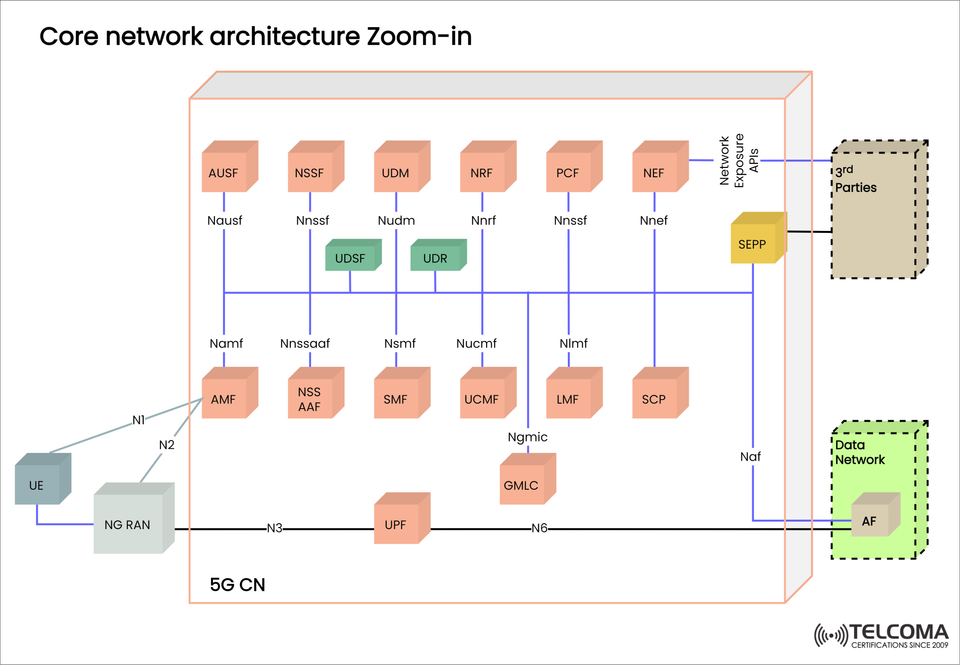

The 5G Core Network (5GC) is really the backbone of the entire 5G setup, enabling super-fast, dependable, and smart communication. Unlike older generations, the 5GC is cloud-native, service-oriented, and virtualized, which means it can adapt better to a variety of applications like self-driving cars, smart cities, IoT, and essential services.
In the accompanying diagram, we take a closer look at the Core Network (CN) architecture, highlighting its network functions (NFs), interfaces, and supporting elements. In this article, we'll break down what each component does, explain how they connect, and show how the 5GC enhances flexibility, scalability, and security for modern telecommunications.
What Makes 5G Core Network Architecture Unique
The 5GC is constructed using a Service-Based Architecture (SBA) instead of the traditional point-to-point designs of previous generations.
Here are some of the key advantages:
Cloud-native deployment with containerized microservices.
Network slicing, which allows multiple services to run on the same infrastructure.
API-driven interfaces for easy integration with third-party services.
Dynamic scalability to handle spikes in traffic and the growing number of IoT devices.
This kind of flexibility enables telecom providers to cater to enhanced mobile broadband (eMBB), ultra-reliable low-latency communication (URLLC), and massive machine-type communication (mMTC) all at once.
Components and Functions of 5G Core Network Architecture
The architecture is made up of several key functions, each with its own role to play.
- User Equipment (UE) and NG-RAN
UE (User Equipment): This includes devices like smartphones, IoT sensors, or modules in self-driving cars.
NG-RAN (Next Generation Radio Access Network): This provides the wireless link between the UE and the 5GC, featuring gNBs (gNodeBs) that manage radio communications.
Interfaces:
N1: Connects UE to AMF for signaling.
N2: Links NG-RAN to AMF.
N3: Connects NG-RAN to UPF for user-plane data.
- Access and Mobility Management Function (AMF)
Handles user registration, mobility management, and setting up connections.
Provides authentication support through communication with AUSF.
Manages session contexts, ensuring smooth transitions between cells.
The AMF serves as the initial gateway between the UE and the 5GC, facilitating secure control-plane communication.
- Session Management Function (SMF)
Responsible for setting up, modifying, and releasing sessions.
Assigns IP addresses to users.
Controls and configures the User Plane Function (UPF) for data flow.
The SMF ensures efficient management of user sessions across various slices and applications.
- User Plane Function (UPF)
Acts as the data forwarding engine within the 5GC.
Routes data packets between the UE and external networks.
Supports traffic steering, quality of service (QoS) management, and edge computing.
Interface:
N6 connects UPF to outside data networks.
Authentication and Security Functions
AUSF (Authentication Server Function): Manages user authentication requests.
UDM (Unified Data Management): Holds subscription data.
ARPF (within UDM): Generates authentication vectors.
UDR (Unified Data Repository): Keeps user profiles and policies.
UDSF (Unstructured Data Storage Function): Supports the storage of dynamic, application-specific data.
Together, these functions ensure secure authentication, authorization, and data integrity.
Policy and Control Functions
PCF (Policy Control Function): Sets rules for QoS, billing, and access permissions.
NSSF (Network Slice Selection Function): Assigns users to the right network slices based on what services they need.
NEF (Network Exposure Function): Provides secure APIs for third-party integration.
This group ensures that policy enforcement and slicing decisions meet user needs and operator goals.
Supporting Functions
NRF (Network Repository Function): A directory of available NFs, detailing their capabilities and status.
SCP (Service Communication Proxy): Guarantees reliable communication among NFs, including retries and overload management.
LMF (Location Management Function): Delivers location services, which are vital for emergency situations and IoT applications.
UCMS/UCNF (Unified Communication Management Function): Aids in configuration and network management.
GMLC (Gateway Mobile Location Center): Provides location info for services that rely on geolocation.
Inter-Operator Security and APIs
SEPP (Security Edge Protection Proxy): Safeguards signaling messages exchanged between different operator networks, especially during roaming.
AF (Application Function): Connects external data networks and application servers to the 5GC.
Network Exposure APIs: Allow third parties secure access to network capabilities (for example, QoS adjustments or session information).
This setup makes 5G an open and programmable platform, fostering innovation while ensuring security.
Interface Between Purpose
N1 UE ↔ AMF Control-plane signaling
N2 NG-RAN ↔ AMF Radio signaling
N3 NG-RAN ↔ UPF User-plane traffic
N6 UPF ↔ Data Network Internet/app connectivity
Nrf All NFs ↔ NRF NF discovery and registration
Naf AF ↔ 5GC Application integration
Nnef NEF ↔ Third-party APIs Secure network exposure
How Core Network Architecture Supports 5G Applications
Self-Driving Cars: Needs low-latency communication using UPF and SMF.
Smart Cities: Manages a lot of IoT connections through AMF and NSSF.
Healthcare & AR/VR: Uses policy-driven QoS managed by PCF.
Enterprise Services: Network slicing handled by NSSF, ensuring security.
By combining flexibility, programmability, and strong authentication, the 5GC supports various industries beyond just telecom.
Main Advantages of 5G Core Network Architecture
Scalability: Cloud-native deployment allows for easy scaling.
Flexibility: Capable of handling multiple services with network slicing.
Security: Comprehensive protection via AUSF, SEPP, and UDM.
Interoperability: Standardized APIs for easier third-party integration.
Resilience: Built-in redundancy and communication proxies to ensure continuous service.
Challenges of 5G Core
Even with its benefits, the 5GC comes with some complexities:
Expanded Attack Surface: APIs and third-party integrations can increase risk.
Operational Complexity: Coordinating virtualized functions requires effective automation.
Inter-Operator Trust: Keeping roaming and federation secure is crucial.
Operators will need to invest in AI-driven monitoring, automation, and compliance frameworks to tackle these issues.
Wrapping Up
The 5G Core Network Architecture signifies a major shift from older network models, providing a service-oriented, cloud-native, and secure platform for future communication.
With its network functions (like AMF, SMF, UPF, AUSF, PCF, NEF, etc.), robust interfaces, and exposure APIs, it empowers operators to deliver scalable, programmable, and ultra-reliable services.
For telecom professionals, getting a grip on the 5GC is essential for rolling out next-gen services. And for tech enthusiasts, it’s an insight into how 5G networks are built to support the industries, cities, and societies of tomorrow.
As 5G becomes more widespread, the Core Network will stay central, driving innovation while providing reliability and security in this digital age.