
5G-Enabled Vehicular Networks: Architecture, Benefits, and Future Applications

5G technology is really changing the game across various industries, and the automotive sector is reaping some of the biggest rewards. Thanks to its super low latency, high data speeds, and huge connectivity capabilities, 5G-enabled vehicular networks (V2X) are setting the stage for transportation systems that are not only smarter but also safer and more efficient.
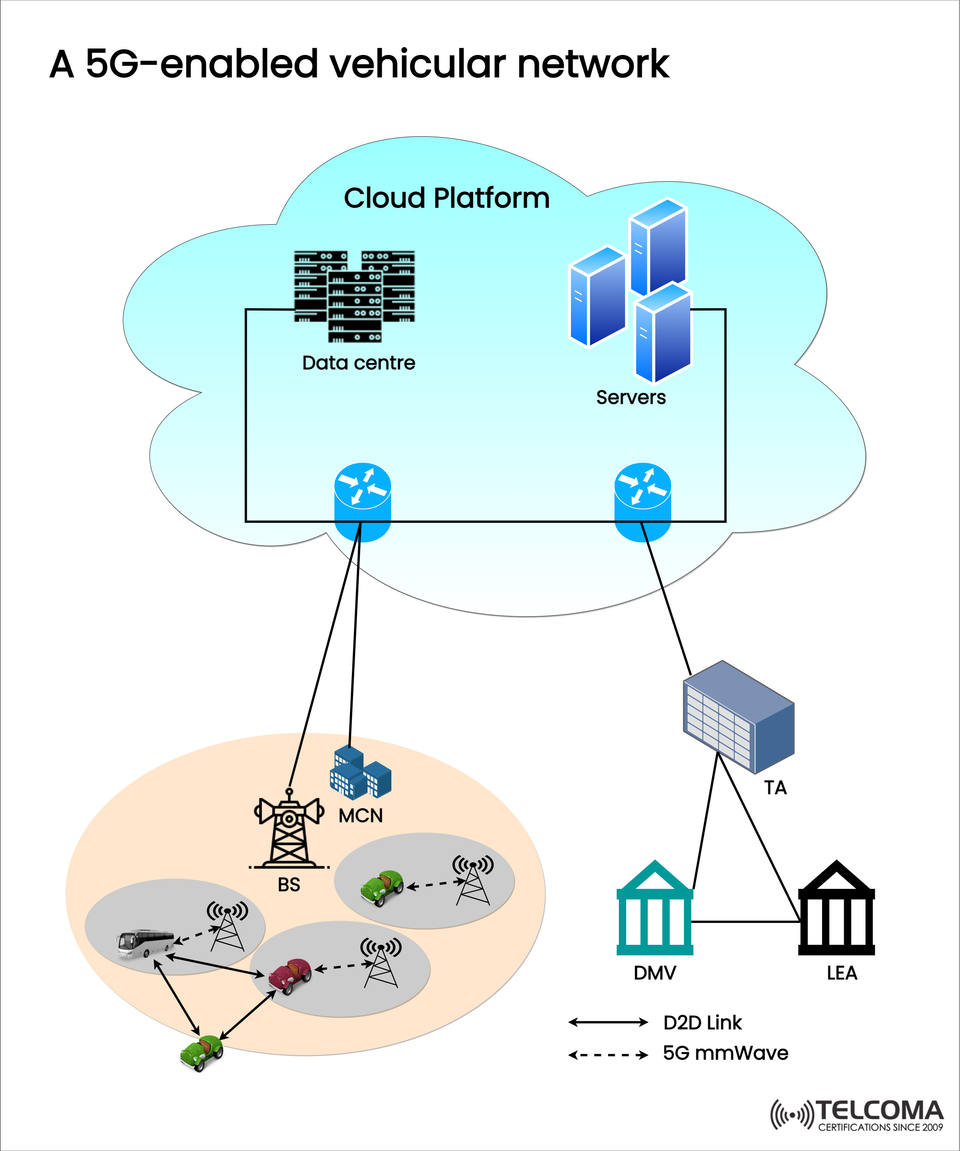
The image we've shared gives a clear picture of a 5G-enabled vehicular network setup, showing how cars, base stations, cloud services, and regulatory bodies work together to create a connected environment. In this post, we’re going to dive into the architecture, how it all works, the benefits it brings, and the challenges that come with these networks, especially for telecom pros and tech enthusiasts.
What is a 5G-Enabled Vehicular Network?
A 5G-enabled vehicular network is essentially a communication system that links vehicles, roadside infrastructure, and cloud services through high-speed 5G wireless technology. It goes beyond the usual vehicle-to-vehicle (V2V) communication, allowing for:
V2I (Vehicle-to-Infrastructure): Communicating with roadside units and base stations.
V2N (Vehicle-to-Network): Connecting to cloud services and data centers.
V2P (Vehicle-to-Pedestrian): Boosting pedestrian safety with mobile alerts.
V2X (Vehicle-to-Everything): An all-encompassing ecosystem that integrates all forms of vehicular communication.
Key Components of a 5G-Enabled Vehicular Network
The image highlights several important elements of the network architecture:
Vehicles and Roadside Units (RSUs): - Vehicles chat with each other and RSUs through device-to-device (D2D) links. - 5G mmWave technology allows for super-fast communication, even in crowded urban settings.
Base Station (BS): - This provides the cellular connectivity vehicles need. - It serves as a gateway connecting local vehicular communication to the cloud.
Mobile Communication Network (MCN): - Keeps vehicles linked to telecom infrastructure. - Handles seamless transitions as vehicles move at high speeds.
Cloud Platform: - Comprised of data centers and servers. - Manages, processes, and distributes vehicular and traffic data in real time.
Trusted Authority (TA), DMV, and LEA: - TA (Trusted Authority): Responsible for identity verification and authentication. - DMV (Department of Motor Vehicles): Keeps records of driver and vehicle registrations. - LEA (Law Enforcement Agencies): Uses vehicular data to maintain security and regulatory compliance.
Communication Technologies in 5G Vehicular Networks
The figure shows two key communication technologies:
D2D Link (Device-to-Device): - Enables direct conversations between vehicles without needing to go through a base station. - This allows for quick data sharing for collision avoidance and cooperative driving.
5G mmWave: - Operates at high frequencies to provide multi-gigabit speeds. - Perfect for dense traffic situations, like in smart cities. - But it does come with challenges like limited range and the need for a clear line of sight.
Benefits of 5G-Enabled Vehicular Networks
- Enhanced Road Safety
Provides real-time alerts on accidents, road conditions, and pedestrian crossings.
Vehicle platooning helps ensure safer, coordinated driving.
- Efficient Traffic Management
Cloud-based analytics help streamline traffic flow.
Smart routing cuts down on congestion and saves fuel.
- Ultra-Low Latency Communication
Essential for autonomous vehicles that need split-second responses.
Enables quick coordination between vehicles and infrastructure.
- Advanced Infotainment Services
Offers seamless media streaming in connected cars.
Provides high-speed internet access for passengers.
- Regulatory Compliance and Security
Collaborating with the DMV and LEA ensures data-driven enforcement of laws.
The Trusted Authority (TA) checks vehicle identities to prevent fraud.
Use Cases of 5G Vehicular Networks
Autonomous Driving: - Vehicles share sensor data in real time to drive without human input.
Emergency Vehicle Priority: - Ambulances and fire trucks can send priority signals to nearby cars and traffic lights.
Smart Parking Systems: - Cars can communicate with parking structures for real-time availability updates.
Fleet Management: - Logistics companies can monitor and manage their fleets through cloud dashboards.
Accident Reporting: - Automatic crash alerts sent to emergency services for quick reactions.
Challenges in 5G-Enabled Vehicular Networks
Even with all its potential, there are a few technical and operational hurdles to consider:
High Infrastructure Costs: Setting up 5G base stations and millimeter-wave antennas throughout cities can get pricey.
Spectrum Management: Allocating bandwidth for cars while avoiding interference is tricky.
Security Risks: It’s important to guard against jamming, spoofing, and cyberattacks.
Latency in Edge Cases: Keeping latency low in remote or rural areas is still a challenge.
Privacy Concerns: Working with the DMV and LEA necessitates strict data governance to protect user privacy.
Comparative View: Traditional Vehicular Networks vs. 5G-Enabled Networks
Feature Traditional Networks5G-Enabled NetworksLatency50–100 ms< 1 ms (ultra-low latency)Data Rate Up to 100 Mbps Up to 20 Gbps Scalability Limited device support Millions of devices per square km Communication Mostly V2I and V2VV2X (V2I, V2V, V2N, V2P, V2X)Cloud Integration Minimal Advanced real-time data processing Autonomous Driving Support Partial Full support with millisecond updates
Future Outlook
The future of intelligent transport systems (ITS) depends heavily on 5G-enabled vehicular networks. With the integration of AI, edge computing, and blockchain, the next wave of vehicle communication will:
Offer fully autonomous driving experiences.
Support vehicle-to-grid (V2G) energy exchanges in electric mobility.
Create smart city ecosystems where cars act as mobile sensors.
Telecom companies, regulators, and automakers must work together to ensure a solid, secure, and scalable network rollout.
Conclusion
The image illustrates how a 5G-enabled vehicular network links vehicles, base stations, cloud platforms, and regulatory bodies into a cohesive ecosystem. By utilizing D2D links, 5G mmWave technology, and cloud integration, these networks allow for real-time communication, safer roads, and better traffic systems.
For those in telecom, grasping this architecture is essential for building the infrastructure for future mobility. Sure, there are challenges like costs, security, and privacy, but the advantages clearly outweigh these risks.
As we transition into a hyper-connected transportation era, 5G-enabled vehicular networks will be the foundation for autonomous vehicles, smart logistics, and advanced urban mobility.