
5G Enabling Aspects Explained: Spectrum, Radio, Access, and Core Technologies

5G technology isn’t just a step up from 4G; it’s a whole new game for the telecom world. Unlike earlier versions, which mainly aimed at faster data speeds, 5G brings together a host of features across spectrum, radio, access, and core network segments to deliver an unmatched level of performance.
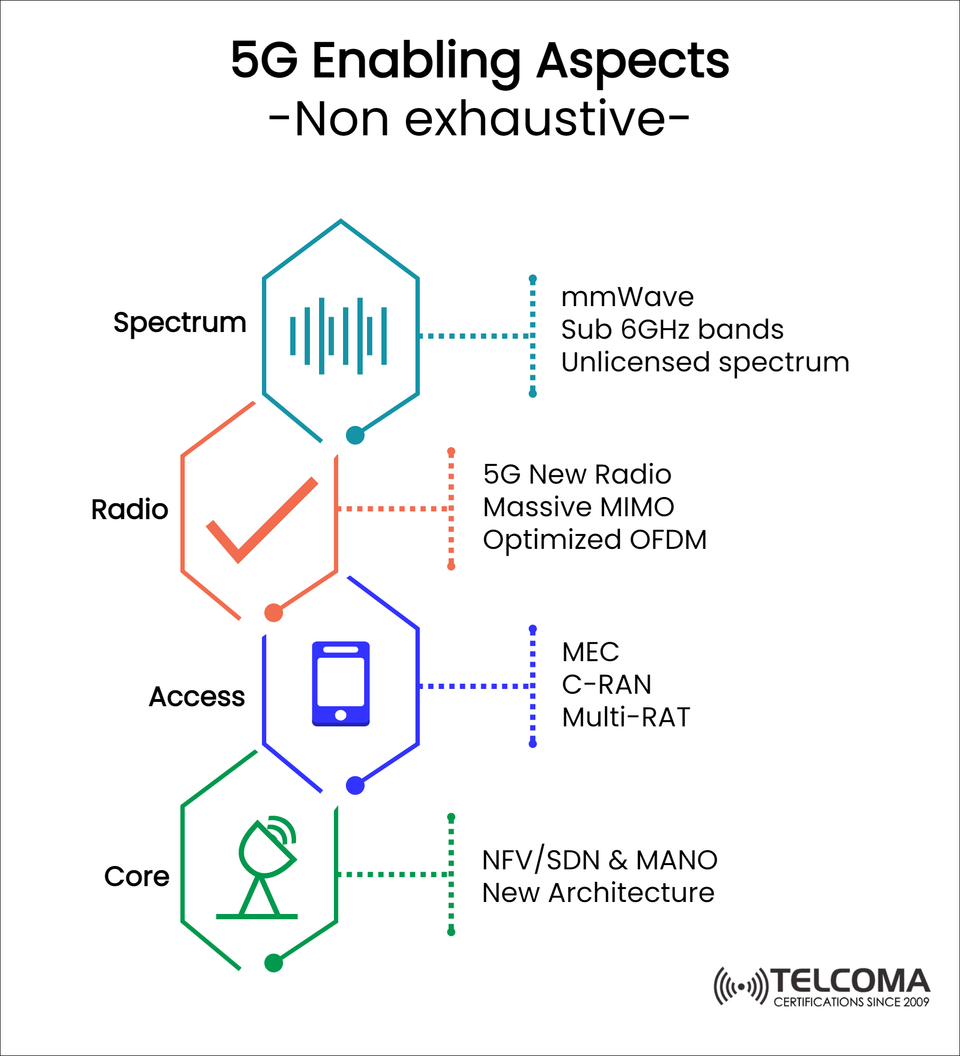
The infographic above outlines some key enabling aspects that drive 5G, such as mmWave, massive MIMO, C-RAN, MEC, NFV, and SDN. Together, these innovations allow 5G to provide ultra-low latency, massive connectivity, and high reliability for a wide range of applications—from self-driving cars to smart cities and industrial IoT.
In this blog, we’re going to dive into each of these enabling aspects, talk about why they matter, and explore how they’re shaping the 5G revolution.
- Spectrum: The Foundation of 5G
Spectrum is basically the lifeblood of any wireless communication system, and 5G makes use of a much broader range of frequency bands than its predecessors.
Key Spectrum Enablers in 5G:
mmWave (millimeter wave): Operates at super high frequencies (24 GHz and above), offering massive bandwidth and ultra-fast data rates, making it perfect for hotspots and crowded areas.
Sub-6 GHz bands: These strike a balance between coverage and capacity. While mmWave delivers speed, sub-6 GHz ensures that signals can reach through walls and other obstacles.
Unlicensed spectrum: This enables operators and businesses to establish private 5G networks tailored for sectors like manufacturing and healthcare.
By blending licensed, unlicensed, and shared spectrum, 5G manages to deliver both broad coverage and localized high performance.
- Radio: Advanced Transmission Technologies
The radio layer in 5G introduces some major innovations in how data is transmitted, enhancing efficiency and overall performance.
Key Radio Enablers in 5G:
5G New Radio (NR): A fresh global standard that supports flexible spectrum usage, scalable bandwidth, and advanced features like beamforming.
Massive MIMO (Multiple Input Multiple Output): Utilizes extensive antenna arrays to send and receive multiple data streams at the same time, increasing capacity and spectral efficiency.
Optimized OFDM (Orthogonal Frequency-Division Multiplexing): Boosts resistance to interference and allows for scalable subcarrier spacing across various frequency ranges.
These advancements ensure 5G radio networks can provide faster speeds, less interference, and more reliable connections—even in tough environments.
- Access: Smarter Connectivity Models
Access technologies shape how users and devices connect to the network. Given the rapid growth of IoT and edge applications, 5G access methods are designed to be flexible, efficient, and scalable.
Key Access Enablers in 5G:
MEC (Multi-Access Edge Computing): Moves processing closer to the user, cutting down latency and enabling real-time applications like AR, VR, and self-driving cars.
C-RAN (Centralized Radio Access Network): Centralizes baseband processing for multiple cells, which enhances network coordination and efficiency, leading to cost savings.
Multi-RAT (Radio Access Technology): Guarantees seamless integration with 4G, Wi-Fi, and other networks, ensuring uninterrupted connectivity in varied environments.
By integrating MEC, C-RAN, and Multi-RAT, 5G maintains both scalability and backward compatibility, while also setting the stage for advanced services at the network’s edge.
- Core: Virtualized and Flexible Network Backbone
The core network is where 5G really distinguishes itself from earlier generations. Rather than relying on fixed infrastructure, 5G utilizes a cloud-native, service-based architecture for more flexibility and efficiency.
Key Core Enablers in 5G:
NFV (Network Functions Virtualization): Virtualizes network functions (like firewalls and load balancers), reducing the dependence on costly hardware.
SDN (Software-Defined Networking): Offers programmable network control, enabling dynamic resource allocation and real-time traffic optimization.
MANO (Management and Orchestration): Ensures smooth orchestration of virtualized functions for effective operations.
New 5G Core Architecture: Built around a service-based model (SBA), it supports features like network slicing, allowing multiple tailored virtual networks to exist on the same physical infrastructure.
This flexible and programmable 5G core is essential for meeting the diverse needs of enhanced mobile broadband (eMBB), massive IoT (mMTC), and ultra-reliable low-latency communications (URLLC).
Comparative Overview: 5G Enabling Aspects
Domain | Enabling Aspects | Key Benefits
Spectrum | mmWave, Sub-6 GHz, Unlicensed spectrum | Wider coverage, ultra-high speed, private 5G networks
Radio | 5G NR, Massive MIMO, Optimized OFDM | Higher capacity, reliability, spectral efficiency
Access | MEC, C-RAN, Multi-RAT | Low latency, scalable connectivity, seamless integration
Core | NFV, SDN, MANO, New Architecture | Network slicing, flexibility, automation, efficiency
Why These Enabling Aspects Matter
The significance of these enabling aspects can’t be stressed enough. Each one plays a vital role in making sure 5G delivers on its promises:
mmWave and sub-6 GHz spectrum → Provide high speed and extensive coverage.
Massive MIMO and 5G NR → Ensure improved reliability and increased data throughput.
MEC and C-RAN → Offer scalability and real-time processing for applications that need low latency.
NFV and SDN → Facilitate automation, agility, and cost-effectiveness in managing complex networks.
Together, these technologies create the foundation of 5G networks, enabling applications like:
Self-driving cars that require immediate decision-making.
Smart factories that leverage connected robots for predictive maintenance.
Immersive experiences such as cloud gaming, AR, and VR.
Smart healthcare solutions, featuring remote diagnostics and robotic surgeries.
Challenges in Implementing 5G Enabling Aspects
While the 5G enabling aspects hold a lot of promise, telecom professionals are up against several challenges:
High costs for deploying mmWave infrastructure and massive MIMO antennas.
Spectrum availability and regulations that differ from region to region.
Complex integration of networks when combining 4G, Wi-Fi, and other RATs.
Security risks in virtualized systems (NFV/SDN).
Getting past these challenges will call for global collaboration, standardization, and innovation.
Conclusion
The success of 5G hinges on the collaboration of several enabling aspects—spectrum expansion, advanced radio technologies, smarter access methods, and a flexible, virtualized core. These innovations empower 5G to deliver super-fast speeds, ultra-low latency, massive device connectivity, and solid reliability.
For telecom experts, grasping these enabling aspects is crucial for designing, deploying, and optimizing the next wave of networks. For tech lovers, they offer a sneak peek into how 5G will change industries, cities, and daily life.
As we continue to dive deeper into the 5G era, these enabling aspects will keep evolving, laying the groundwork for 6G and beyond.