
5G Enhanced Overall System Architecture Explained

The shift to 5G networks is a game changer for telecom infrastructure—how it’s designed, rolled out, and managed. 5G isn’t just about faster speeds; it brings in low latency, massive IoT connectivity, network slicing, and edge computing.
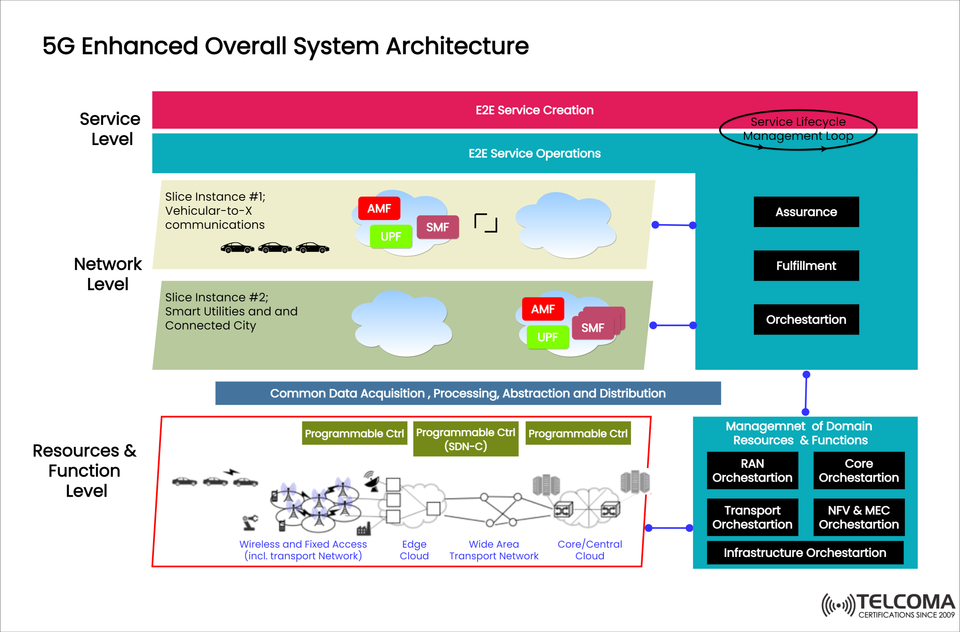
To harness these features, operators need to embrace a flexible, programmable, and automated system architecture. The 5G Enhanced Overall System Architecture, as shown in the diagram, offers a clear framework that integrates service creation, network slicing, orchestration, and programmable control across different areas.
In this post, we’ll break down the architecture layer by layer, explain what each part does, and see how it supports end-to-end (E2E) service delivery for various 5G applications.
Overview of 5G Enhanced Overall System Architecture
The architecture is structured into three main levels:
Service Level – Focuses on E2E service creation, operations, and lifecycle management.
Network Level – Works on implementing service instances using network slicing.
Resources & Function Level – This is where the programmable infrastructure sits, including RAN, edge cloud, transport, and core networks.
These layers are linked through common data acquisition, processing, abstraction, and distribution, which makes sure that resources, orchestration, and services can communicate effectively.
- Service Level: E2E Service Creation and Operations
At the top of the architecture is the service layer, which centers on E2E service creation and service operations.
E2E Service Creation: Telecom providers can quickly design and launch new services using automation and programmability. This includes options for consumers (think AR/VR streaming, gaming) and businesses (like smart factories and private 5G).
E2E Service Operations: Services are continuously monitored, optimized, and managed throughout their lifecycle. Here, the Service Lifecycle Management Loop plays a crucial role in ensuring ongoing improvements through feedback.
Core functions at this level include:
Orchestration – Automating how services are deployed across various domains.
Fulfillment – Making sure resources are allocated properly.
Assurance – Keeping an eye on and guaranteeing QoS, latency, and reliability.
Example: For instance, a network slice for Vehicular-to-X (V2X) communication can be created and managed at this level, assuring ultra-low latency for autonomous driving.
- Network Level: Network Slicing in Action
The network level turns service requirements into actual slice instances. Each slice is a logically separated, end-to-end segment of the network, built for specific applications.
Example Slice Instances in the Diagram:
Slice Instance #1 – Vehicular-to-X Communications
Designed for connected and autonomous vehicles.
Needs ultra-low latency and high reliability.
Uses elements like AMF (Access and Mobility Management Function), SMF (Session Management Function), and UPF (User Plane Function).
Slice Instance #2 – Smart Utilities and Connected City
Tailored for IoT-driven applications like smart grids, sensors, and surveillance.
Requires scalability and efficient management of a lot of IoT devices.
Uses the same core functions (AMF, SMF, UPF) but set up differently.
Key takeaway:
You have the same physical infrastructure, but with different logical slices optimized for various needs.
This allows for multi-service delivery without needing separate physical networks.
- Resources & Function Level: Programmable Infrastructure
At the bottom, we have the Resources & Function Level, which provides the actual infrastructure. This layer supports programmability, letting controllers and orchestrators dynamically allocate resources.
Components at this level:
Wireless and Fixed Access (incl. Transport Network) – The RAN, incorporating 5G NR and transport links.
Edge Cloud – Offers local compute and storage solutions for applications that are sensitive to latency.
Wide Area Transport Network – This connects RAN, edge, and core networks.
Core/Central Cloud – Manages centralized functions like subscriber management and global service orchestration.
Programmable Controllers (SDN-C and Others)
Controllers ensure that each domain is managed on the fly:
Programmable Ctrl (RAN/Edge/Core) – Software-defined networking (SDN) controllers manage traffic flow and policies dynamically.
Programmable Ctrl (SDN-C) – Specifically for transport networks, allowing for traffic engineering and QoS guarantees.
This programmability is critical for data plane flexibility, letting telecom operators change network configurations as needed.
Orchestration Across Domains
A vital part of this architecture is managing domain resources and functions through orchestration.
Types of Orchestration in 5G Enhanced Architecture:
RAN Orchestration – Manages radio access resources.
Core Orchestration – Takes care of core network functions like AMF, SMF, and UPF.
Transport Orchestration – Looks after wide-area transport links for connectivity.
NFV & MEC Orchestration – Handles network function virtualization and edge computing resources.
Infrastructure Orchestration – Deals with both physical and virtual layers of infrastructure.
Orchestration ensures that despite being independent, each domain works cohesively within the end-to-end system.
Common Data Acquisition, Processing, and Distribution
Between the network level and the resource level, the architecture integrates a common data acquisition and processing layer.
This acts as a data fabric, which:
Collects telemetry and performance metrics from various domains.
Simplifies complexity to give orchestrators unified insights.
Distributes relevant data to assurance, orchestration, and lifecycle management systems.
This part is crucial for AI-driven analytics, enabling closed-loop automation so the network can self-optimally adjust based on real-time conditions.
Benefits of 5G Enhanced Overall System Architecture
Adopting this architecture offers several benefits:
- End-to-End Service Automation
Automated service creation and lifecycle management.
Quicker time-to-market for new services.
- Network Slicing for Diverse Use Cases
Tailored slices for automotive, smart cities, healthcare, etc.
Isolation guarantees that one service’s traffic won’t affect another.
- Programmable Infrastructure
SDN controllers allow for real-time adjustments.
Operators can dynamically manage bandwidth, latency, and compute resources.
- Scalability and Agility
Elastic infrastructure that adjusts to demand.
Perfect for significant IoT deployments.
- Assurance and Reliability
Continuous monitoring ensures SLA compliance.
Self-healing and adaptive networks boost uptime.
Comparison: Traditional 4G vs 5G Enhanced Architecture
Feature4G Networks5G Enhanced Architecture Service Creation Static, time-consuming Automated, dynamic Network Slicing Limited End-to-end, multi-slice Orchestration Manual, domain-specific Automated, multi-domain Infrastructure Rigid Programmable & elastic Latency Tens of msSub-1 ms for URL LC IoT Support Moderate Massive IoT scalability
Real-World Applications
Autonomous Vehicles (V2X)
Low-latency slices ensure safe vehicle-to-vehicle communication.
Smart Cities
Supports utilities, surveillance, and connected sensors.
Industry 4.0
Private 5G slices for manufacturing plants.
Healthcare
Remote surgeries with guaranteed QoS.
Immersive Media
AR/VR experiences powered by edge computing.
Conclusion
The 5G Enhanced Overall System Architecture serves as a roadmap for delivering next-gen telecom services. By blending E2E service automation, network slicing, programmable infrastructure, and multi-domain orchestration, it helps operators meet the varied needs of industries and consumers alike.
From autonomous vehicles and smart cities to Industry 4.0 and healthcare, this framework promises scalability, flexibility, and reliability. It’s not just an upgrade from 4G; it’s a complete reimagining of how networks are structured, function, and generate revenue.
As we gear up for 6G and beyond, the tenets of programmability, automation, and orchestration outlined in this architecture will remain essential for future connectivity.