
5G Evolution Explained: Key 3GPP Releases (Rel-15, Rel-16, Rel-17)
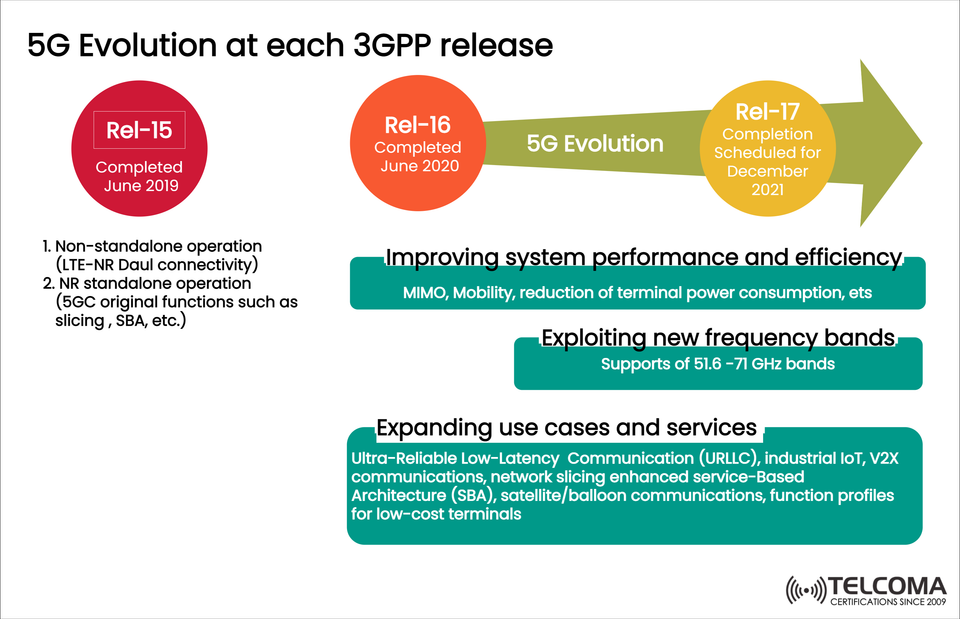

The Evolution of 5G Through 3GPP Releases: Rel-15, Rel-16, and Rel-17
5G, or the fifth generation of mobile networks, is shaping up to be much more than just faster internet on our smartphones. It’s a groundbreaking development in telecommunications that offers super-fast data speeds, minimal latency, and the ability to connect billions of devices all at once. The driving force behind this change is the 3rd Generation Partnership Project (3GPP), the global standards organization that defines and advances 5G technology through various release phases.
In this blog, we’ll explore 3GPP Releases 15, 16, and 17, highlighting how each phase has pushed the limits of mobile communications and paved the way for the future of connectivity.
3GPP Release 15: The Beginning of 5G (Completed June 2019)
Release 15 kicked off the 5G era, laying a solid foundation for both non-standalone and standalone 5G operations:
Non-standalone (NSA) operation:
This setup used LTE-NR dual connectivity, allowing 5G to work alongside 4G LTE.
This approach helped operators roll out 5G more quickly by building on existing LTE networks.
Standalone (SA) operation:
Introduced the 5G Core (5GC), bringing in new features like network slicing and Service-Based Architecture (SBA).
This meant 5G could be deployed independently of LTE.
Key Highlights of Rel-15:
Established the first global standard for 5G networks.
Facilitated quicker adoption with NSA.
Gave birth to crucial features like slicing, setting up industry-specific use cases.
3GPP Release 16: Boosting 5G Performance (Completed June 2020)
Release 16 built on what Rel-15 had started, with a strong emphasis on performance, efficiency, and extending the range of 5G.
Enhancing System Performance and Efficiency
Improved MIMO (Multiple Input, Multiple Output) for better data throughput.
Enhanced mobility management for uninterrupted connectivity.
Reduced terminal power consumption, leading to longer battery life for devices.
Tapping Into New Frequency Bands
Added support for the 51.6–71 GHz bands, unlocking mmWave applications.
These higher frequencies delivered faster speeds but also came with their own coverage challenges that needed addressing.
Broadening Use Cases and Services
Ultra-Reliable Low-Latency Communications (URLLC): Essential for fields like autonomous vehicles, industrial IoT, and mission-critical applications.
V2X communications: Improved connectivity for smart transportation, connecting vehicles to everything around them.
Network slicing enhancements: More tailored services for various industries.
Satellite and balloon-based communications: Helped extend coverage to remote areas.
Low-cost terminal profiles: Made it easier for a wider range of markets to access 5G.
Key Highlights of Rel-16:
Boosted efficiency and scalability, leading to more global adoption.
Laid the groundwork for industrial IoT applications.
Opened up the mmWave spectrum for next-gen services.
3GPP Release 17: Broadening Horizons (Scheduled Completion: December 2021)
Release 17 further evolved 5G with a focus on scalability and a wider range of applications.
Main Areas of Focus
Performance Upgrades:
Further enhancements in mobility, MIMO, and energy efficiency.
Extended Frequency Support:
Improved backing for higher frequency bands.
Expanded Use Cases:
Broader IoT enhancements, including massive machine-type communications (mMTC).
More advanced satellite communication integration.
Better support for low-cost, power-efficient devices.
Rel-17 is designed to make 5G even more adaptable, catering to applications in sectors beyond just urban areas, such as agriculture, logistics, and aerospace.
5G Evolution Summary (Rel-15 to Rel-17)
Release Completion Date Key FeaturesRel-15June 2019NSA & SA operation, 5G Core, slicing, SBARel-16June 2020Performance improvements, 51.6–71 GHz support, URLLC, V2X, satellite/balloon communicationRel-17Dec 2021 (scheduled)Extended frequency support, advanced IoT, satellite integration, low-cost terminal profiles
Why These 3GPP Releases Matter
Each of these 3GPP releases is crucial in shaping the future of telecom:
Rel-15: Set the stage for 5G adoption.
Rel-16: Delivered on performance, efficiency, and industrial applications.
Rel-17: Increased versatility for global connectivity and emerging industries.
For those in the telecom industry, keeping up with these releases is key for planning infrastructure, using spectrum wisely, and developing future-ready applications.
Conclusion
The journey of 5G through 3GPP Releases 15, 16, and 17 highlights how international standards can drive innovation in telecommunications. From establishing essential connectivity to enhancing performance for industrial applications and venturing into new frequencies, each release has expanded the possibilities of what’s achievable.
As 5G becomes integrated across IoT, smart cities, autonomous transport, and more, the groundwork laid by these releases ensures that scalability, efficiency, and inclusivity are in place. Looking forward, upcoming releases will keep refining and expanding 5G, gearing up for 6G and beyond.
Content Focus:
A thorough breakdown of NSA operation (LTE-NR dual connectivity).
Insights on SA operation and what made the 5G Core (5GC) a major shift.
The significance of slicing, SBA, and early implementations.
Advantages for both operators and users.
A technical dive into why Release 15 was a crucial milestone.
Part 2: 3GPP Release 16 – Boosting Performance and Efficiency (Finalized June 2020)
Content Focus:
Improvements in MIMO, mobility, and energy efficiency that Release 16 offered.
Challenges and advantages of utilizing new bands (51.6–71 GHz).
An in-depth look at URLLC: why it's crucial for mission-critical services.
The expansion into V2X (vehicle-to-everything) and industrial IoT.
Integrating satellite/balloon technology and enhancing global reach.
Part 3: 3GPP Release 17 – Broadening Horizons (Expected Completion: Dec 2021)
Content Focus:
Enhancements in mobility and MIMO with Rel-17.
Support for additional frequency ranges.
Massive Machine-Type Communications (mMTC).
Satellite integration to benefit rural and global coverage.
Low-cost terminal profiles aimed at wider adoption.
Laying the groundwork for the 6G evolution.