
5G Evolution: Transition from NSA to SA with Option 4 Explained
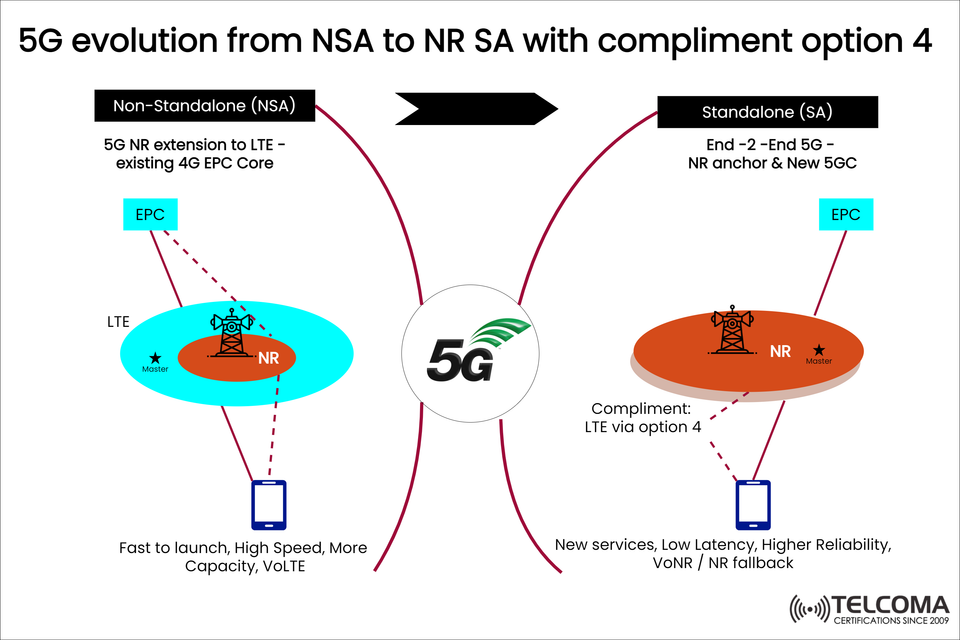

5G Transition from NSA to SA with Option 4
Moving from 4G LTE to 5G New Radio (NR) isn’t just about faster internet speeds; it’s really about reshaping mobile networks to achieve low latency, high reliability, and advanced services. The diagram included shows how 5G progresses from Non-Standalone (NSA) to Standalone (SA), with Option 4 playing a key role in facilitating a smooth transition.
In this blog, we’ll cover:
The differences between NSA and SA.
The significance of Option 4 in 5G development.
The advantages for telecom providers and users.
How VoLTE and VoNR fit into this shift.
What is Non-Standalone (NSA) in 5G?
5G Non-Standalone (NSA) was the initial commercially used 5G architecture. This model operates with:
LTE (4G) as the primary node, handling control signaling.
5G NR (New Radio) as the secondary node, enhancing data speeds.
The Evolved Packet Core (EPC) from 4G is reused, so there’s no immediate need for a complete 5G Core (5GC).
Key Features of NSA:
Quick to deploy because it uses existing LTE infrastructure.
High-speed connectivity is made possible by adding NR to LTE.
Supports VoLTE for voice, as 5G NR in NSA doesn’t natively handle voice calls.
This setup allowed operators to quickly provide 5G services without waiting for a full 5G core.
What is Standalone (SA) in 5G?
5G Standalone (SA) is the true complete 5G deployment model. Unlike NSA, SA uses:
5G NR as the main technology for both data and control.
A completely new 5G Core (5GC) based on Service-Based Architecture (SBA).
It does not rely on LTE networks at all.
Key Features of SA:
Full 5G network with NR as the main component.
Super-low latency enabling real-time applications such as autonomous driving and AR/VR.
More reliability and flexibility through network slicing.
VoNR (Voice over New Radio) support for native 5G voice calls.
SA represents the long-term goal for 5G, facilitating next-gen services far beyond what NSA can do.
The Role of Option 4 in 5G Development
The diagram highlights Option 4 as an essential part in the transition from NSA to SA. But what exactly is Option 4?
In 3GPP’s deployment options for 5G, Option 4 involves:
5G NR connected to the 5G Core (5GC) as the primary technology.
LTE functioning as a secondary node, providing extra coverage and fallback.
This is essentially the opposite of NSA (where LTE is primary and NR is secondary).
Importance of Option 4:
It lets operators deploy SA while still making use of LTE coverage.
Ensures VoNR adoption with LTE fallback in areas where NR coverage might be lacking.
Eases the transition from NSA (Option 3) to SA (Option 2).
NSA vs SA vs Option 4: A Quick Comparison
Feature NSA (Option 3)SA (Option 2)SA with Option 4 Complement Anchor Technology LTE (Master)NR (Master)NR (Master) with LTE support Core NetworkEPC5GC5GCVoice Services Vo LTE Vo NR Vo NR + LTE fallback Deployment Speed Fast Moderate Balanced Coverage Strong (LTE-based)Dependent on NR rollout Hybrid – NR-driven with LTE support Target Use Cases Enhanced Mobile Broadband (eMBB)Full 5G services (eMBB, URLLC, mMTC) Transitional deployments, rural support
Advantages of NSA Deployment
Quick Entry into the Market: Operators could market 5G quickly.
Utilizes LTE Investments: Takes advantage of existing EPC.
Boosts Data Speeds: Improves broadband capacity.
Limitation: NSA doesn’t support VoNR; it relies on VoLTE for voice calls.
Advantages of SA Deployment
Genuine 5G Experience: Ultra-low latency with complete 5G.
Accommodates New Services: Network slicing, AR/VR, and IoT on a large scale.
VoNR Native Support: No need to rely on LTE for voice.
Limitation: Requires considerable investment in 5GC and NR coverage.
Benefits of Option 4 in Transition
Smooth Transition Path: Helps bridge the gap from NSA to SA.
Enhanced Coverage: Guarantees LTE can support when NR coverage is weak.
Improved User Experience: Provides seamless fallback for both voice and data.
Flexibility for Operators: Minimizes service interruptions during early SA rollouts.
VoLTE vs VoNR During the Transition
Voice services are crucial in this transition.
In NSA, voice services depend on VoLTE.
In SA, the standard option is VoNR.
With Option 4, providers can implement VoNR with LTE fallback, ensuring reliability.
Reasons Why VoNR is Superior:
Lower latency for voice calls.
Steady quality even during peak data use.
Simplified network design due to reduced dependencies on LTE.
Operator Strategies for Transition
Telecom operators typically take these steps:
Start with NSA – a quick, cost-effective entry using EPC.
Slowly implement SA – roll out 5GC and NR as coverage expands.
Employ Option 4 as a support – ensure LTE coverage backs up early SA deployments.
Transition voice services to VoNR – move away from VoLTE as NR coverage grows.
This step-by-step approach helps mitigate risks while ensuring uninterrupted service.
Why This Transition is Important
The shift from NSA to SA with Option 4 isn’t just technical; it’s strategic:
For Operators: Balanced investments, continuity of service, and smoother transitions.
For End-Users: Reliable connectivity, better voice quality, and access to new services.
For the Industry: Speeds up the implementation of URLLC, IoT, and smart city upgrades.
Challenges in the NSA-to-SA Migration
Coverage Issues: 5G NR rollout demands dense infrastructure.
Device Compatibility: Not all smartphones currently support VoNR.
Costs: Establishing a new 5GC and reinforcing NR networks demands significant capital.
Interworking Complexity: Seamless transitions between LTE and NR must be perfected.
The Future Beyond SA
Once SA is fully operational, the opportunities are immense:
Network Slicing: Tailored slices for different industries (like healthcare or manufacturing).
Support for Massive IoT: Connectivity for billions of low-power devices.
Ultra-Reliable Low-Latency Communication (URLLC): Vital services like remote surgeries and self-driving cars.
5G Advanced & 6G Roadmap: Builds on the SA groundwork for even smarter networks.
Wrapping Up
The diagram illustrates the path of 5G evolution from NSA to SA, with Option 4 as a crucial component.
NSA (Option 3): Quick deployment anchored by LTE with VoLTE for voice.
SA (Option 2): True end-to-end 5G with VoNR.
Option 4: The bridge—ensuring LTE backup while SA develops.
For telecom operators, Option 4 offers a practical approach—utilizing existing LTE while rolling out NR and 5GC. For users, it guarantees fast, reliable connectivity with smooth transitions from VoLTE to VoNR.
In short, the NSA-to-SA migration supported by Option 4 is how 5G becomes feasible, dependable, and ready for the future.