
5G Fixed Wireless Access (FWA) Architecture: 4G Interworking and 5G Core (5GC) Integration Explained
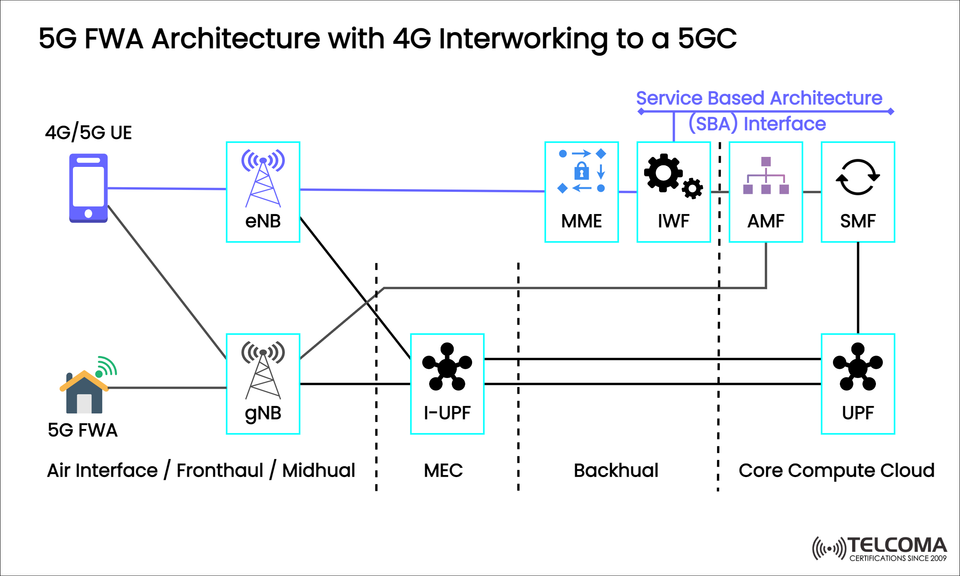

5G FWA Architecture with 4G Interworking to a 5G Core (5GC)
5G Fixed Wireless Access (FWA) is changing the game for broadband connectivity by using mobile network infrastructure to provide fiber-like speeds to homes and businesses without the hassle of laying down a ton of fiber cables. The image provided shows how 4G and 5G technologies work together within a 5G Core (5GC) framework to offer smooth, high-speed access, especially in places where wired broadband is hard to come by.
This setup mixes 4G eNB, 5G gNB, and 5GC elements, which helps ensure a seamless transition and cooperation between LTE and 5G New Radio (NR) systems.
Understanding 5G Fixed Wireless Access (FWA)
What is 5G FWA?
5G Fixed Wireless Access is all about delivering broadband services to fixed locations — think homes, offices, and even rural spots — by relying on wireless radio links instead of the usual cables. It makes use of 5G New Radio (NR) or enhanced LTE technologies, achieving gigabit-level speeds over a fixed connection that links the base station to customer premise equipment (CPE).
Why 4G Interworking Matters
While 5G is spreading fast, let's not forget that 4G LTE is still the backbone of our global mobile networks. Interworking makes it possible for existing 4G elements (like eNB and EPC components) to link up with a 5G Core (5GC), enabling a non-standalone or hybrid 5G deployment. This ensures:
A smooth transition from LTE to 5G
Ongoing service availability
Smart use of existing infrastructure.
5G FWA Architecture Components Explained
The image gives a look at the end-to-end architecture — from the air interface to the core compute cloud — illustrating how the various nodes and interfaces work together to deliver 5G FWA services.
4G/5G User Equipment (UE)
This category includes devices like:
Fixed Wireless CPEs (Customer Premise Equipment)
5G routers
Smartphones that can connect via both LTE and 5G NR.
These gadgets support both LTE (E-UTRA) and 5G NR (New Radio) interfaces for flexible access.
- eNB (Evolved Node B)
This is the 4G LTE base station that links 4G UEs to the network.
Within a hybrid 5G FWA setting, the eNB interacts with the 5G Core (5GC) via the N26 interface (through the Interworking Function).
It handles legacy control and data signaling and can direct 5G FWA data to the Intermediate User Plane Function (I-UPF).
- gNB (Next Generation Node B)
The 5G NR base station, which manages new radio interfaces and higher bandwidth communications.
Directly connects to the 5G Core using NG interfaces.
Offers low-latency, high-capacity, and enhanced mobile broadband (eMBB) features, making it perfect for FWA applications.
- I-UPF (Intermediate User Plane Function)
This is the local user plane function generally found at the edge or MEC (Multi-Access Edge Computing) site.
It routes and processes traffic closer to the user for: * Low-latency services * Reduced backhaul load * Local content delivery
In FWA scenarios:
The I-UPF helps manage traffic from the central core, sending user data to local or regional service applications.
MEC (Multi-Access Edge Computing)
MEC brings compute and storage resources close to the access layer, letting applications run near the user. For 5G FWA, MEC allows for:
Real-time analytics
Caching of popular content
Edge processing for IoT or AR/VR applications
This setup supports ultra-low latency and makes efficient use of bandwidth.
MME (Mobility Management Entity)
In 4G networks, the MME is in charge of session and mobility control. When working with 5GC:
The MME coordinates with the Interworking Function (IWF) to share session and authentication data.
It ensures seamless handover and session continuity when a 4G device moves into a 5G environment.
- IWF (Interworking Function)
The Interworking Function is a key player for 4G–5G interoperability.
Functions:
Bridges the Evolved Packet Core (EPC) and the 5G Core (5GC).
Translates signaling between the MME (4G control plane) and AMF (5G Access and Mobility Management Function).
Guarantees session continuity across technologies via the N26 interface.
This function allows older LTE users and devices to take advantage of 5G Core capabilities like better security and service orchestration.
- AMF (Access and Mobility Management Function)
Handles registration, mobility, and authentication for 5G UEs.
Receives translated signaling from the IWF for LTE-based sessions.
Part of the Service-Based Architecture (SBA) core framework.
- SMF (Session Management Function)
Oversees and manages UE data sessions, including IP allocation and session policy enforcement.
Works with the UPF (User Plane Function) for data path management.
Plays a crucial role in 5G FWA for QoS enforcement and dynamic session handling.
- UPF (User Plane Function)
The central user plane entity in the 5G Core.
Takes care of: * Packet forwarding * QoS enforcement * Traffic routing to external networks or service clouds.
In the 5G FWA setup, the UPF operates in the core compute cloud, while a distributed I-UPF looks after local breakout traffic at the network's edge.
Service-Based Architecture (SBA) Interface
The image points out the SBA interface connecting 5G Core network functions like AMF, SMF, and IWF. This service-oriented design allows:
Dynamic network function interaction through APIs
Scalable deployment of microservices
Improved orchestration and automation
SBA ensures that both 4G and 5G control-plane elements communicate effectively during hybrid operations.
Advantages of 5G FWA with 4G Interworking
Seamless Migration: Lets operators leverage existing LTE infrastructure while rolling out 5G.
Cost Efficiency: Cuts down CAPEX by extending 4G assets while gaining the benefits of 5G Core advancements.
Enhanced Coverage: Brings 5G FWA to rural or suburban areas with LTE support.
Improved Performance: Dual connectivity boosts throughput and reliability.
Low-Latency Services: MEC and I-UPF integration allow for local breakout and quick-response applications.
Future Outlook: Towards Full 5G Standalone FWA
As networks evolve toward 5G Standalone (SA):
The IWF will become redundant as all nodes shift to native 5GC connectivity.
Network slicing will enable operators to allocate virtualized resources for FWA, IoT, or enterprise customers.
AI-driven orchestration will handle session management, energy optimization, and predictive maintenance automatically.
This development promises to deliver ultra-reliable, high-speed broadband that rivals fiber connectivity — even in areas that are underserved.
Conclusion
The 5G FWA Architecture with 4G Interworking to 5GC showcases the advantages of hybrid connectivity — blending LTE’s established strengths with the innovations of the 5G Core. By utilizing components like eNB, gNB, IWF, I-UPF, and SBA interfaces, telecom operators can provide high-speed, low-latency broadband to homes and businesses today while laying the groundwork for full 5G standalone deployments.