
5G-FMC Standardization Timetable Explained: Toward Unified Wireline and Wireless Networks

As 5G keeps developing, one of its biggest hurdles is figuring out how to sync up wireless and wireline access networks. For a while now, telecom companies have treated these infrastructures separately, which has led to higher operational costs and more complex systems. To tackle these issues head-on, Fixed-Mobile Convergence (FMC) in the age of 5G aims to establish a common core network that supports both mobile and fixed access without a hitch.
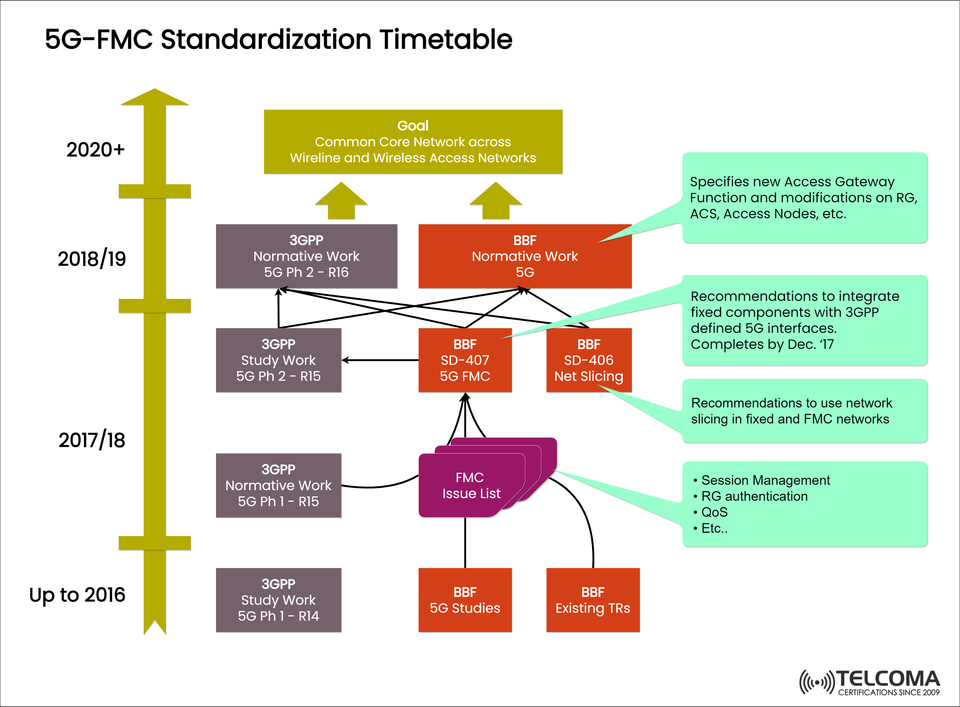
The 5G-FMC Standardization Timetable, which is pushed forward by 3GPP (3rd Generation Partnership Project) and BBF (Broadband Forum), outlines the journey from initial studies to formal regulations. This roadmap is crucial for ensuring different systems can work together, use resources efficiently, and offer advanced features like network slicing, session management, and quality of service (QoS).
The Goal of 5G-FMC Standardization
At the core of 5G-FMC is the ambition to create a common core network that bridges wireline and wireless access networks. This convergence enables operators to deliver a consistent experience for users, whether they’re connecting through fiber, DSL, Wi-Fi, or mobile 5G radio access (gNB).
Some key advantages of this unified approach include:
Reduced operational complexity with a single converged architecture.
Increased flexibility for rolling out innovative services.
Smooth user experience across various devices and access types.
Support for advanced 5G features like network slicing, authentication, and traffic prioritization.
Timeline of 5G-FMC Standardization
The path toward FMC standardization is a collaborative one, with both 3GPP and BBF working side by side to align their standards. Here’s a rundown of the timeline from early studies to full-on implementation.
Up to 2016: Early Studies
3GPP Study Work (5G Phase 1 – R14): This laid the foundation for the first 5G specs.
BBF 5G Studies & Existing TRs: Focused on the requirements for fixed broadband and how they could mesh with mobile technologies.
2017–2018: Transition to Normative Work
3GPP Normative Work (5G Phase 1 – R15): Established the core architecture of 5G, with an emphasis on mobile-first networks.
BBF SD-406 (Net Slicing): Offered guidance on how to implement network slicing in fixed and converged settings.
BBF SD-407 (5G FMC): Addressed the integration of fixed access with the 3GPP-defined 5G interfaces.
During this time, they began defining FMC issues, tackling session management, RG (Residential Gateway) authentication, and QoS.
2018–2019: Study Phase 2 and Refinement
3GPP Study Work (5G Phase 2 – R15): Looked at enhancements for scalability, reliability, and how to integrate with non-3GPP access.
BBF Recommendations: Provided feedback on aligning fixed access tech with the latest 5G specs.
2020 and Beyond: Normative Completion
3GPP Normative Work (5G Phase 2 – R16): Defined improvements for FMC, ensuring that the 5G core could smoothly manage wireline access.
BBF Normative Work on 5G: Clarified updates for Residential Gateways (RGs), Access Control Systems (ACS), and Access Nodes.
Both groups worked together to reach the goal of a united, converged core network.
FMC Issue List: Core Challenges Addressed
The FMC issue list points out the key challenges that needed standardizing for better wireline-wireless integration:
Session Management: Keeping sessions steady as users switch between different access networks.
RG Authentication: Securely verifying residential gateways when they connect to the 5G core.
Quality of Service (QoS): Ensuring reliable performance for services like video streaming and gaming that are sensitive to delays.
Mobility Support: Supporting seamless transfers between Wi-Fi, fiber, and 5G networks.
The Role of Network Slicing in 5G-FMC
One of the most game-changing aspects of 5G-FMC is network slicing. As defined in BBF SD-406, slicing lets operators set aside virtualized resources within the same physical setup.
For instance:
Enhanced Mobile Broadband (eMBB): A high-throughput slice designed for streaming and video services.
Ultra-Reliable Low-Latency Communication (URLLC): A slice tailored for industrial automation and other critical applications.
Massive IoT (mIoT): A slice aimed at connecting low-power, large-scale IoT devices.
Using network slicing across fixed and mobile domains guarantees end-to-end performance, making FMC a key player in creating smart homes, businesses, and industrial networks.
How BBF and 3GPP Collaboration Enables FMC
The success of 5G-FMC hinges on the collaboration between BBF and 3GPP:
3GPP: Outlines the 5G Core (5GC) architecture, interfaces (N1–N5), and mobility protocols.
BBF: Translates these definitions into fixed broadband settings, ensuring compatibility for gateways, access nodes, and authentication systems.
Joint Efforts: Work together to align recommendations on RG modifications, access gateway functions, and network slicing.
This partnership makes sure that fixed broadband users can access the same innovations as mobile users, leading to consistent service delivery across all types of access.
Why 5G-FMC Matters for Operators and Users
For Operators
Streamlined network management with one converged core.
Cost savings by eliminating parallel infrastructures.
Ability to offer bundled services (mobile + broadband + IoT).
For Users
Smooth connectivity across devices (like phones, laptops, smart TVs, IoT).
Consistent performance and QoS, regardless of which access network is being used.
Better security and authentication for fixed access.
Key Takeaways from the Standardization Timetable
Up to 2016: Initial study work by 3GPP and BBF.
2017/18: Normative work kicks off, focusing on FMC and network slicing.
2018/19: BBF recommendations start aligning with 3GPP study work.
2020+: Achievement of a common 5G core network for both wireline and wireless access.
Conclusion
The 5G-FMC Standardization Timetable showcases a collaborative effort by 3GPP and BBF to merge wireline and wireless access networks into a unified 5G core. This roadmap not only streamlines operations for telecom companies but also ensures that users enjoy seamless, secure, and high-quality connectivity, no matter if they’re on mobile or fixed broadband.
By bringing together features like network slicing, QoS management, and RG authentication, FMC is set to be a cornerstone in delivering next-gen connectivity for everyone, everywhere.