
5G Function Split Between Central and Distributed Units: Options, Benefits, and Challenges

Function Split Between Central and Distributed Units in 5G Networks
One of the biggest game changers in 5G network architecture is its ability to flexibly deploy various functions across the Central Unit (CU) and the Distributed Unit (DU). This is a shift from 4G LTE's more rigid eNodeB setup. Instead, 5G brings in a service-based architecture (SBA) made up of modular components.
A key part of this architecture is the function split, which outlines how the Radio Access Network (RAN) functions are divided between the CU and DU. This decision has serious implications for latency, capacity, cost efficiency, and scalability.
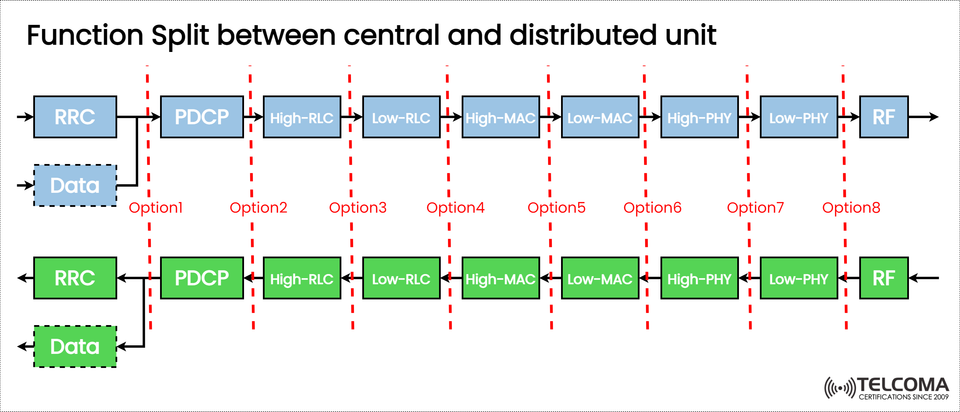
The image above provides a look at the function split options across the protocol stack, showcasing how each split (from Option 1 to Option 8) separates the RRC, PDCP, RLC, MAC, PHY, and RF functions.
In this blog, we'll break down the eight function split options, looking at their pros and cons, as well as how they apply to different 5G use cases.
Overview of CU and DU in 5G
Before we jump into the function split, let's clarify the roles:
Central Unit (CU)
Takes care of higher-layer protocol processing like RRC (Radio Resource Control) and PDCP (Packet Data Convergence Protocol).
Usually found in a centralized data center or cloud setting.
Adds control-plane intelligence and flexibility.
Distributed Unit (DU)
Handles lower-layer, real-time tasks such as RLC (Radio Link Control), MAC (Medium Access Control), and PHY (Physical Layer).
Positioned closer to cell sites to keep latency low.
Radio Unit (RU)
Manages RF (Radio Frequency) duties, linking directly with antennas.
The function split is all about figuring out how much responsibility sits with the CU versus the DU.
The Eight Function Split Options
The image presents various split points throughout the protocol stack. Here's a quick overview:
Option CU Functions DU Functions Typical Use Case
Option 1RRC, PDCP, RLC, MAC, PHYRF
Traditional RAN, closest to 4G eNodeB
Option 2RRC, PDCPRLC, MAC, PHY, RFWidely adopted split for 5G NSA/SA deployments
Option 3RRC, PDCP, High-RLCLow-RLC, MAC, PHY, RFBalanced control vs. real-time split
Option 4RRC, PDCP, RLC, High-MACLow-MAC, PHY, RFMid-level flexibility
Option 5RRC, PDCP, RLC, MACPHY, RFLow-latency applications
Option 6RRC, PDCP, RLC, MAC, High-PHYLow-PHY, RFAdvanced centralized PHY processing
Option 7RRC, PDCP, RLC, MAC, PHY (High+Low)RF
Known as "Split PHY", widely researched for fronthaul
Option 8RRC, PDCP, RLC, MAC, PHYRFBaseline model (no split at PHY)
- Key Highlights of Each Split
Option 1: Fully Centralized RAN
The CU manages all functions except for RF.
Needs extremely low-latency fronthaul.
Closest to the Cloud-RAN (C-RAN) setup.
Option 2: PDCP-RLC Split
One of the most practical splits seen in real-world deployments.
Keeps the control plane centralized, while real-time functions for the user plane are close to the cell site.
Strikes a solid balance between latency and flexibility.
Options 3 and 4: Variations of RLC and MAC Splits
Offer a middle ground.
Handy when networks require custom latency and efficiency adjustments.
Option 5: MAC-PHY Split
Keeps real-time PHY processing close to the cell site.
Helps reduce fronthaul bandwidth needs.
Perfect for low-latency services like URLLC.
Option 6: High-PHY vs Low-PHY Split
Centralizes advanced PHY tasks like channel coding and scheduling.
Moves low-PHY processing closer to the radio.
Good for optimizing massive MIMO and beamforming.
Option 7: Split-PHY
This one’s gotten a lot of attention in research for fronthaul optimization.
Balances PHY tasks between CU and DU.
Supports scalable massive MIMO in densely populated areas.
Option 8: PHY-RF Split
Keeps centralization to a minimum, with most processing happening at DU/RU.
Best suited for networks focused on coverage and simplicity.
Benefits of Function Split
Adopting CU/DU splits brings several operational and economic advantages:
Flexibility: Operators can pick a split that best fits their use case, spectrum, and latency needs.
Resource Efficiency: Centralization boosts resource pooling and utilization.
OPEX Reduction: Cloud-based CU setups lower costs thanks to virtualization and automation.
Scalability: Capable of supporting a range of 5G applications, from eMBB to URLLC and mMTC.
Multi-vendor Interoperability: Open RAN efforts take advantage of standardized splits for vendor-neutral rollouts.
Challenges of Function Split
Even though function splits enable versatility, they come with their own set of challenges:
Fronthaul Requirements: Some splits (like Option 1 and Option 7) require extremely high bandwidth and low latency.
Synchronization: Precise timing synchronization is key for lower-layer splits.
Complexity: Deploying hybrid splits across extensive networks can get complicated.
Standardization Gaps: Not every split option is fully standardized in 3GPP; operators need to align with O-RAN Alliance guidelines.
Function Split in Real 5G Deployments
In the field, Option 2 (PDCP-RLC split) has really taken off for 5G networks, mainly in:
Non-Standalone (NSA) 5G: Easy to integrate with existing LTE setups.
Standalone (SA) 5G: Allows for flexible deployment of control-plane and user-plane separation (CUPS).
O-RAN Architectures: A lot of O-RAN specifications are based on Option 2 and Option 7 splits.
On the other hand, Option 7 (Split PHY) is being looked into for massive MIMO deployments, while Option 6 is appealing for low-latency URLLC applications.
Future Outlook
With 6G research already in the works, function splits are poised to get even more dynamic, using AI/ML for real-time optimization. We might see adaptive splitting, where CU/DU roles shift depending on traffic load, user mobility, and QoS requirements.
Conclusion
The function split between central and distributed units is a key component of 5G’s flexible architecture. By presenting eight split options, 5G allows operators to balance latency, cost, and performance based on their deployment needs.
Option 2 (PDCP-RLC split) has emerged as the most widely used in real deployments.
Option 7 (Split-PHY) shows promise for advanced MIMO and fronthaul optimization.
Other splits offer unique trade-offs for specific use cases.