
5G Global Unique Temporary Identifier (GUTI) Explained: Structure and Role in 5G

Safeguarding Identities in 5G
As mobile networks evolve, ensuring user privacy and effective mobility management is more important than ever. Unlike older systems, 5G comes with a stronger mechanism for protecting identities by using temporary identifiers instead of fixed ones during signaling processes.
At the core of this system is the 5G Global Unique Temporary Identifier (GUTI), which is an 80-bit identifier designed to keep subscriber identities hidden while allowing for smooth movement throughout the 5G core network.
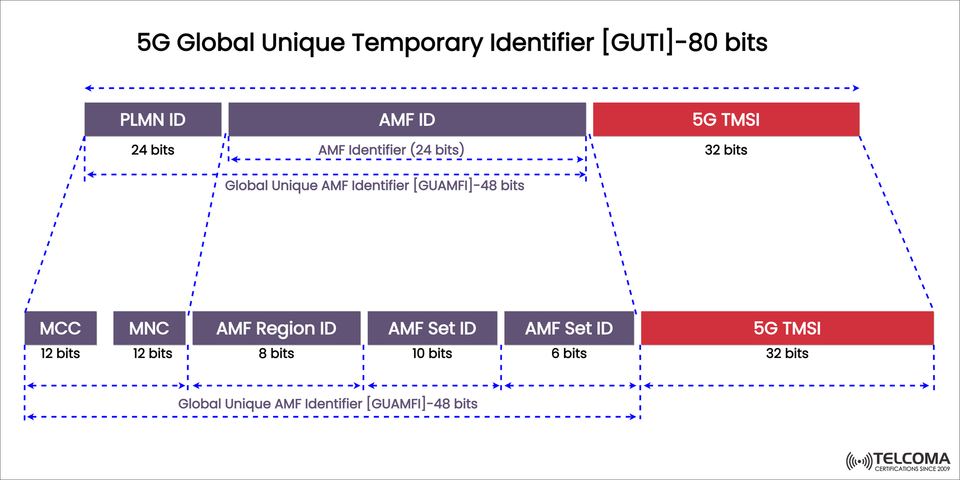
The diagram included gives a visual breakdown of how the GUTI is structured and its bit allocation. Let’s dive into the details.
What Exactly is GUTI in 5G?
The Global Unique Temporary Identifier (GUTI) is a temporary identifier that the Access and Mobility Management Function (AMF) assigns to users within the 5G Core.
It takes the place of the permanent SUPI (Subscription Permanent Identifier), helping to maintain the confidentiality of sensitive subscriber information.
It’s employed in signaling messages to protect subscriber privacy while ensuring continuous session management.
The GUTI is periodically reallocated to boost security.
In simpler terms: SUPI is confidential, while GUTI is both temporary and secure.
Structure of the 5G GUTI (80 bits)
The 5G GUTI comprises two main components:
GUAMFI (Global Unique AMF Identifier) – 48 bits
5G-TMSI (Temporary Mobile Subscriber Identity) – 32 bits
- GUAMFI (48 bits)
The Global Unique AMF Identifier points to the specific AMF responsible for the user. It includes:
PLMN ID (24 bits) * MCC (12 bits): Mobile Country Code * MNC (12 bits): Mobile Network Code * Together, these identify the operator’s network uniquely.
AMF ID (24 bits) * AMF Region ID (8 bits): Identifies the AMF's geographical area. * AMF Set ID (10 bits): Groups AMFs within the area. * AMF Pointer/Set ID (6 bits): Directs to a specific instance of an AMF.
With this setup, every AMF entity within a PLMN can be distinctly identified across the globe.
- 5G-TMSI (32 bits)
This is assigned by the AMF.
Acts as a temporary identifier for user signaling.
It changes regularly to thwart tracking attempts.
Breakdown of GUTI Components
Component Bit LengthPurposeMCC12 bits Identifies the countryMNC12 bits Identifies the operator within the country AMF Region ID8 bits Identifies where the AMF is located AMF Set ID10 bits Groups AMFs in the region AMF Pointer/Set6 bits Points to a specific AMF instance GUAMFI Total48 bits Unique global AMF identifier5G-TMSI32 bits Temporary user identifier GUTI Total80 bits Complete 5G temporary identity
Why is GUTI Important in 5G Networks?
- Privacy Protection
GUTI replaces the permanent SUPI in transmissions, enhancing user privacy.
It stops IMSI catchers (fake base stations) from tracking users.
- Seamless Mobility Management
Ensures users can be tracked and handed over between AMFs without revealing the SUPI.
Facilitates continuous sessions during handovers and roaming.
- Efficient Signaling
Cuts down on signaling overhead by providing a unique but temporary identity.
Helps the core network quickly recognize subscribers.
- Security Enhancement
The GUTI can be periodically refreshed.
This prevents long-term tracking of user activities.
How GUTI Works in Practice
Step 1: Registration
When a user equipment (UE) registers with the 5G Core, the AMF assigns it a GUTI.
SUPI is only used at first for authentication through SUCI (Subscription Concealed Identifier).
Step 2: Mobility Events
During handovers or when transitioning from idle to active states, the UE presents itself using the GUTI.
The network utilizes GUAMFI to trace back to the appropriate AMF.
Step 3: Reallocation
The AMF can update or reassign the GUTI at intervals.
This makes it harder for attackers to connect activities back to the same subscriber.
GUTI vs SUPI vs 5G-TMSI
Identifier Scope Exposure Security Level SUPI Permanent subscriber identity (similar to IMSI)Should never be exposed Highly sensitive5G-TMSITemporary part of GUTI Exposed in signaling Protected but reused GUTI Comprehensive temporary identifier (80 bits)Exchanged during procedures Secure and refreshed
GUTI and Roaming in 5G
When a subscriber roams into a different PLMN:
The visiting network allocates a new GUTI.
The MCC and MNC within the GUTI identify the visited operator.
GUAMFI makes sure that mobility and session management requests are directed to the right AMF instance.
This positions GUTI as essential for smooth international roaming while ensuring privacy.
Challenges in GUTI Management
Reallocation Frequency: If done too often, it can lead to increased signaling overhead.
Storage in UE and AMF: Both need to keep mapping tables of valid GUTIs.
Synchronization During Handover: Any mismatches can lead to registration failures.
Roaming Complexity: Requires coordination between home and visiting networks.
Best Practices for Telecom Engineers
Implement effective GUTI reallocation strategies to balance privacy and signaling.
Regularly check AMF assignments to avoid duplication.
Train teams to recognize issues related to GUTI registrations.
Use strong SUCI encryption to safeguard the SUPI even during initial exchanges.
Monitor and fine-tune GUTI management during roaming situations.
Comparing LTE and 5G Identifiers
To really grasp the importance of 5G GUTI, it's useful to look at how it stacks up against LTE identifiers. LTE primarily used IMSI and GUTI, while 5G brings in SUPI, SUCI, and an improved GUTI model to enhance user privacy.
Identifier Network Description Exposure Risk Security Mechanism IMSI (International Mobile Subscriber Identity)
LTE/4GPermanent identity stored in SIM High (can be intercepted via IMSI catchers)None (directly exposed in some signaling)GUTI (Globally Unique Temporary Identifier)
LTE/4GTemporary identity assigned by MME Medium Reallocated periodically SUPI (Subscription Permanent Identifier)
5GPermanent identity (similar to IMSI)Very high if exposed Protected by SUCI (encryption)SUCI (Subscription Concealed Identifier)
5GEncrypted form of SUPI for initial authentication Low Encrypted with home network public key5G-TMSI5GTemporary part of GUTI Medium Changed frequently GUTI (5G)
5G80-bit temporary identity assigned by AMF Low Stronger allocation logic + frequent refresh
Conclusion: GUTI as the Guardian of Privacy in 5G
The 5G Global Unique Temporary Identifier (GUTI) is far more than just a random identifier—it serves as the backbone of subscriber privacy, secure signaling, and mobility management in 5G.
By substituting the permanent SUPI with a temporary 80-bit GUTI, the 5G Core keeps user identities shielded even in complex mobility scenarios.
For telecom professionals, grasping the structure, function, and challenges of GUTI is vital for creating secure and efficient 5G networks.