
5G Handover Procedure Explained: Access Technology Change and SMF Switching

A Closer Look at 5G Handover Procedures for Access Technology Changes
Handover procedures play a crucial role in mobile communication systems. They ensure users can move smoothly between different cells, access technologies, or core network elements without dropping their connections. With 5G, this process gets even more complex, thanks to the mix of various access technologies, the need for ultra-low latency, and a wide range of service demands.
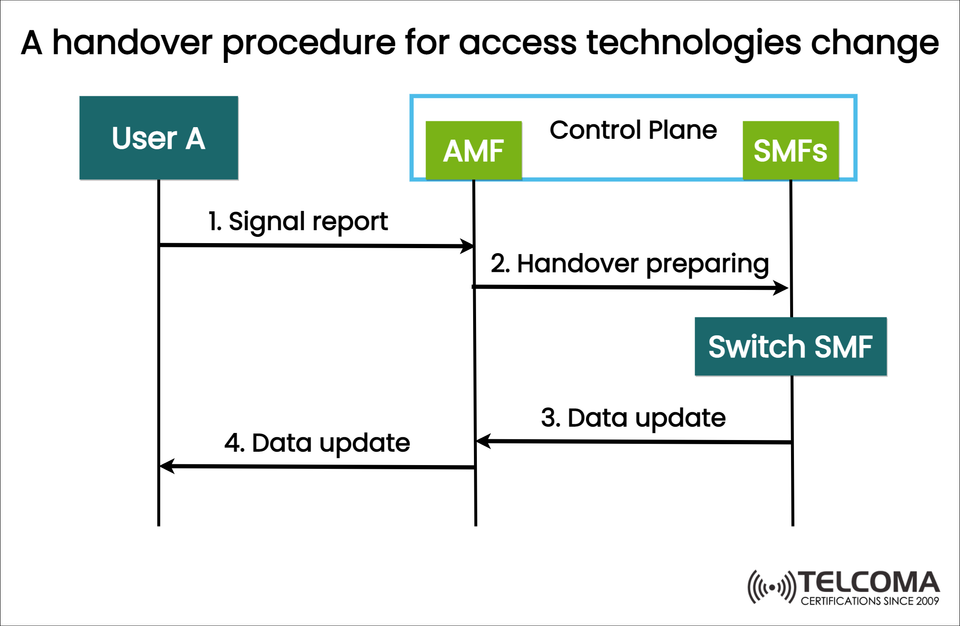
The image included shows a handover procedure for changing access technologies, detailing how the User Equipment (UE), the Access and Mobility Management Function (AMF), and the Session Management Functions (SMFs) work together to manage the shift.
In this blog, we’ll break down this procedure, explain what each part does, and emphasize why smooth handovers are essential for ensuring Quality of Service (QoS) and a good user experience.
Why Handover is Important in 5G
Mobility is key in 5G networks. Users expect to stay connected without interruption when they’re moving through different environments, like:
Switching between 4G LTE and 5G NR (dual connectivity and inter-RAT handover).
Transitioning from macro to small cells for better load balancing.
Moving from licensed to unlicensed spectrum access.
Roaming between public and private 5G networks.
Without strong handover mechanisms, users could face dropped calls, interruptions in data sessions, and overall poor performance—not ideal for situations like autonomous driving, remote surgeries, or mission-critical IoT applications.
The Key Players in the Procedure
Before we get into the details, let’s clarify the roles of each component in the diagram:
User A (UE): This refers to the mobile device or user equipment that generates and consumes data.
AMF (Access and Mobility Management Function): A control-plane function managing registration, mobility, reachability, and access authentication.
SMF (Session Management Function): Responsible for managing PDU sessions, allocating IP addresses, and working with UPF (User Plane Function) for routing.
Switch SMF: Represents the new session management function that’s selected when the UE moves to a different access technology.
Step-by-Step Breakdown of the Handover Process
The handover process for changing access technology in 5G generally includes the following steps:
- Signal Report (UE → AMF)
The UE checks the radio link quality and sends measurements (like RSRP, SINR, and CQI) to the AMF.
If the UE senses poor quality or detects a better signal from another technology, it triggers the mobility management process.
Example: A smartphone leaves a 5G NR area and picks up stronger LTE signals.
- Handover Preparation (AMF → SMFs and Switch SMF)
The AMF kicks off the handover preparation by coordinating with the current SMF and the target SMF.
Key tasks here include: * Choosing the new SMF. * Setting up new resources. * Preparing the target network to keep the session going.
This step is vital to prevent packet loss and ensure session continuity when shifting between different access technologies.
- Data Update (Switch SMF → AMF)
The new SMF updates the session info with the AMF.
This includes updating session contexts, routing rules, and QoS policies to align with the new access technology.
The AMF ensures control-plane consistency between the old and new SMFs.
- Data Update (AMF → User A)
Lastly, the AMF notifies the UE about the updated session and access parameters.
The UE can then switch to the new access technology without any hiccups.
From the user's point of view, everything stays connected.
Key Features of 5G Handover
Multi-Access Support: * Handover can happen across NR, LTE, Wi-Fi, and even satellite connections.
Session Continuity: * Thanks to SMF and UPF anchoring, applications stay active.
Seamless User Experience: * Latency is kept to a minimum to prevent dropped connections during real-time services.
Flexible Core Network Functions: * A service-based architecture allows for on-demand SMF selection.
4G vs. 5G Handover: A Comparison
Aspect | 4G LTE Handover | 5G Handover
Architecture | Centralized EPC | Service-based, modular 5GC
Entities | MME, SGW, PGW | AMF, SMF, UPF
Access Types | LTE only | NR, LTE, Wi-Fi, satellite (multi-RAT)
Session Management | Anchored in SGW/PGW | Anchored in SMF/UPF with dynamic switching
Performance Goal | Basic mobility continuity | Ultra-low latency, QoS-driven mobility
Challenges with Handover for Access Technology
Despite progress, there are still hurdles to overcome:
Latency Sensitivity: Even slight delays can disrupt ultra-reliable low-latency communications (URLLC).
Security Risks: Handover processes can create openings for man-in-the-middle attacks or fake base stations.
Complex SMF Selection: Choosing the right SMF in a fast-changing multi-access setting can be resource-intensive.
Interoperability: Making handovers smooth across various networks (public, private, licensed, unlicensed) continues to be a challenge.
Ways to Improve Handover
To tackle these challenges, telecom operators and vendors are rolling out solutions like:
AI-Driven Mobility Prediction: Machine learning models forecast user movement and prep for handovers in advance.
Network Slicing-Aware Handover: This ensures that each service slice (eMBB, URLLC, mMTC) keeps its QoS while on the move.
Secure Handover Protocols: Enhanced authentication and encryption during transitions.
Edge Computing Integration: Anchoring sessions at edge UPFs helps cut down on handover latency.
Real-World Examples
Autonomous Vehicles: Need to switch between macro cells and roadside small cells for ongoing V2X communication.
Industrial IoT: Robots operating in factory zones must smoothly transition between private 5G slices.
Public Safety: First responders using 5G NR and LTE networks during emergencies can’t afford dropped sessions.
Consumer Mobility: Everyday activities like streaming video on a fast train rely on seamless inter-RAT handovers.
Wrap-Up
The handover process for changing access technology is a key aspect of managing mobility in 5G. It ensures users enjoy smooth, low-latency, and secure connections as they move across different networks.
By coordinating the roles of UE, AMF, and SMFs, the 5G system ensures that:
Sessions stay stable.
QoS needs are met.
Various access technologies work together effectively.
For those in telecom, getting a grip on this process is crucial for creating strong, future-proof 5G systems. As we look toward 6G, making handovers more efficient will be even more critical, especially for applications that demand low latency and reliability.