
5G High-Level Architecture: Data Centers, CESC Manager & Network Slicing Explained

Why 5G Architecture is Important
5G networks are built to handle the demand for super-fast connectivity, very low latency, and huge scalability. Unlike earlier generations, 5G isn’t just about quicker mobile internet—it also supports critical IoT applications, smart cities, self-driving cars, and automation in industries.
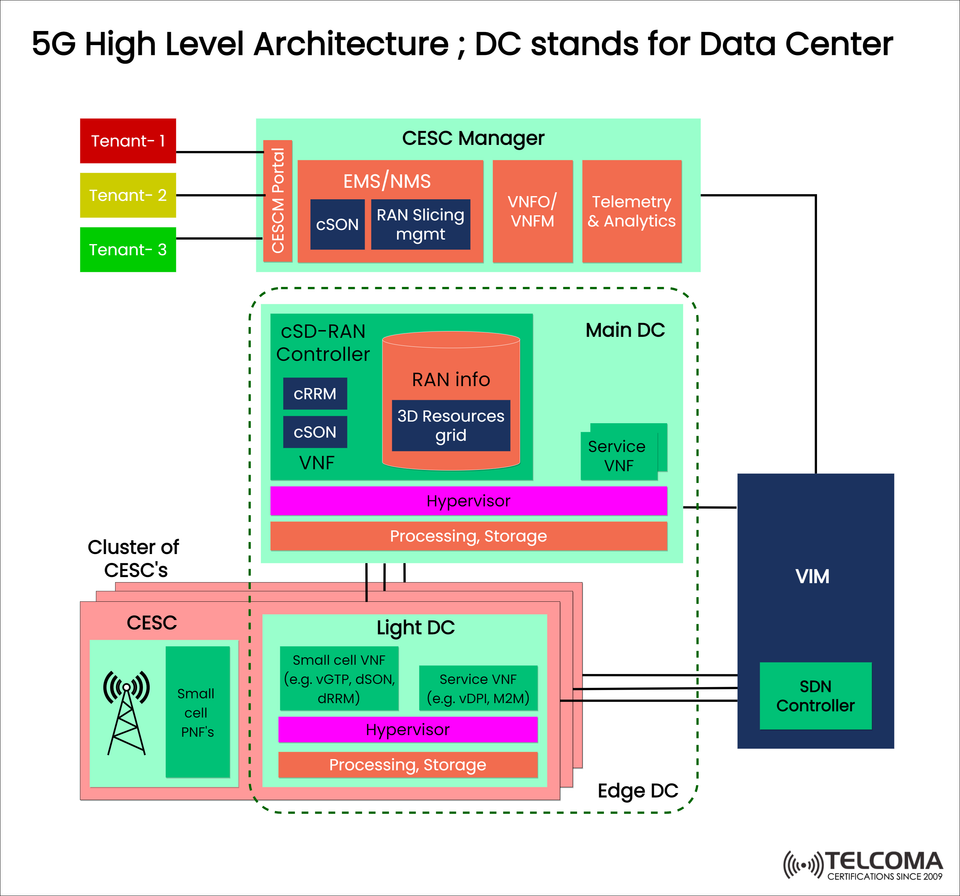
At the core of this is a distributed, software-defined, and virtualized architecture, which helps telecom providers manage resources efficiently, slice networks, and roll out services at scale. The image above shows the 5G High-Level Architecture, where Data Centers (DCs), Cloud-Enabled Small Cells (CESCs), and Virtualized Infrastructure Managers (VIMs) play essential roles.
Core Components of the 5G High-Level Architecture
The diagram emphasizes some key components:
- Tenants
Different tenants (like Tenant-1, Tenant-2, Tenant-3) can connect to the network through the CESC Portal.
This multi-tenancy setup allows various operators, businesses, or service providers to securely and independently use the same infrastructure.
A major advantage is Network slicing, which offers tailored services like IoT, enhanced Mobile Broadband (eMBB), and Ultra-Reliable Low-Latency Communications (URLLC).
- CESC Manager
The Cloud-Enabled Small Cell Manager (CESC Manager) runs the 5G infrastructure.
It includes:
EMS/NMS (Element & Network Management Systems) – Responsible for managing devices and networks.
cSON (Centralized Self-Organizing Network) – Automates the optimization of small cells.
RAN Slicing Management – Dynamically allocates Radio Access Network resources to different tenants.
VNFO/VNFM (Virtual Network Function Orchestration & Management) – Takes care of deploying, scaling, and overseeing VNFs.
Telemetry & Analytics – Offers real-time monitoring, performance metrics, and predictive analysis.
Key takeaway: The CESC Manager acts as the brains of the operation, ensuring automation, orchestration, and customization for each tenant.
- Main Data Center (Main DC)
The Main DC is the central hub for network intelligence. It consists of:
cSD-RAN Controller – Handles and optimizes Radio Access Networks.
cRRM: Centralized Radio Resource Management.
cSON: Centralized Self-Organizing Network functionalities.
VNF: Virtualized network functions hosted here.
RAN Info & 3D Resource Grid – Manages radio network information with a resource allocation grid for improved performance.
Service VNFs – Supports advanced services like IoT platforms or specialized applications for businesses.
Hypervisor Layer – Abstracts hardware resources for secure VNF hosting.
Processing & Storage – Provides the computing power and storage needed for network functions.
Role of Main DC: Serves as the central intelligence point for extensive orchestration and resource optimization.
- Edge Data Center (Edge DC / Light DC)
To address 5G’s low-latency needs, processing is done closer to users through Edge Data Centers (Light DCs).
Small Cell VNFs – Examples: vGTP (virtual GPRS Tunneling Protocol), dSON (distributed SON), dRRM (distributed Radio Resource Management).
Service VNFs – Examples: vDPI (virtual Deep Packet Inspection), M2M (Machine-to-Machine communication).
Hypervisor Layer – Virtualization for running various VNFs.
Processing & Storage – Manages localized data to ensure faster responses.
Importance of Edge DCs: They cut down latency by processing traffic locally rather than sending everything to the Main DC. This supports scenarios like autonomous driving, AR/VR, and industrial IoT.
- CESC Cluster
The Cloud-Enabled Small Cell (CESC) cluster links several small cells with edge computing nodes.
These connect with both Main DC and Edge DC for smooth communication.
Small cell PNFs (Physical Network Functions) deliver the radio interface for users.
Advantage: Scalability—operators can set up clusters in cities, suburbs, or rural areas based on demand.
- Virtualized Infrastructure Manager (VIM) & SDN Controller
VIM (Virtualized Infrastructure Manager): Manages compute, storage, and networking resources across data centers.
SDN (Software-Defined Networking) Controller: Facilitates flexible and programmable network routing.
Together, they ensure dynamic resource allocation, automated scaling, and adaptable connectivity throughout the 5G architecture.
How 5G Architecture Enables Network Slicing
One of the standout features of 5G is network slicing, allowing various logical networks to function on shared infrastructure.
Tenant-1 Example: High-bandwidth streaming services (eMBB).
Tenant-2 Example: Mission-critical IoT with URLLC needs.
Tenant-3 Example: Smart cities using massive IoT (mMTC).
Each slice is managed independently, secured, and optimized, thanks to the orchestration by the CESC Manager and resource distribution in Main and Edge DCs.
Benefits of the 5G High-Level Architecture
This architecture guarantees that telecom networks can support a variety of use cases while remaining flexible and cost-efficient.
Key Benefits:
Ultra-Low Latency: Edge DCs ensure real-time responsiveness.
Scalability: Virtualization and clustering allow for dynamic growth.
Flexibility: Accommodates multiple tenants and use cases through slicing.
Automation: Self-organizing networks and orchestration reduce manual work.
Resource Optimization: Centralized and distributed RRM ensures efficient spectrum use.
Future-Proofing: VNFs and SDN allow for ongoing service evolution.
Example Use Cases Powered by This Architecture
Smart Cities: Effective resource management for IoT devices.
Self-Driving Cars: Real-time communication with minimal delay.
Industry 4.0: Factory automation utilizing machine-to-machine (M2M) communication.
Healthcare: Remote surgeries relying on ultra-reliable connectivity.
Engaging Media: AR/VR experiences and high-quality streaming using enhanced broadband.
Comparison Table: Main DC vs Edge DC
Feature Main DC (Centralized)Edge DC (Distributed)Latency Higher (due to centralized location)Ultra-low (closer to end-users)Processing Power High computing & storage capacity Moderate, localized processing Use Cases Network orchestration, analytics Real-time IoT, AR/VR, autonomous driving Scalability Manages large-scale operations Scales with CESC clusters
Conclusion
The 5G High-Level Architecture combines centralized intelligence with distributed edge processing. With CESC Managers, Main DCs, Edge DCs, and SDN-enabled virtualization, it supports a wide range of 5G applications—from smart homes to self-driving cars.
By bringing together network slicing, VNFs, SDN, and automation, telecom operators can deliver scalable, flexible, and low-latency services to various tenants at the same time. This architecture represents not just a technological advancement but also the groundwork for the digital transformation of industries globally.