
5G High-Level Technical Architecture: RAN, MEC, Core, and Network Slicing

5G isn’t merely an upgrade over 4G—it represents a real shift in how networks are built. Unlike its predecessors, which were heavy on hardware, 5G leans into virtualization, cloud-native principles, and service-based architecture (SBA) to cater to various performance needs.
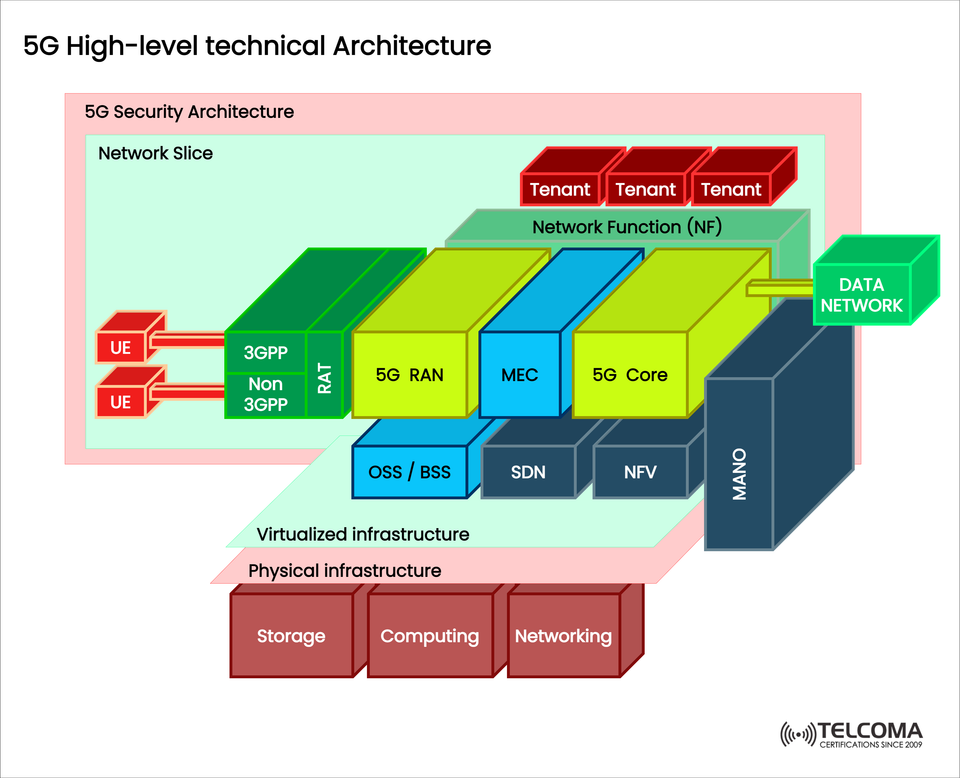
The 5G High-Level Technical Architecture consists of several layers: physical infrastructure, virtualized functions, radio access, the core, and orchestration layers. These elements work together to enable network slicing, ultra-low latency, high reliability, and scalability.
In this article, we’ll break down the architecture into easy-to-understand sections, looking closely at each part highlighted in the diagram.
- The Foundation: Physical and Virtualized Infrastructure
At the base of the 5G architecture is the infrastructure layer, which supports everything that happens above it.
Physical Infrastructure
Storage: Takes care of the huge amounts of user and network data.
Computing: Supplies the processing power for virtual functions and AI tasks.
Networking: Keeps different network components connected.
Virtualized Infrastructure
Built on physical resources using NFV (Network Function Virtualization).
Enables sharing and easy scalability of resources.
Allows operators to run various network slices on the same physical setup.
This division between physical and virtual layers is vital for the flexibility and scalability that 5G applications require.
- Radio Access Technologies (RAT)
5G accommodates both 3GPP (standardized 5G/4G technologies) and non-3GPP access (like Wi-Fi), ensuring smooth connectivity in different settings.
5G RAN (Radio Access Network)
Links User Equipment (UE), such as smartphones, IoT devices, and sensors, to the 5G network.
Uses Massive MIMO and beamforming to boost spectral efficiency.
Guarantees low latency and high throughput for communication.
By incorporating various RATs, 5G creates a cohesive access experience, allowing users to enjoy continuous service across different tech.
- Multi-Access Edge Computing (MEC)
MEC is a game-changing addition to the 5G architecture. It processes data right at the edge of the network, close to users, minimizing reliance on centralized data centers.
Benefits of MEC in 5G:
Ultra-low latency: Essential for autonomous driving, industrial automation, and AR/VR.
Less bandwidth usage: Processes data locally before sending it to the core.
Improved reliability: Supports critical services by reducing delays.
When MEC combines with 5G RAN and Core, networks can deliver context-aware and location-specific services in real-time.
- The 5G Core (5GC)
The 5G Core is constructed on a service-based architecture (SBA), moving away from the monolithic 4G EPC (Evolved Packet Core). It accommodates modular, cloud-native network functions (NFs).
Key Functions of the 5G Core:
Authentication and Security: Keeps network access secure.
Session Management Function (SMF): Manages sessions between devices and the data network.
User Plane Function (UPF): Oversees data forwarding and traffic management.
Network Exposure Function (NEF): Provides APIs for third-party applications and services.
Policy Control Function (PCF): Balances QoS (Quality of Service) and resource allocation.
This adaptability allows operators to tailor services for various industries using network slicing.
- Support Systems and Network Virtualization
Supporting functions play a crucial role in ensuring smooth operations and efficient management of the network.
OSS/BSS (Operations and Business Support Systems):
Handle subscriber data, billing, and customer services.
Offer real-time monitoring and analytics for network performance.
SDN (Software-Defined Networking):
Separates the control plane from the data plane.
Facilitates centralized traffic management.
Enables dynamic routing and automation.
NFV (Network Function Virtualization):
Substitutes dedicated hardware with software-based network functions.
Allows for cost efficiency, agility, and scalability in service deployment.
- MANO: Management and Orchestration
At the top layer is MANO (Management and Orchestration), which ensures that all virtualized resources and network slices are managed effectively.
MANO Responsibilities:
Resource Orchestration: Assigns computing, storage, and networking resources.
Lifecycle Management: Oversees deployment, scaling, and termination of virtual network functions (VNFs).
Service Assurance: Confirms that performance meets SLAs (Service Level Agreements).
MANO is essential for enabling multi-tenant environments, where different operators or companies can use dedicated slices of the same infrastructure.
- Network Slicing: A Game-Changer
One of the standout features of 5G is network slicing. This allows operators to create multiple virtual networks on the same physical infrastructure, each tailored for specific applications.
Example Slices:
eMBB (Enhanced Mobile Broadband): High-speed internet for streaming, AR/VR, and cloud gaming.
mMTC (Massive Machine-Type Communications): Supports IoT devices in smart cities and agriculture.
URLLC (Ultra-Reliable Low-Latency Communications): Facilitates autonomous vehicles, robotic surgery, and industrial automation.
By isolating resources, slicing keeps the performance of one slice from impacting others, delivering customized services.
- Security in 5G Architecture
Security is woven into every layer of the architecture:
At the RAN: Safeguards data sent between UE and the base station.
At the Core: Manages user authentication and encryption.
Across Slices: Ensures each network slice has its own security policies.
The 5G security architecture features robust encryption, identity management, and fraud detection to protect users and businesses alike.
Comparative View: 4G EPC vs. 5G Core
Aspect4G EPC5G Core (5GC)Architecture Monolithic Service-based (SBA), cloud-native Flexibility Limited High, supports modular functionsLatency~50ms<1ms with MEC and URLLC support Network Slicing Not supported Fully supported Scalability Hardware-bound Software-defined, scalable via NFV/SDN
This comparison highlights how 5G architecture significantly outshines older systems.
Conclusion
The 5G high-level technical architecture signifies a major transition from hardware-dependent telecom systems to cloud-native, virtualized, and software-defined frameworks. By integrating 5G RAN, MEC, Core, OSS/BSS, SDN/NFV, and MANO, it enables network slicing, low latency, massive IoT, and high reliability.
For telecom professionals, grasping this layered architecture is crucial for rolling out 5G networks that can handle the varied needs of industries—from smart cities to self-driving cars.
Ultimately, 5G isn’t just an upgrade; it’s a revolution, paving the way for a hyper-connected future.