
5G High-Level Technical Architecture: RAN, MEC, Core, and Network Slicing

5G, the fifth generation of mobile networks, is really changing the game in telecom. Instead of sticking to the old, hardware-heavy systems, it’s moving towards a cloud-native, software-driven setup that’s much more flexible.
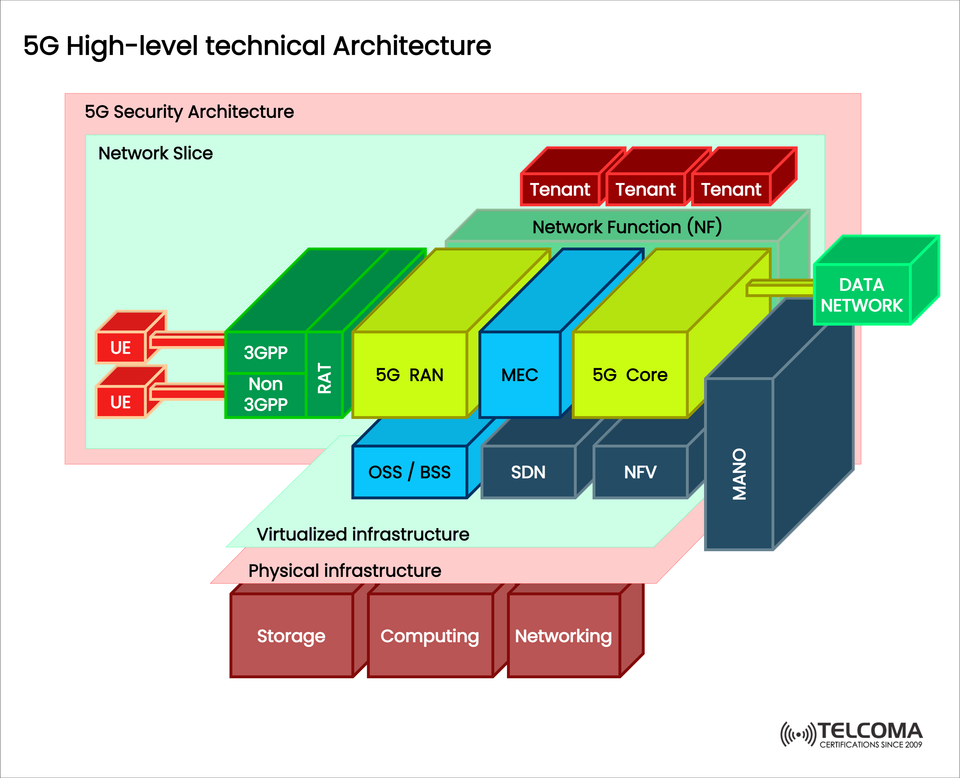
The image you see uploaded gives a good look at the high-level technical architecture of 5G. It illustrates how different elements like user equipment (UE), RAN, MEC, 5G Core, SDN/NFV, OSS/BSS, and MANO all fit together in a layered structure. This setup is crucial for supporting advanced uses like autonomous vehicles, smart cities, AR/VR, and industrial automation.
In this blog, we’ll break down the 5G architecture in detail, looking at its components and why it’s so important for the future of telecom.
Key Elements of the 5G High-Level Technical Architecture
- User Equipment (UE)
The UE includes devices like smartphones, IoT sensors, AR/VR headsets, and autonomous cars.
These devices tap into the network through:
3GPP access technologies (like 5G New Radio).
Non-3GPP access (such as Wi-Fi and satellite).
This diversity helps ensure that users can connect seamlessly across different network types.
- Radio Access Technology (RAT) and 5G RAN
The RAN in 5G is pretty cutting-edge, supporting:
5G New Radio (NR) across sub-6 GHz and mmWave spectrum.
Massive MIMO technology to boost capacity.
Beamforming to use spectrum more effectively.
This RAT layer allows for smooth interactions between cellular and non-cellular access, so users can enjoy consistent service no matter how they connect.
- Multi-access Edge Computing (MEC)
MEC brings cloud computing capabilities closer to users at the network edge. This helps reduce latency and supports real-time services. Key features include:
Local data processing for things like IoT, gaming, and AR/VR.
Less backhaul traffic to central networks.
Running enterprise applications directly at the edge.
MEC is vital for applications needing quick responses, like autonomous vehicles, smart manufacturing, and telehealth, where every millisecond counts.
- 5G Core (5GC)
The 5G Core Network is all about being cloud-native, service-based, and virtualized. Its setup supports:
Service-Based Architecture (SBA), where network functions interact through APIs.
Network slicing to create tailored virtual networks for different use cases (like eMBB, mMTC, and URLLC).
Seamless interworking with older networks while preparing for upgrades.
The 5G Core takes care of subscriber verification, mobility management, policy control, and QoS, making sure everything runs reliably and can scale as needed.
- SDN (Software-Defined Networking)
SDN separates the control and forwarding aspects of the network, offering:
Centralized control over network resources.
Dynamic traffic management.
Easier orchestration of services.
Thanks to SDN, operators can adjust to traffic demands in real-time, boosting both network efficiency and user experience.
- NFV (Network Functions Virtualization)
NFV shifts traditional hardware network functions to software-based VNFs (Virtual Network Functions). Examples include:
Virtualized firewalls.
Virtualized Evolved Packet Core (vEPC).
Virtualized IMS (IP Multimedia Subsystem).
With NFV, you get cost savings, scalability, and flexibility, speeding up service launches across various fields.
- OSS/BSS
OSS (Operations Support Systems) and BSS (Business Support Systems) are still essential in 5G networks.
OSS handles network operations, provisioning, and service assurance.
BSS manages billing, customer relationships, and service monetization.
Together, OSS/BSS help providers deliver and monetize services effectively.
- MANO (Management and Orchestration)
The MANO framework orchestrates resources in a virtual environment. It ensures:
Automated provisioning of VNFs.
Resource scaling based on demand.
Lifecycle management of network slices.
MANO is crucial for managing the complexity of 5G service delivery, especially when dealing with multiple tenants.
- Network Slicing
Network slicing is one of the most powerful features of the 5G architecture. It allows operators to create several virtual networks on the same physical infrastructure:
eMBB Slice: Perfect for high data rates (think video streaming, AR/VR).
mMTC Slice: Made for tons of IoT devices (like in smart cities or agriculture).
URLLC Slice: Ensures super low latency and reliability (useful for autonomous driving and industrial automation).
This adaptability makes 5G suitable for various industry needs.
- Security Architecture
Security is built into every level of 5G, focusing on confidentiality, integrity, and availability:
Enhanced subscriber authentication.
End-to-end encryption for sensitive information.
Protection from DDoS attacks and signaling storms.
With so many devices connected today, strong security is an absolute must in the architecture.
Layered Infrastructure of 5G
The image illustrates how 5G functions across multiple layers:
Physical Infrastructure - Handles storage, computing, and networking resources. Forms the hardware backbone.
Virtualized Infrastructure - Supports NFV and SDN for adaptable service delivery.
Network Functions - Includes RAN, MEC, Core, and service orchestration.
Applications and Tenants - Multiple tenants can safely share the same physical resources through network slicing.
This layered structure helps providers offer scalable, efficient, and secure telecom services.
Comparative Overview of 5G Architecture Components
Component Function Key Benefit
UE: End-user devices access via 3GPP and non-3GPP networks 5G RAN: Connects UE to core, high capacity, low latency MEC: Edge processing, real-time responsiveness 5G Core: Service-based network core, network slicing, scalability SDN: Software-defined control, centralized, flexible network management NFV: Virtualized network functions, cost-efficient, scalable infrastructure OSS/BSS: Operational and business support, service assurance, and monetization MANO: Orchestration framework, automated lifecycle management
Why This Architecture Matters for Telecom Professionals
The 5G high-level architecture isn’t just some technical layout—it’s a roadmap for the future of telecom ecosystems.
For those in the field, it offers:
Flexibility through virtualization and software-driven designs.
Revenue opportunities with network slicing and private 5G.
Scalability to support millions of IoT devices.
Innovation platforms for businesses and developers.
Conclusion
The 5G high-level technical architecture illustrates a shift from older telecom models to cloud-native, flexible, and smart networks. By integrating RAN, MEC, 5G Core, SDN, NFV, OSS/BSS, and MANO on a virtualized infrastructure, telecom providers can deliver customized services with exceptional efficiency.
For telecom professionals, getting a grip on this architecture is crucial to unlocking 5G’s full potential. And for tech enthusiasts, it reveals the complexity and innovation that power autonomous vehicles, smart factories, and immersive AR/VR.
In the end, this architecture proves that 5G is not just an upgrade from 4G but a transformational platform for our digital future.