
5G Initial Context Setup and Data Transfer Explained: How UE and 5G Core Establish Communication

Explaining 5G Initial Context Setup and Data Transfer
The process of registering for 5G involves several interactions among the User Equipment (UE), gNB, and 5G Core (5GC). Once the network checks authentication, pulls subscription info, and sets up policies, it moves on to establish the Initial Context Setup. This step is crucial because it connects the UE to the data network, paving the way for actual data transfer.
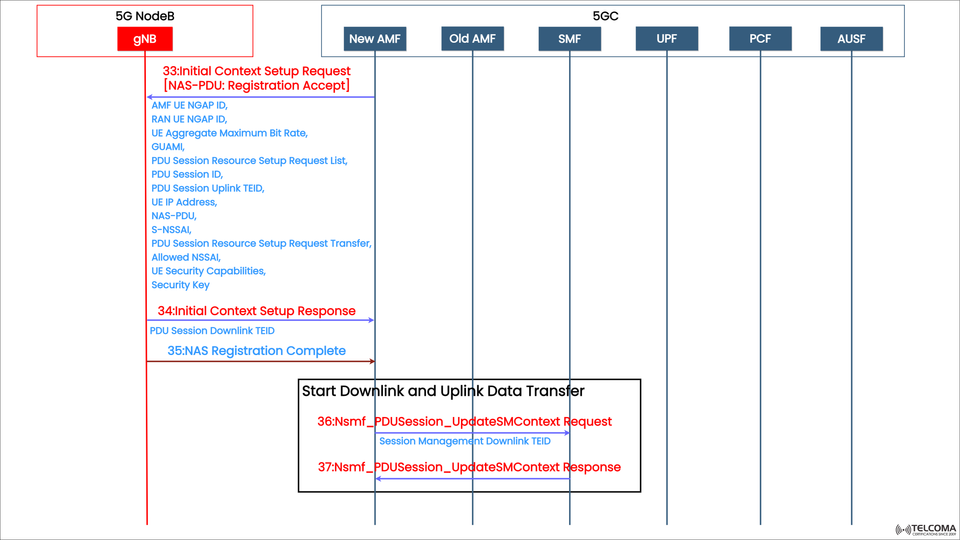
The diagram above shows the last steps in the 5G registration and PDU session setup sequence, highlighting messages 33 to 37 in the overall registration process.
Overview: From Registration to Data Flow
At this part of the 5G attach procedure, the network has:
Registered the UE with the Access and Mobility Management Function (AMF),
Retrieved subscription and policy details from the UDM and PCF,
Set up the Session Management Function (SMF) and User Plane Function (UPF) for the PDU session, and
Created the AMF–gNB–UE signaling context needed.
Now, with the Initial Context Setup, the UE’s signaling and bearer information gets lined up between the gNB and the AMF, which allows user data sessions to kick off.
Key Network Elements Involved
Network Function | Full Name | Role in This Procedure
gNB | Next Generation Node B | Establishes RRC and NGAP connectivity with UE
AMF | Access and Mobility Management Function | Handles registration, authentication, and context setup
SMF | Session Management Function | Manages PDU sessions and user plane configuration
UPF | User Plane Function | Forwards and routes user data packets
PCF | Policy Control Function | Provides policy and QoS control (set up earlier)
This step wraps up NAS registration and sets the stage for bidirectional data flow (both downlink and uplink) through the 5G User Plane.
Step-by-Step Breakdown of the Message Flow
Step 33: Initial Context Setup Request [NAS–PDU: Registration Accept]
Message Direction: AMF → gNB
The AMF kicks off the Initial Context Setup Request to the gNB. This message is pretty detailed as it brings together various session, policy, and security parameters needed for the UE to connect.
Key Parameters Included:
AMF UE NGAP ID – Identifies the UE context on the AMF side.
RAN UE NGAP ID – The corresponding UE ID on the gNB side.
UE Aggregate Maximum Bit Rate (AMBR) – Sets the max data rate for the UE.
GUAMI (Globally Unique AMF ID) – Uniquely identifies the AMF serving the UE.
PDU Session Resource Setup Request List – Holds details for the PDU Session, such as:
PDU Session ID
Uplink TEID (Tunnel Endpoint ID for uplink)
UE IP Address
NAS–PDU (Registration Accept) – The NAS message confirming successful registration.
S–NSSAI (Single Network Slice Selection Assistance Information) – Points out the network slice for the session.
Allowed NSSAI – Lists the network slices the UE can use.
UE Security Capabilities – Details supported encryption/integrity algorithms.
Security Key (Kgnb) – Used to create radio-level encryption keys between UE and gNB.
This message gives the gNB all the details needed to:
Set up RRC and NGAP parameters,
Establish GTP-U tunnels with the UPF (through SMF), and
Send the NAS message confirming registration to the UE.
Step 34: Initial Context Setup Response
Message Direction: gNB → AMF
The gNB replies with an Initial Context Setup Response, confirming the UE resources are set up and the context is created at the RAN.
Included Information:
PDU Session Downlink TEID – Tunnel ID for setting up the downlink data path.
This indicates that both uplink and downlink TEIDs are ready, which means user data transfer can be configured through the UPF.
Step 35: NAS Registration Complete
Message Direction: UE → AMF
After the UE gets the NAS-PDU (Registration Accept) in the Initial Context Setup Request, it sends a NAS Registration Complete message to the AMF via the gNB.
Purpose:
Confirms that the UE has registered successfully with the network.
Lets the AMF finalize the UE's context and registration status.
This marks the end of the registration procedure — the UE is now fully registered and set to start using the 5G Core network.
Kicking Off Data Transfer: Activating Downlink and Uplink Paths
Once registration is done, the network sets up the user plane paths to start actual data transfer.
Step 36: Nsmf_PDUSession_UpdateSMContext Request
Message Direction: AMF → SMF
The AMF sends this message to the SMF to update the Session Management Context.
Purpose:
Syncs session management details with the established PDU session.
Informs the SMF that the UE is ready for data transfer.
This message includes the Session Management Downlink TEID, defining the data forwarding path from the UPF to the gNB for downlink data.
Step 37: Nsmf_PDUSession_UpdateSMContext Response
Message Direction: SMF → AMF
The SMF confirms the request, indicating the data path is set up successfully.
Once this response comes in:
The User Plane Function (UPF) and gNB are completely synced.
Both Downlink and Uplink data transfer can start without a hitch.
This wraps up the end-to-end data path establishment between the UE and the external data network.
Technical Insights: The Importance of Initial Context Setup
The Initial Context Setup phase is vital because it ensures all parts of the 5G system are properly aligned before user data starts flowing.
Key Technical Benefits:
Secure Communication: The UE security context is transferred and activated at the gNB.
Optimized Data Paths: Uplink and downlink TEIDs are set for low-latency transport.
Efficient Resource Allocation: Guarantees that bandwidth and slicing resources match user subscriptions.
Interoperability: Connects AMF, SMF, and UPF to keep service continuous during mobility.
Real-World Application Example
Picture a subscriber powering on their 5G smartphone:
The UE connects to the nearest 5G gNB.
After authentication, the AMF sends the Initial Context Setup Request.
The gNB sets up radio bearers, security keys, and data tunnels.
The UE sends NAS Registration Complete.
The SMF and UPF sync paths for traffic flow.
Within milliseconds, the UE starts exchanging IP packets — whether it’s for browsing, video streaming, or communicating with IoT devices.
Conclusion
The Initial Context Setup and NAS Registration Completion mark the closing stages of the 5G UE registration process. This sequence bridges the gap between signaling and actual data exchange, establishing control and user planes for communication.
By syncing up across the AMF, gNB, SMF, and UPF, the network ensures that every UE session is securely set up, policy-compliant, and primed for high-speed data transfer.
Grasping these steps enables telecom professionals to enhance 5G network performance, reduce attach latency, and provide the seamless user experience that characterizes next-gen connectivity.