
5G Key Capabilities and Deployments Over Time: From Release 15 to Release 17
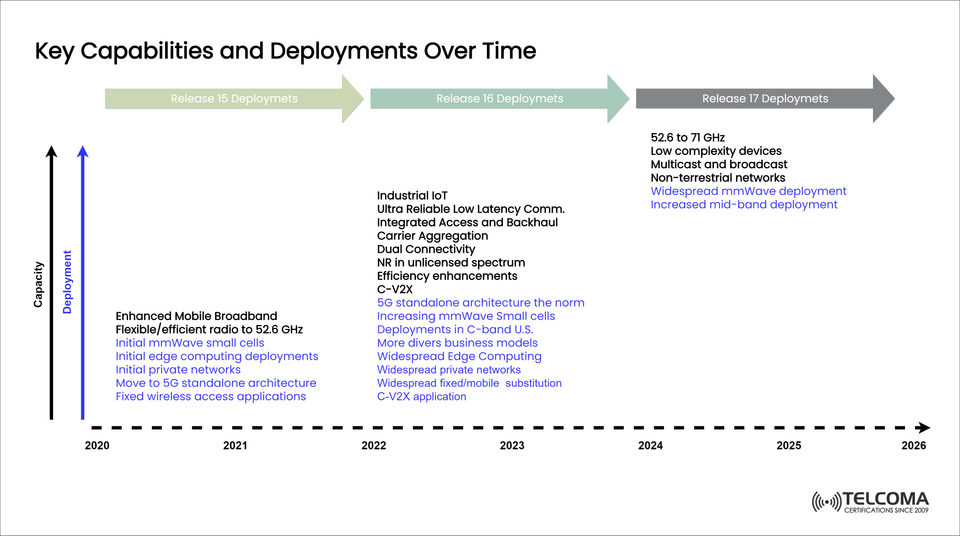

Key Capabilities and 5G Deployments Over Time: Release 15 to Release 17
As the technology maturation process of 5G has progressed, we have seen significant innovation between Release 15, Release 16 and Release 17. These releases have been guided through the 3GPP standardization process and have concentrated on enabling new capabilities and ways to deploy the full array of 5G technology.
📅 5G Timeline Overview: Release-based progress
Release Timeline Release Release Purpose
2020 - 2021 Release 15 Initial deployments, enhanced mobile broadband, mmWave trials
2022 - 2023 Release 16 Low latency comms, industrial IoT, carrier aggregation, edge computing
2024 - 2026 Release 17 Non-terrestrial networks, 71 GHz spectrum, multicast, extensive mmWave
🔑 Release 15 (2020 - 2021): The foundation of 5G
Release 15 was the start of 5G technology's commercial journey. Released with flexibility, enhanced mobile broadband (eMBB) and spectrum utilization in mind, it represented early progress to deploy infrastructure and the use of some proof-of-concept use cases.
Key Capabilities:
Support to utilize frequencies up to 52.6 GHz
Deployment of initial mmWave small cell sites
Early integration of edge computing
Development of private 5G networks
Enable Fixed Wireless Access (FWA) use cases
Prepare for a transition to 5G standalone (SA) architecture.
Key Capabilities and 5G Deployments Over Time: Release 15 to Release 17
As the technology maturation process of 5G has progressed, we have seen significant innovation between Release 15, Release 16 and Release 17. These releases have been guided through the 3GPP standardization process and have concentrated on enabling new capabilities and ways to deploy the full array of 5G technology.
How can we describe the evolution of 5G deployments and technological capabilities? To provide an overview of this process, this blog post provides a timeline of 5G deployments and technological innovations, represented in the visual roadmap below, to provide relevant context for professionals to understand the progress that has been achieved.
📅 5G Timeline Overview: Release-based progress
Release Timeline Release Release Purpose
2020 - 2021 Release 15 Initial deployments, enhanced mobile broadband, mmWave trials
2022 - 2023 Release 16 Low latency comms, industrial IoT, carrier aggregation, edge computing
2024 - 2026 Release 17 Non-terrestrial networks, 71 GHz spectrum, multicast, extensive mmWave
🔑 Release 15 (2020 - 2021): The foundation of 5G
Release 15 was the start of 5G technology's commercial journey. Released with flexibility, enhanced mobile broadband (eMBB) and spectrum utilization in mind, it represented early progress to deploy infrastructure and the use of some proof-of-concept use cases.
Key Capabilities:
Support to utilize frequencies up to 52.6 GHz
Deployment of initial mmWave small cell sites
Early integration of edge computing
Development of private 5G networks
Enable Fixed Wireless Access (FWA) use cases
Prepare for a transition to 5G standalone (SA) architecture.
🚀 Release 17 (2024–2026): Expanding Possibilities
Release 17 is expanding what 5G can do by exploring areas such as non-terrestrial, thoughts on new device ecosystems, and higher spectrum bands to better connect everyone and create new business opportunities.
Key Features:
Spectrum support has been expanded to 71 GHz
Support for lower complexity devices (e.g., IoT sensors)
Multicast and Broadcast features for more efficient content delivery
Non-terrestrial network (NTN) connections (e.g., satellites)
Widespread mmWave rollout
Mid-band spectrum use will still be supported
This release will help 5G be better utilized globally and allow for applications to reach rural internet connections, large IoT scale, and advanced automotive.
📌 Summary of 5G Rollout Trends
Deployment Milestones by Category Release 15 Release 16 Release 17
mmWave Rollouts Initial Growing Widespread
Edge computing Initial Widespread Mature
Private Networks Initial Widespread Standardized
C-V2X Introduced Applications Expanding
Non-terrestrial networks - - Supported
Mid-band Rollouts Limited C-band focused Expanded
Stand-alone Architecture Introduced Norm Ubiquitous
🔚 Conclusion
The journey from 5G Release 15 to Release 17 has illustrated the planned evolution of mobile networks--from initially enabling enhanced broadband to further enhancements for more advanced use cases such as industrial automation, vehicle-to-everything communication and satellite capabilities.
🔮 Future Implications for Telecom and Tech Professionals
The evolution of 5G through Releases 15, 16, and 17 involves more than technical capabilities; it involves foresight. Here are considerations for stakeholders exploited through this evolution:
📡 For Network Operators:
CapEx planning: Any investment in mmWave infrastructure, mid-band spectrum, or edge computing should be expected with the timing of each release.
Private 5G: With what is poised to become the most ubiquitous deployment after Release 16, operators should create turnkey solutions for the enterprise.
Non-terrestrial networks: Release 17 will grow new segments of the market, particularly rural areas, where maritime and aerial coverage is needed.
🧠 For Technology Leaders & Developers:
Edge-native architecture: Applications should be developed to minimize latency and explore underpinning functions that can exist at the edge.
C-V2X: Smart city and autonomous driving use cases provide developing markets needing domain knowledge in V2X protocols and safety standards.
Energy efficiency IoT: Your developed solution must support low complexity, battery constrained devices that leverage Release 17 improvements to be deployed.
🏭 For Enterprises:
Industrial automation: Utilize URLLC and private 5G technologies for real-time robotics, smart factories, and digital twins.
Broadcast services: You will be able to multicast or broadcast content utilizing Release 17's capabilities to serve large user bases without congesting the network.
Satellite-enabled operations: Combining terrestrial and non-terrestrial 5G will allow logistics, fleet management, or even remote mining operations to consider alternatives.
🌐 Beyond Release 17: A Look to 5G-Advanced and 6G
While Release 17 is a milestone, it will also provide the starting point for our move to 5G-Advanced (Release 18) and eventually, 6G. Take a brief look ahead:
5G-Advanced will include:
🧭 Strategic Insights for 5G Stakeholders
To turn the roadmap for Releases 15 to 17 into meaningful actions, here is a role-based checklist of considerations for stakeholders in the telecom ecosystem:
🔧 Network Architects:
📍 Build-out frequency spectrum plans: Determine how mid-band and mmWave can work together in urban, suburban, and rural scenarios.
🧱 Design for modularity (on the edge) using cloud-native, disaggregated RAN and core elements to remain nimble as releases start to come online.