
5G Key Capabilities and Deployments Timeline: Release 15 to Release 17 Explained
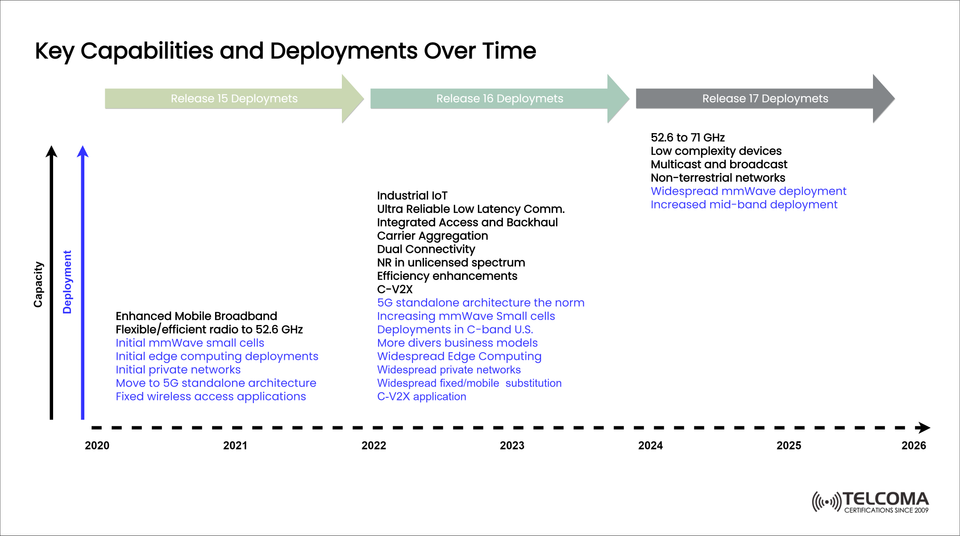

The Key Capabilities and Deployments of 5G Over Time (2020 to 2026)
With the 5G ecosystem continuing to mature, all subsequent 3GPP releases provide newer and more advanced capabilities for improved performance, capacity, and use cases. This blog post decodes the visual roadmap of 5G deployments from Release 15 to Release 17, highlighting the key capabilities that have transformed mobile and wireless communications.
Key Features:
Enhanced Mobile Broadband (eMBB)
Flexible/Efficient Radio Access up to 52.6 GHz
Early mmWave Small Cells
Edge Computing Deployments
Private Network Capability Trials
5G Standalone (SA) Architecture Transition
Fixed Wireless Access (FWA) Capability
This was also the start of mmWave, and experimentation with private services and somewhat bulk edge processing, all critical for using for low-latency use cases and other types of important processing useful for new wireless use cases/experiential use cases.
Notable Additions:
Industrial IoT and URLLC (Ultra-Reliable Low Latency Communication)
Integrated Access and Backhaul (IAB)
Carrier Aggregation & Dual Connectivity
Use of Unlicensed Spectrum
C-V2X (Cellular Vehicle-to Everything) introduction
Standalone 5G Architecture as Normal
Edge Computing Adoption at Scale
Adoption of Business Models in Two Modes
Fixed/Mobile Substitution Cases
🚀 Release 17 Deployments (2024–2026): Next-Generation 5G Networks
Release 17 is deploying as an ongoing product but will push the limits of 5G specification with focus on specialized service use cases, and more frequency bands specified in the 3rd Generation Partnership Project's (3GPP) specification.
Emerging Capabilities:
52.6 – 71 GHz Frequency Band Extension
Device Types for Low Complexity and Cost Efficient Devices
Multicast and Broadcasting Conditions
Integration of Non-Terrestrial Networks (NTN)
Deployment of mmWave Spectrum With 5G
Deployment of mid-band Spectrum Over 5G
Release 17 capabilities position the mobile community to move to 5G-Advanced specifications and one step closer toward 6G by supporting satellite connectivity, rural connectivity, and strong device interoperability.
📊 Summary Table:
5G Releases and Key Developments
Release Year(s) Key Areas of Focus
15 2020−2021 eMBB, mmWave, SA Architecture, Edge, FWA
16 2022−2023 URLLC, IoT, C-V2X, IAB, Carrier Aggregation, SA Norm
17 2024−2026 71 GHz Support, NTN, Broadcast, Low Complexity Devices
🔚 Conclusion:
A pathway from 5G maturity to 5G Advanced
The journey taken from 5G Release 15 to Release 17 represents the telecom industry's march toward a hyper-connected, low-latency, and scalable wireless world. Each of these releases is maturing the capabilities of 5G and how it can be applied, from private networks and smart factories - to hybrid communications with satellite capabilities.
As we prepare for the final chapters of Release 17 deployments, telecom industry stakeholders, including vendors, operators, and developers, need to be ready to embrace 5G-Advanced, and approaching the initial vision of 6G. The next few years will be essential in determining how the trial work and time taken now becomes part of the norm.
Keywords:
5G Releases, Release 15, Release 16, Release 17, 5G Timeline, mmWave, Edge Computing, C-V2X, URLLC, 5G Standalone, Industrial IoT, Non-terrestrial Networks, telecom evolution
🛠️ Strategic Launch Insights: From Pilot to Scale
Transitioning from release to release does not just signify an addition of features: it carries with it increasing complexity and numerous integration hurdles that will need to be strategically managed.
Deployment and Integration Considerations for Each Release:
🔹 Release 15: Establishing the Foundation
Operators: Required to invest resources into additional RAN build-out and core upgrades for 5G SA.
Vendors: Understood that their work on chips, devices, etc will now extend into bands that will reach up to 52.6 GHz.
Use Case Focus: Enhanced Mobile Broadband (eMBB) and Fixed Wireless Access (FWA).
🔹 Release 16: Expanding the Ecosystem
Operators: Will be managing densifying their networks, utilizing unlicensed spectrum and implementing further edge deployments.
Industries: Will initiate pilots in smart factories, logistics, and transportation.
Use Case Focus: Industrial IoT, low-latency machine control, and C-V2X.
🔹 Release 17: Pushing New Markets.
Operators: Will be managing further integration opportunities with satellite networks and even larger spectrum ranges (71 GHz), for example.
Vendors: Will be doing their best to design and manufacture hardware that would be inexpensive for low-complexity IoT devices.
Use Case Focus: Non-terrestrial coverage, media broadcast provisions over 5G, and high frequency coverage in heavily populated urban areas.
mmWave (Millimeter Wave) Pros: Extremely high throughput, critical for dense applications (stadiums, urban hotspot deployments).
🚗 Feature Spotlight: C-V2X and the automotive world
C-V2X is one of the most transformative elements brought forth in Release 16 and further expanded in Release 17.
Benefits:
Vehicle-to-Vehicle (V2V): Real-time communication leading to collision avoidance.
Vehicle-to-Infrastructure (V2I): Access to traffic signal data and on-road conditions.
Vehicle-to-Network (V2N): Access cloud-based services and navigational information.
Industry Impacts:
Automotive OEMs are incorporating C-V2X chips into connected car platforms.
Smart transportation ecosystems are emerging, especially in China, EU, and the U.S.
🛰️ Non-Terrestrial Networks (NTNs): A new frontier discussed in Release 17
NTNs are key to providing advanced connectivity in hard-to-reach locations, such as rural areas, by incorporating satellites into the 5G network.
Use Cases:
Disaster Recovery: Assuring reliable communications in crisis zones.
Expanding Rural Coverage: Bringing 5G to rural communities.
Maritime and Aviation: Connectivity outside the terrestrial network.
Challenges:
Latencies management and frequency coordination.
Regulatory and spectrum harmonization across geographic regions.
📈 Going Forward: Building on 5G-Advanced and preparing for 6G
Release 18 and beyond (often referred to as 5G-Advanced) will take innovations from Release 17 and improved them and develop other opportunities to include:
AI-native networks
Advanced MIMO (Massive Input Massive Output)
Improvements to energy efficiency
Time-sensitive networking (TSN)
Expanded capabilities of non-terrestrial networks.
✅ Kudo's for Telecom Professionals
If you want to 'stay in the game':
Look into training on 5G SA, mmWave planning and C-V2X deployment.
Consider engaging the vendor community and hyperscalers for edge and private network capabilities.
Stay on top of spectrum policies and regulations as they relate to NTN.
Weigh and adjust business models for B2B verticals in healthcare, manufacturing, and logistics.
📚 Final Thoughts
The period between 2020 and 2026 marks a pivotal moment in our perspective around mobile communications. 5G is increasingly flexible, intelligent, and suitable for industry with every 3GPP release. To note, what was just a mobile broadband solution before is now being deployed as a single fabric for connectivity, regarless of whether it is a smartphone or a satellite.