
5G Link Budget Explained: Signal Loss, Receiver Sensitivity, and Network Planning

Understanding the 5G Link Budget: Signal Loss, Receiver Sensitivity, and Network Planning
Building a solid 5G network means grasping how signals move between the gNodeB (gNB) and mobile devices. A vital part of this is the link budget.
A link budget essentially tracks all the gains and losses a radio signal faces as it travels from the transmitter (gNB) to the receiver (user equipment or UE). By accurately calculating these factors, network planners can figure out if a reliable communication link is possible.
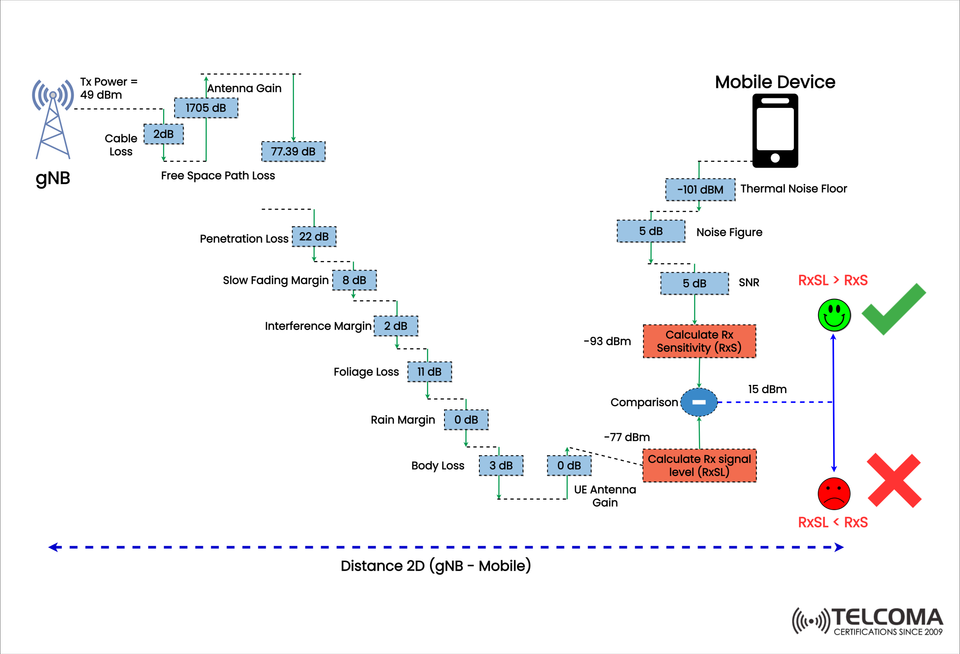
The diagram uploaded lays out the link budget for a 5G system, highlighting key elements like transmit power, antenna gains, environmental losses, and receiver sensitivity. Let’s dive into each part.
What’s a Link Budget in 5G?
A link budget is like a balance sheet for signal strength. It starts with the transmit power of the base station and then subtracts various losses (like free space path loss, penetration loss, and fading), while adding in gains (like antenna gain).
In the end, you compare the received signal level (RxSL) with the receiver sensitivity (RxS). If RxSL > RxS, the signal is strong enough for good communication. If not, users might face dropped calls, slow speeds, or worse—no service at all.
Parts of a 5G Link Budget
The diagram shows the journey of a radio signal from the gNB to a mobile device, step by step.
- Transmit Power (Tx Power)
For this example, Tx Power = 49 dBm.
This is the starting power level at which the gNB sends out the signal.
- Cable Loss
We subtract 2 dB for cable loss between the transmitter and the antenna.
This represents inefficiency in the physical cabling.
- Antenna Gain
The antenna offers a 17.05 dB gain, which enhances the effective radiated power.
- Free Space Path Loss
As the signal travels, it encounters 77.39 dB of free space path loss due to distance.
This is a significant factor in the attenuation of wireless systems.
Environmental and Propagation Losses
Various real-world factors further reduce signal strength:
Penetration Loss: 22 dB (from walls, buildings).
Slow Fading Margin: 8 dB (due to shadowing effects).
Interference Margin: 2 dB (from other cell signals).
Foliage Loss: 11 dB (due to trees and vegetation).
Rain Margin: 0 dB (considered negligible here).
Body Loss: 3 dB (absorption by the human body).
- UE Antenna Gain
User equipment contributes 0 dB gain, meaning no added amplification.
- Received Signal Level (RxSL)
After accounting for all gains and losses, the received signal level comes out to -77 dBm.
Receiver Sensitivity (RxS)
Receiver sensitivity refers to the minimum signal level a mobile device needs to accurately detect and decode information.
The diagram outlines how RxS is calculated:
Thermal Noise Floor: -101 dBm.
Noise Figure (NF): 5 dB, indicating receiver hardware inefficiency.
Required SNR: 5 dB, the minimum signal-to-noise ratio needed for decent performance.
When you put these together, the calculated RxS = -93 dBm.
Comparing RxSL and RxS
RxSL = -77 dBm
RxS = -93 dBm
Since RxSL > RxS, it means the link is strong enough. The difference of 15 dB margin ensures reliable connectivity in current conditions.
If RxSL had been lower than RxS, the device would struggle with signal strength, resulting in connection issues.
Why Link Budget Matters in 5G Network Design
A well-thought-out link budget is key for:
Coverage Planning: Figuring out how far a cell tower can effectively service users.
Capacity Management: Keeping consistent data speeds at the cell's edges.
Quality of Experience (QoE): Avoiding dropped calls, buffering, and sluggish data performance.
Spectrum Utilization: Optimizing frequency use for urban versus rural setups.
Cost Efficiency: Cutting down the number of sites by maximizing coverage.
Practical Elements Affecting 5G Link Budget
Environmental Losses
In urban settings (with tall buildings), there’s a lot of penetration loss.
Rural areas might see foliage loss, but generally face less interference.
Frequency Dependence
Higher frequencies (like mmWave) face greater path loss and penetration issues.
Lower frequencies (below 6 GHz) travel farther but provide less bandwidth.
Mobility and Body Loss
The user's location and movement (think indoors or underground) heavily influence RxSL.
Body absorption adds an unavoidable loss margin.
Weather Conditions
Rain, fog, and atmospheric absorption have a more significant effect on higher frequency bands.
Basic Link Budget Formula
A general formula for link budget is:
RxSL = Tx Power – Losses + Gains
Losses cover path loss, fading, interference, and body/foliage effects, while gains account for antenna gain on both ends.
To ensure reliable functioning:
RxSL ≥ RxS
Example Calculation (based on the diagram)
Tx Power: 49 dBm
Cable Loss: -2 dB
Antenna Gain (gNB): +17.05 dB
Free Space Path Loss: -77.39 dB
Penetration Loss: -22 dB
Slow Fading: -8 dB
Interference: -2 dB
Foliage Loss: -11 dB
Rain Margin: -0 dB
Body Loss: -3 dB
UE Antenna Gain: +0 dB
Final RxSL = -77 dBm
With receiver sensitivity at -93 dBm → Since -77 dBm > -93 dBm, the link checks out.
Link Budget Table
Parameter Value Tx Power (gNB)49 dBm Cable Loss-2 dB Antenna Gain (gNB)+17.05 dB Free Space Path Loss-77.39 dB Penetration Loss-22 dB Slow Fading Margin-8 dB Interference Margin-2 dB Foliage Loss-11 dB Rain Margin0 dB Body Loss-3 dBUE Antenna Gain0 dBRxSL-77 dBm Thermal Noise Floor-101 dBm Noise Figure5 dB Required SNR5 dBRxS-93 dBm Margin (RxSL – RxS)+15 dB
The Future of Link Budgets in 5G and 6G
As networks advance:
AI and ML will help adjust link budgets in real time.
Beamforming and massive MIMO will improve antenna gain and lower path loss.
mmWave and beyond (6G THz bands) will require even more precise link budget planning due to higher attenuation.
Dynamic Spectrum Sharing (DSS) will add complexity to link budget calculations.
Summary
The 5G link budget is crucial for network design, making sure that every mobile device can connect reliably to the gNB despite real-world losses. By balancing Tx power, antenna gain, propagation losses, and receiver sensitivity, telecom engineers can create networks that consistently perform well.
In the example given, the RxSL (-77 dBm) surpasses the RxS (-93 dBm), yielding a 15 dB margin—plenty to ensure solid connectivity.
As 5G grows and 6G becomes a reality, link budgets will continue to be a key player in telecom planning, shaping the future of wireless connectivity.