
5G Low-band Utilization: DSS vs Re-farming in EN-DC Networks

Utilizing Low-band in 5G: DSS vs Re-farming in EN-DC Networks
The development of 5G Non-Standalone (NSA) networks has been influenced not just by the use of high-band and mid-band frequencies, but also by smart applications of low-band spectrum. While high bands (FR2/mmWave) provide outstanding capacity, low bands (sub-1 GHz) are crucial for broad coverage and better indoor penetration.
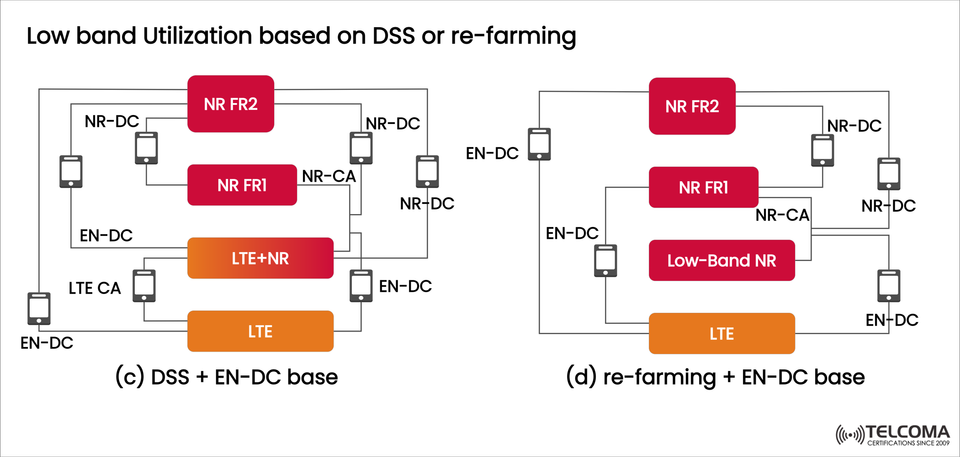
The diagram above shows two ways to use low-band in the NSA EN-DC (E-UTRA-NR Dual Connectivity) architecture:
(a) DSS + EN-DC base
(b) Re-farming + EN-DC base
Both options help operators make the most of their spectrum while maintaining smooth connectivity across LTE and NR. Let’s dive into these two methods and see how they impact performance.
The Importance of Low-band in 5G
5G often brings to mind lightning-fast speeds in mid-band and mmWave, but low-band spectrum is just as vital for a few key reasons:
Nationwide coverage: Sub-1 GHz frequencies cover more ground and penetrate buildings effectively.
Anchor role in EN-DC: Provides solid coverage while higher bands enhance capacity.
Mobility and reliability: Guarantees a consistent experience during transitions.
IoT and rural coverage: Supports widespread connectivity for all sorts of applications.
Without using low-band efficiently, 5G would have a tough time delivering broad coverage along with high throughput.
EN-DC and Low-band Integration
What is EN-DC (E-UTRA NR Dual Connectivity)?
In NSA mode, LTE acts as the primary anchor, while NR (FR1/FR2) serves as an additional node.
Devices can connect to both LTE and NR, improving throughput and reliability.
Low-band LTE anchors are essential for maintaining control plane stability.
Operators need to choose how to best utilize low-band frequencies: through DSS (Dynamic Spectrum Sharing) or Re-farming.
DSS + EN-DC Base (Dynamic Spectrum Sharing)
On the left side (c) of the diagram, DSS-based utilization is depicted.
How DSS Works
DSS allows LTE and NR to share the same spectrum on-the-fly.
Resources are allocated to LTE and NR users based on demand.
Both technologies can coexist without needing a complete reallocation.
Key Components in the Diagram
LTE and NR coexist: The spectrum can serve LTE-only, NR-only, or a mix of both.
EN-DC support: LTE anchors low-band while NR (FR1, FR2) adds capacity.
LTE+NR resource blocks: Devices can operate in shared channels.
Advantages of DSS
Enables quick 5G rollout without shutting down LTE.
Flexible use of existing spectrum resources.
Eases the transition for users moving from LTE to 5G.
Challenges of DSS
Less spectral efficiency than dedicated NR usage.
Increased complexity in signaling and scheduling.
Performance can vary based on traffic types.
Re-farming + EN-DC Base
On the right side (d) of the diagram, re-farming is shown.
How Re-farming Works
Re-farming completely reallocates a low-band LTE carrier for NR use.
Instead of sharing, LTE entirely vacates the band.
The low-band becomes a dedicated NR carrier, often paired with LTE via EN-DC.
Key Components in the Diagram
Low-band NR carrier: Exclusive NR allocation boosts efficiency.
EN-DC anchoring: LTE remains the primary anchor, albeit with fewer bands.
NR-CA (Carrier Aggregation): Allows combining low-band NR with FR1/FR2.
Advantages of Re-farming
Offers better spectral efficiency than DSS.
Enhanced NR performance due to dedicated resources.
Future-proofing by gradually reducing reliance on LTE.
Challenges of Re-farming
LTE coverage and capacity could drop if spectrum is shifted too hastily.
Requires sufficient LTE capacity on other bands to cater to legacy users.
Slower migration compared to DSS, especially in multi-operator settings.
DSS vs Re-farming: A Technical Comparison
Feature DSS (Dynamic Spectrum Sharing)Re-farming Spectrum Use Shared dynamically between LTE & NR Dedicated exclusively for NR Deployment Speed Fast, immediate deployment Slower, requires LTE migration Efficiency Lower due to signaling overhead Higher due to exclusive NR use Coverage Maintains LTE + NR simultaneously May reduce LTE coverage if spectrum is shifted User Experience Good for mixed LTE/NR users Better NR experience, weaker LTE Best Use Case Early 5G rollout in LTE-heavy markets Mature markets with declining LTE traffic
Real-world Operator Strategies
Operators globally are taking a hybrid approach, starting with DSS and transitioning to re-farming as LTE demand decreases.
Early Stage (2020–2022): DSS was heavily used to roll out 5G quickly.
Transition Stage (2023–2025): Gradual re-farming of LTE low-band spectrum to NR.
Future Stage (beyond 2025): Full NR utilization, keeping LTE for legacy support.
For instance:
US & Europe: Strong DSS deployment in low-bands (700–900 MHz).
Asia (like Korea and Japan): Aggressive re-farming as LTE adoption stabilizes.
Technical Impact on EN-DC
Both DSS and re-farming improve EN-DC by making sure low-band spectrum can support high-band NR connections.
With DSS, LTE anchors continue to be stable, allowing for co-existing LTE and NR.
With Re-farming, the anchor role shifts as NR takes on a larger role in EN-DC, paving the way for Standalone (SA) 5G.
This change is essential because low-band anchors are the backbone for mobility and coverage, while mid/high bands (FR1/FR2) supply additional capacity.
DSS vs Re-farming: Which is Better?
There’s no clear-cut answer — it really hinges on market conditions and operator goals.
DSS is preferable when:
LTE traffic is still significant.
There's a need for speedy 5G rollout.
Spectrum resources are tight.
Re-farming is a better fit when:
LTE traffic has dropped off.
Operators seek greater NR efficiency.
The network is gearing up for Standalone 5G.
Most operators begin with DSS and shift to re-farming as user adoption picks up.
Future Outlook: From EN-DC to SA
While DSS and re-farming enhance NSA deployments, the ultimate aim is Standalone (SA) 5G. In SA, NR will rely less on LTE anchors.
DSS → Re-farming → SA: A natural progression.
Low-band NR will stay vital for coverage, even as SA becomes the norm.
Operators will balance low-band NR for coverage with mid/high-band NR for capacity.
Conclusion
The diagram outlines two important methods for low-band utilization in 5G NSA EN-DC networks:
DSS (Dynamic Spectrum Sharing): Quick, flexible, but less efficient.
Re-farming: Dedicated, efficient, but requires LTE migration.
For operators, it’s not really “DSS vs re-farming” but more like “DSS now, re-farming later” as LTE use drops and 5G picks up.
Both strategies play a crucial role in ensuring low-band spectrum can continue to support 5G, making it possible to integrate smoothly with higher bands and leading the way toward Standalone 5G networks.