
5G Network Architecture Explained | Key Components & Functions

5G has totally changed the game for the telecom world, bringing super-fast connections, reliable low-latency communications, and the ability to connect tons of IoT devices. But to really get a grip on what 5G is all about, we gotta dive into its network architecture — the backbone that makes everything tick.
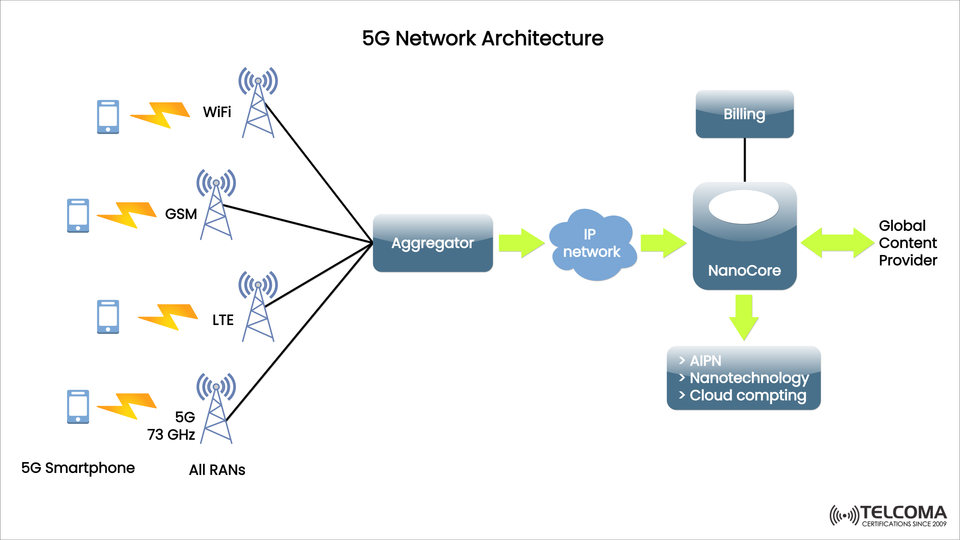
The diagram above gives us a look at a high-level 5G network architecture, which covers everything from access networks to the core network, along with the IP backbone and global content delivery.
In this article, we'll break down each part, explain what it does, and see how they all work together to create seamless connectivity for the next generation.
Understanding the 5G Network Architecture
- Multi-RAN Connectivity (Access Layer)
It all starts with the Radio Access Networks (RANs). 5G supports different types of access — and by that, I mean it can pull together all sorts of networks:
Wi-Fi: This uses unlicensed spectrum to keep connectivity affordable.
GSM: It still supports those older 2G networks just in case you need voice fallback.
LTE (4G): Acts as a coverage anchor, especially when deploying NSA (Non-Standalone) 5G.
5G NR (73 GHz mmWave): These high-frequency bands pack a punch with fast data rates and low latency.
By merging these RANs, 5G ensures a smooth connection no matter what device or spectrum you're using.
- Aggregator
Next up is the Aggregator, which takes traffic from all the RANs and sends it to the core network. This helps with handovers and balances the load between different types of access.
Key Functions of the Aggregator:
Collects user data from multiple RANs.
Manages traffic based on quality of service requirements.
Makes sure users have a seamless experience while on the move.
- IP Network Backbone
The IP network is the transport layer that links the RAN aggregation to the core network. This all-IP backbone enables:
High-speed data transport.
Network slicing for various service types like eMBB, URLLC, and mMTC.
Secure and efficient routing for signals and user data.
- NanoCore (5G Core Network)
At the core of this architecture is the NanoCore, representing the 5G Core (5GC). Unlike LTE’s EPC, 5GC is completely service-based, so network functions are virtualized and connected through APIs.
Key Features of NanoCore:
Service-Based Architecture (SBA): Functions like AMF, SMF, and UPF operate as independent services.
Cloud-Native Deployment: Built to run on NFV/Cloud infrastructure for easy scaling.
AI-Powered Optimization: The Nano Core uses AI and nanotechnology for predictive analysis and smart traffic routing.
- Global Content Provider Integration
On the right side of the diagram, we see Global Content Providers linked to the Nano Core. This means direct connections with CDNs and OTT platforms, which cuts down on latency and enhances user experience for things like video streaming and cloud gaming.
- Billing and Policy Control
This architecture includes a Billing Function that tracks data usage, ensures proper charging, and enforces policies through the Policy Control Function (PCF), which allows operators to offer different service levels — like premium 5G gaming plans.
- Advanced Features – AI, Nanotechnology, and Cloud Computing
The bottom part mentions All-IP Networks, Nanotechnology, and Cloud Computing, emphasizing that 5G’s strength isn't just in speed but also in its flexibility.
AI/ML: Used for proactive network management and spotting issues.
Nanotechnology: Helps to make antennas smaller and devices more efficient.
Cloud Computing: Supports Multi-Access Edge Computing for ultra-low latency services.
Benefits of This 5G Architecture
Feature | Benefit
Multi-RAN Aggregation | Smooth user experience, even during handovers.
IP Backbone | High-speed, secure data transport.
NanoCore (5GC) | Flexible, scalable cloud-native core network.
Edge Computing Support | Ultra-low latency apps become possible.
Global Content Peering | Better quality experience for streaming and real-time applications.
Use Cases Enabled by 5G Network Architecture
Enhanced Mobile Broadband (eMBB): 4K/8K streaming, VR/AR experiences.
Ultra-Reliable Low Latency Communications (URLLC): Remote surgeries, self-driving cars.
Massive IoT (mMTC): Smart cities, connected sensors, industrial IoT.
Step-by-Step Diagram Breakdown
To make things clearer, here’s a step-by-step rundown of the 5G network architecture diagram:
User Device Layer (5G Smartphones)
Devices can handle multiple access types — Wi-Fi, GSM, LTE, and 5G NR.
5G devices switch between networks based on coverage, quality of service, and application needs.
Radio Access Layer (All RANs)
Each access network (like Wi-Fi access points, GSM base stations, LTE eNodeBs, and 5G gNodeBs) sends traffic to the next layer.
Multi-connectivity allows for simultaneous connections, boosting reliability.
Aggregator
This is where all RANs converge.
It manages traffic aggregation, scheduling, and prioritizing quality of service.
Enables network slicing by directing traffic to the right logical network.
IP Network (Transport Layer)
Responsible for routing data packets to the core network.
Uses Software Defined Networking for dynamic path selection and traffic optimization.
Nano Core (5G Core)
Fully virtualized, microservices-based core network.
Supports service-based architecture, where functions communicate via APIs.
Uses AI, edge computing, and nanotech to dynamically optimize performance.
Global Content Providers
Direct peering cuts latency for video streaming, gaming, and enterprise apps.
Traffic is routed smartly based on content location and user proximity.
Billing & Policy Control
Monitors user activity and applies network policies.
Ensures correct billing for network slices and premium services.
Conclusion
The 5G network architecture seen here is a next-gen, all-IP, cloud-native system built to support a range of applications with incredible speed, reliability, and scalability. By bringing together multiple RANs, routing data through a strong IP backbone, and utilizing NanoCore for smart core functions, 5G lays the groundwork for a hyper-connected future.
For telecom engineers, grasping this architecture is crucial for designing and fine-tuning networks that can handle everything from massive IoT projects to critical communications — and beyond.