
5G NR Architecture Option 4 and 4a Explained: Dual Connectivity with 5GC
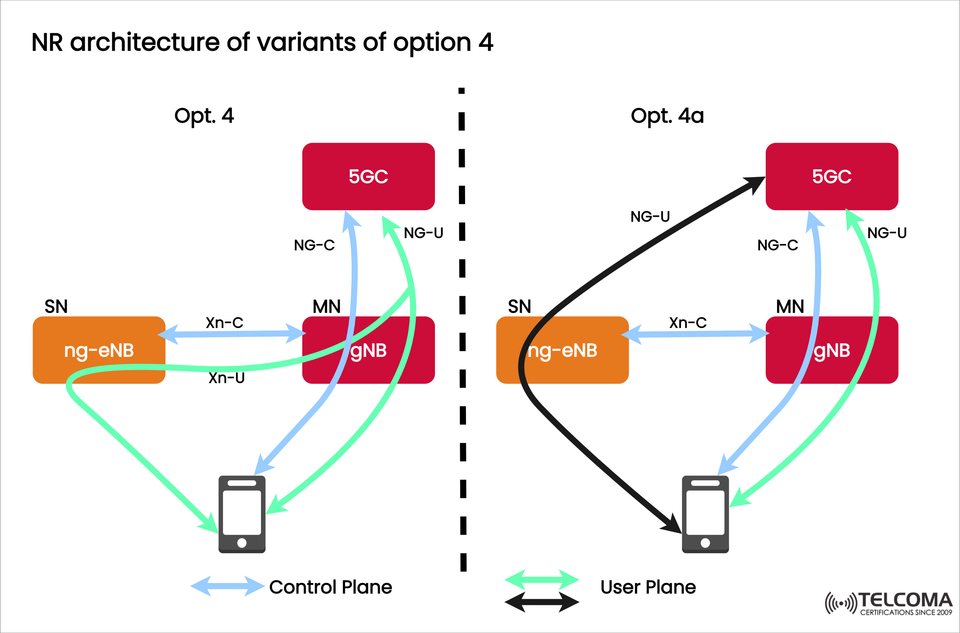

The launch of 5G networks follows several architectural paths set by 3GPP, designed to facilitate a smooth transition from LTE (4G). The initial deployments of 5G were based on Option 3 variants, which relied on the LTE EPC, but later stages brought in Option 4 and 4a, where the setup is anchored on the 5G Core (5GC).
This change is a vital move towards full 5G Standalone (SA) networks since Option 4 variants start to weave in 5GC, while still utilizing LTE evolved nodes.
The diagram included shows the NR architecture for Option 4 and 4a, highlighting how the gNB (next-gen 5G base station), ng-eNB (enhanced LTE eNodeB with next-gen interfaces), and 5GC work together for both the control plane and user plane.
In this article, we'll break down the tech flow, compare Option 4 and 4a, and clarify their parts in the 5G migration journey.
What is Option 4 in 5G NSA?
Option 4 is a Non-Standalone (NSA) dual connectivity architecture where:
The gNB (NR base station) serves as the Master Node (MN).
The ng-eNB (LTE base station upgraded for NG interfaces) acts as the Secondary Node (SN).
The core network is the 5G Core (5GC).
Control Plane (NG-C, Xn-C):
The EPC is no longer in use; now, 5GC manages signaling through the gNB (MN).
The gNB handles control-plane signaling for the UE and coordinates the ng-eNB using the Xn-C interface.
User Plane (NG-U, Xn-U):
User data can go directly from 5GC to gNB (NG-U).
If extra LTE connectivity is needed, the gNB forwards traffic to the ng-eNB using Xn-U.
The UE collects data from both nodes.
✅ Key Point: In Option 4, NR (gNB) is the main player, so 5G is the anchor technology, contrasting with Option 3 where LTE was the anchor.
Option 4a Architecture
Option 4a tweaks the user-plane path for better efficiency.
Control Plane: * Same as Option 4: gNB (MN) controls signaling with 5GC through NG-C. * gNB still manages ng-eNB via Xn-C.
User Plane: * Both gNB and ng-eNB connect directly to 5GC through NG-U. * User data paths don’t need to go through the gNB, which cuts down on latency.
✅ Key Point: Option 4a enables direct EPC-to-ng-eNB user-plane connections, speeding up data transfer and allowing gNB to avoid unnecessary traffic forwarding.
Comparing Option 4 and Option 4a
Here’s a comparison:
Feature Option 4Option 4aMaster Node (MN)gNB (5G NR base station)gNB (5G NR base station)Secondary Node (SN)ng-eNB (LTE base station)ng-eNB (LTE base station)Control Plane5GC → gNB (NG-C) → ng-eNB (Xn-C)5GC → gNB (NG-C) → ng-eNB (Xn-C)User Plane5GC → gNB (NG-U) → ng-eNB (Xn-U) → UE5GC → gNB (NG-U) + 5GC → ng-eNB (NG-U)Latency Higher (traffic forwarded via gNB)Lower (direct ng-eNB to 5GC link)Throughput Moderate Higher (parallel connections)Complexity Simpler More complex (multiple NG-U paths)
Why Option 4 Variants Matter
The shift from LTE EPC (Option 3 variants) to anchoring on 5GC (Option 4 variants) is crucial for operators because:
5GC Adoption: Option 4 marks the first time 5GC enters the architecture while still depending on LTE for coverage.
NR as Master Node: This changes the hierarchy from Option 3 — now 5G NR takes the lead, with LTE just providing supplementary coverage.
Performance Improvements: Particularly, Option 4a reduces latency and boosts throughput with direct 5GC-to-ng-eNB user plane paths.
Future-Ready: This setup eases the transition toward Option 2 (Standalone 5G), where only gNB and 5GC are used.
Real-World Adoption and Challenges
Even though Option 4 is quite powerful in theory, it's been less widely adopted compared to Option 3 due to some practical hurdles:
Infrastructure Readiness: Operators needed to deploy 5GC early, which many delayed to cut costs.
Device Compatibility: Early smartphones were made for LTE-anchored NSA (Option 3), so they weren't as ready for NR-anchored NSA (Option 4).
Coverage Gaps: In the early days, NR coverage was patchy, making LTE a more dependable anchor.
Interoperability: There were complex Xn interfaces between gNB and ng-eNB that needed vendor cooperation, which wasn’t fully developed yet.
Operators’ Strategies
Option 3 First: Most global operators (like Verizon, Vodafone, SK Telecom) opted for Option 3 first because it was easier with EPC.
Option 4 Later: Option 4 variants became more appealing for operators aggressively deploying 5GC early on, including those in China and South Korea.
Migration Path: From Option 4 to Standalone (Option 2)
Option 4 is really just a stepping stone:
Step 1: Roll out Option 3 NSA (LTE as anchor, EPC).
Step 2: Bring in 5GC and switch to Option 4 NSA (NR as anchor, 5GC).
Step 3: Gradually transition to Option 2 SA (gNB directly tied to 5GC without LTE).
This approach guarantees:
Backward compatibility for LTE users.
A gradual shift to 5GC without a sudden overhaul.
A smooth path towards true 5G services, like ultra-reliable low-latency communication (URLLC), massive IoT, and network slicing.
Benefits of Option 4 and 4a
Better Alignment with 5G Vision: Anchoring on NR and 5GC brings networks closer to a Standalone structure.
Enhanced User Experience: Especially, Option 4a speeds up latency and throughput.
Future-Proofing: Early adoption of 5GC sets operators up for advanced 5G applications.
Flexible Transition: Dual connectivity lets operators move traffic between LTE and NR smoothly.
Conclusion
The NR architecture of Option 4 and 4a represents a pivotal phase in the deployment of 5G NSA, shifting the anchor point from LTE EPC to NR with 5GC.
Option 4 handles user-plane traffic via the gNB, with ng-eNB linked through the gNB.
Option 4a takes it a step further by allowing direct connections from ng-eNB to 5GC for user-plane traffic.
In a nutshell, Options 4 and 4a act as bridges: connecting LTE to NR while introducing the 5G Core, ensuring that the transition from NSA to SA happens without a hitch.