
5G NR Architecture Option 7 Explained: Variants 7, 7a, and 7x with 5GC
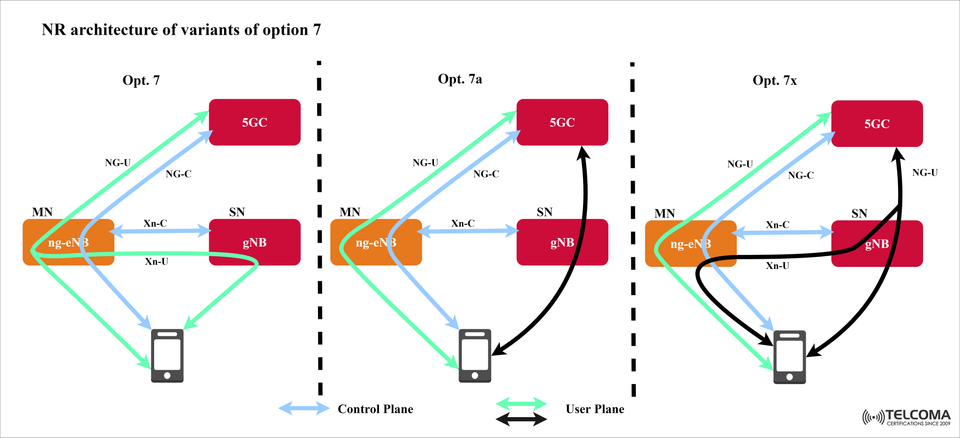

The shift from LTE to 5G New Radio (NR) involves several migration paths based on 3GPP standards. One of the key steps in this transition is the Option 7 variants (7, 7a, 7x), where LTE (ng-eNB) takes the role of the Master Node (MN), while NR (gNB) serves as the Secondary Node (SN).
Unlike Option 4, where NR is the primary anchor, Option 7 keeps LTE as the anchor but connects to the 5G Core (5GC) instead of the older EPC. This setup makes Option 7 a bridge between traditional LTE and fully Standalone 5G (Option 2).
The attached image illustrates the NR architecture for Option 7 variants, displaying both control-plane and user-plane connections among ng-eNB, gNB, and 5GC.
In this post, we’ll dive into Option 7, 7a, and 7x—exploring their architectures, differences, and their significance in the global 5G rollout.
What is Option 7 in 5G NSA?
Option 7 is a Non-Standalone (NSA) dual connectivity architecture where:
Master Node (MN): ng-eNB (LTE node updated with NG interfaces).
Secondary Node (SN): gNB (5G NR base station).
Core Network: 5GC (5G Core).
Control Plane:
The UE’s control signaling is anchored on ng-eNB, which connects to 5GC via NG-C.
ng-eNB also manages communication with gNB through the Xn-C interface.
User Plane:
User-plane data primarily travels from ng-eNB to 5GC (NG-U).
Traffic from gNB is sent to ng-eNB via Xn-U before reaching the UE.
✅ Key point: In Option 7, LTE acts as the anchor technology for both control and user-plane aggregation, with NR enhancing capacity and throughput.
Option 7a Architecture
Option 7a takes Option 7 a step further with a more efficient user-plane design.
Control Plane:
This is the same as Option 7.
ng-eNB stays as the Master Node, managing signaling between 5GC and gNB.
User Plane:
The gNB (SN) can connect directly to 5GC via NG-U, bypassing ng-eNB.
Data can flow at the same time in two ways:
UE ↔ ng-eNB ↔ 5GC.
UE ↔ gNB ↔ 5GC.
✅ Key point: Option 7a reduces latency and boosts throughput by bypassing ng-eNB for gNB traffic.
Option 7x Architecture
Option 7x builds on Option 7a by providing greater flexibility in user-plane routing.
Control Plane:
This is the same as Options 7 and 7a.
ng-eNB continues to be the Master Node, managing gNB via Xn-C.
User Plane:
There are multiple paths:
UE ↔ ng-eNB ↔ 5GC (NG-U).
UE ↔ gNB ↔ ng-eNB ↔ 5GC.
UE ↔ gNB ↔ 5GC directly.
✅ Key point: Option 7x offers hybrid routing, enabling dynamic traffic distribution across LTE and NR for optimized performance.
Comparing Option 7, 7a, and 7x
Feature Option 7Option 7aOption 7xMaster Node (MN)ng-eNB (LTE with NG interfaces)ng-eNB (LTE with NG interfaces)ng-eNB (LTE with NG interfaces)Secondary Node (SN)gNB (5G NR)gNB (5G NR)gNB (5G NR)Control Plane5GC ↔ ng-eNB (NG-C) ↔ gNB (Xn-C)Same as Option 7Same as Option 7User Plane gNB → ng-eNB → 5GC → UEgNB → 5GC (direct) + ng-eNB → 5GCMultiple paths: gNB→5GC, gNB→ng-eNB→5GCLatencyHigher (traffic goes via ng-eNB)Lower (direct gNB-to-5GC link)Flexible (hybrid paths, optimized)Throughput Moderate Higher Highest (multi-path aggregation) Complexity Lower Moderate High (advanced coordination needed)
Why Option 7 Variants Matter
Options 7, 7a, and 7x provide a logical migration path for operators transitioning from LTE EPC to 5GC-based NSA deployments, while still utilizing LTE as the anchor.
Benefits:
Reuse Existing LTE Infrastructure: ng-eNB stays as the anchor, cutting down transition costs.
Early 5GC Adoption: Helps operators get closer to standalone 5G while still maintaining LTE coverage.
Better User Experience: Options 7a and 7x deliver lower latency and improved throughput.
Network Flexibility: Operators can opt for routing through ng-eNB (Opt. 7) or enable direct gNB-to-5GC paths (Opt. 7a/7x).
Real-World Adoption
While Option 7 was part of the 3GPP Release 15 specs, commercial usage has been limited compared to Option 3 (LTE EPC anchor).
Reasons:
Preference for LTE Anchor: Initially, many operators leaned towards Option 3 (with EPC), as it was already widely deployed.
Readiness for 5GC: Option 7 requires early 5GC rollout, which many operators delayed.
Device Compatibility: Early 5G smartphones were mainly optimized for Option 3 NSA.
Interoperability Issues: Complicated Xn interface operations needed collaboration across different vendors.
Where it Fits:
Countries with fast 5GC deployment (like China and South Korea) showed more interest in Option 7 variants.
Particularly useful for dense urban areas, where NR can enhance capacity while maintaining LTE coverage.
Migration Path Toward Standalone (Option 2)
The Option 7 variants aren’t meant to be the final architecture. They’re more like transitional solutions leading to Option 2 (Standalone 5G).
Step 1: Operators roll out NSA Option 3 (LTE as anchor, EPC).
Step 2: Transition to NSA Option 7 (LTE as anchor, but now using 5GC).
Step 3: Finally, move to SA Option 2 (NR + 5GC only, moving away from LTE anchor).
This step-by-step migration allows for:
Smooth device compatibility.
Gradual rollout of 5GC.
Easy coexistence of LTE and NR during the transition.
Benefits of Option 7a and 7x Over Option 7
Lower Latency: Direct gNB-to-5GC connections help avoid unnecessary detours through ng-eNB.
Better Throughput: Option 7x enables simultaneous multi-path data flows.
Scalability: Perfect for high-capacity 5G applications (eMBB, URLLC, IoT).
However, these advantages do come with increased complexity in signaling, coordination, and managing multi-path data flows.
Conclusion
The NR architecture of Option 7 variants (7, 7a, 7x) is crucial in the 5G migration process. By keeping LTE as the anchor (ng-eNB as MN) while adding NR as the secondary node, operators can gradually embrace the 5G Core (5GC) without needing a major overhaul.
Though adoption has been limited compared to Option 3, Option 7 variants play a strategic role in bridging LTE with full standalone NR. For those in the telecom field, understanding these architectures is essential to grasp how operators manage cost, coverage, and performance as they advance towards true 5G Standalone.