
5G NR Capabilities for IIoT: How Private Networks, URLLC, TSN, and Spectrum Transform Industries

5G NR Capabilities for IIoT: Transforming Industrial Connectivity
The Industrial Internet of Things (IIoT) is changing the game in fields like manufacturing, energy, transportation, and healthcare. But these industries have really tough demands—ultra-low latency, high reliability, precise synchronization, and secure private networks. Traditional wireless tech just can't keep up.
That's where 5G New Radio (5G NR) steps in. Rather than just being an upgrade for mobile broadband, 5G NR brings in capabilities specifically designed for industrial applications, allowing for critical operations to run with remarkable performance.
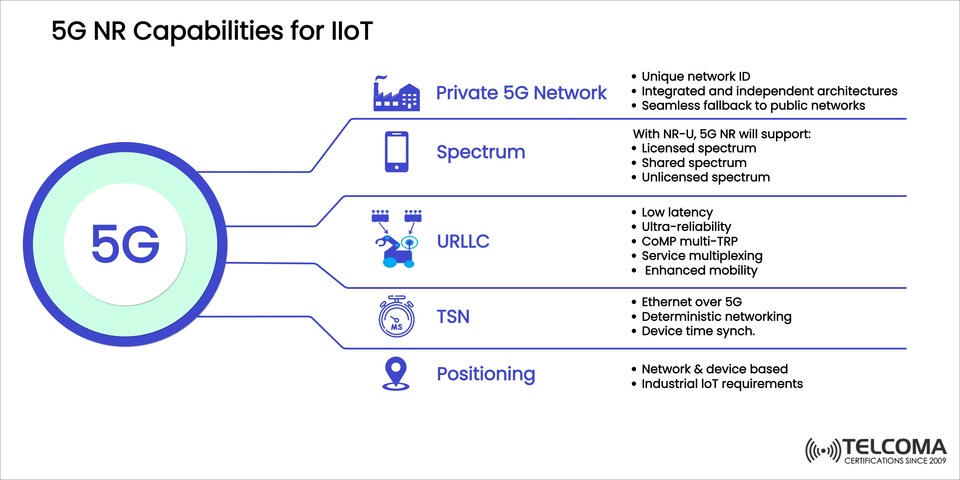
The diagram attached shows five key capabilities of 5G NR for IIoT:
Private 5G Networks
Spectrum Flexibility
Ultra-Reliable Low-Latency Communications (URLLC)
Time-Sensitive Networking (TSN)
Advanced Positioning
Let’s take a closer look at each of these capabilities.
Private 5G Networks: Secure and Customized Industrial Connectivity
More and more companies are setting up private 5G networks to take control, enhance security, and customize their operations. Unlike public mobile networks, private 5G is tailored to the unique needs of specific organizations.
Key Features of Private 5G Networks:
Unique Network ID – Dedicated identifiers help keep them separate from public networks.
Integrated and Independent Architectures – Businesses have the option to link with public systems or run entirely on their own.
Seamless Fallback to Public Networks – Ensures operations can continue smoothly when private coverage isn’t available.
Benefits for IIoT
Factories can successfully operate automated guided vehicles (AGVs) and robotic arms with guaranteed network performance.
The Energy and Mining sectors can conduct remote operations while maintaining secure connections.
In Healthcare, private 5G networks can support XR surgeries and patient monitoring while keeping sensitive data safe.
Private 5G networks really are essential for secure and scalable IIoT setups.
Spectrum: Flexibility for Industrial Environments
Spectrum is essentially the fuel that drives wireless communications. What makes 5G NR unique is that it supports use across various spectrum types—licensed, shared, and unlicensed—letting businesses pick what works best for them.
Supported Spectrum Types with NR-U
Licensed Spectrum – Guarantees quality of service (QoS) with minimal interference, perfect for critical applications.
Shared Spectrum – Balances accessibility and performance, like CBRS in the U.S.
Unlicensed Spectrum – Offers flexible deployment options at lower costs, suitable for less critical IIoT needs.
Why Spectrum Flexibility Matters
Manufacturing plants can depend on licensed spectrum for reliable machine control.
Warehouses and logistics hubs can utilize shared or unlicensed spectrum for cost-effective IoT tracking.
This flexibility makes 5G NR a versatile option that can adapt to different regulatory and economic conditions.
URLLC: Ultra-Reliable Low-Latency Communication
One of the most significant aspects of 5G NR for IIoT is URLLC (Ultra-Reliable Low-Latency Communication).
URLLC Capabilities
Low Latency – Achieves sub-1ms latency for real-time applications.
Ultra-Reliability – Designed for 99.999% reliability, vital for safety-sensitive fields.
CoMP Multi-TRP (Coordinated Multi-Point Transmission with Multi-Transmission Reception Points) – Boosts reliability through redundancy.
Service Multiplexing – Facilitates handling of multiple services at once without compromising quality.
Enhanced Mobility – Keeps stable connections for moving assets like AGVs or drones.
Industrial Applications of URLLC
Smart Factories: Synchronizing robotics in milliseconds.
Energy Sector: Detecting faults and balancing the grid in real-time.
Healthcare: Supporting remote surgeries with XR headsets and robotic tools.
Transportation: Enabling autonomous vehicles to make instantaneous decisions.
Simply put, URLLC guarantees that IIoT applications operate smoothly and without interruption, something no other wireless technology has managed to provide on such a large scale.
TSN: Time-Sensitive Networking over 5G
Industrial operations need deterministic communication, where every task is perfectly timed. This is where Time-Sensitive Networking (TSN) comes in, integrated with 5G NR.
TSN Features in 5G NR
Ethernet over 5G – Brings deterministic Ethernet capabilities into the wireless realm.
Deterministic Networking – Ensures predictable performance, essential for real-time control.
Device Time Synchronization – Aligns devices to a common time reference for precise coordination.
TSN in Action
Industrial Robots: Synchronization for complex multi-robot tasks.
Power Utilities: Keeping distributed energy sources in sync.
Automotive Industry: Coordinating vehicle-to-everything (V2X) systems with sub-millisecond timing.
By enabling TSN over wireless, 5G NR eliminates the need for last-mile Ethernet cables, allowing for flexible yet precise industrial operations.
Positioning: Accuracy for IIoT Applications
Positioning might not get a lot of attention, but it’s crucial in IIoT. 5G NR boosts both network-based and device-based positioning, delivering accuracy that far outstrips traditional GPS, whether indoors or outdoors.
Positioning Capabilities
Network-Based – Utilizes advanced radio measurements for smooth location tracking.
Device-Based – Leverages sensors and GNSS for better accuracy.
IIoT-Specific Requirements – Built to ensure industrial-grade precision and reliability.
Use Cases of 5G NR Positioning
Factories: Keeping tabs on AGVs and tools in real-time.
Mining: Finding personnel and equipment underground where GPS can’t reach.
Healthcare: Monitoring patients or medical devices throughout a hospital complex.
Logistics: Accurate tracking of assets across supply chains.
Having precise positioning is key to ensuring safety, efficiency, and responsibility across different sectors.
How 5G NR Capabilities Work Together for IIoT
While each ability—private 5G, spectrum flexibility, URLLC, TSN, and positioning—offers distinct advantages, the real strength comes from their synergy.
For instance:
On a factory floor, you can run a private 5G network with licensed spectrum, use URLLC for controlling robots, depend on TSN for synchronization, and implement positioning for tracking AGVs—all in seamless harmony.
In the healthcare sector, a hospital could work with a hybrid spectrum setup, enabling URLLC-powered XR surgeries while using positioning for patient monitoring.
This integrated approach is why 5G NR truly enables Industry 4.0.
Industry Benefits of 5G NR for IIoT
Capability Industrial Benefit Example Use Case Private 5GSecurity & reliability Factory automation Spectrum Flexibility Deployment choice, cost optimization Warehousing IoT sensors URL LC Real-time safety-critical communication Remote surgery, smart grids TSN Precise synchronization Robotics, automotive V2XPositioningAccurate tracking & monitoring Mining, logistics, healthcare
Conclusion
5G NR is more than just faster mobile broadband—it’s a transformational technology for industrial IoT. With features like private 5G networks, flexible spectrum deployment, URLLC, TSN, and advanced positioning, industries can achieve the kind of reliability, precision, and scalability that older wireless technologies simply can’t deliver.
For those in telecom, it’s clear: 5G NR lays the groundwork for Industry 4.0. By harnessing these capabilities, companies can tap into new efficiencies, enable critical use cases, and secure their place in an increasingly connected industrial future.