
5G NR Data Flow Explained: From IP Packets to MAC PDUs
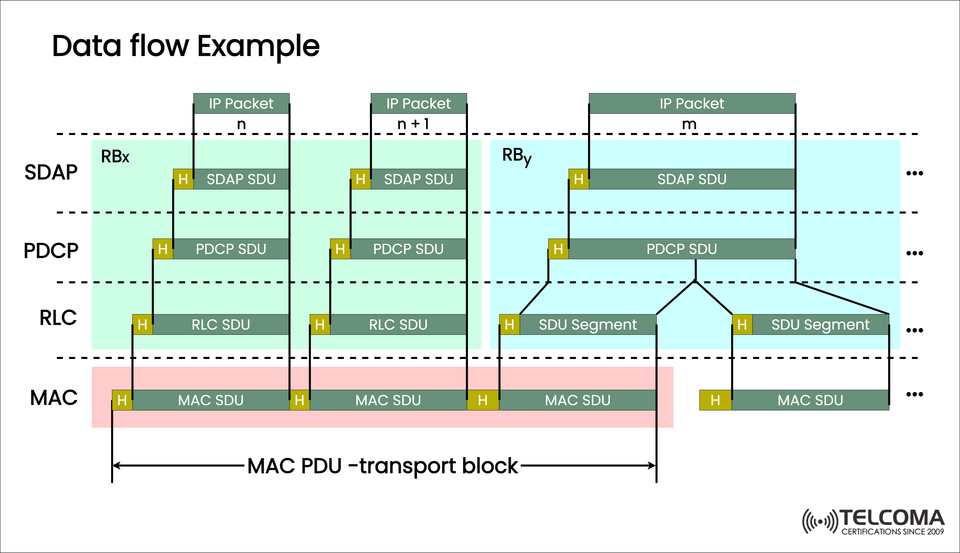

In 5G New Radio (NR), user data goes through several transformations as it travels from the application layer down to the physical layer. Each protocol layer — SDAP, PDCP, RLC, and MAC — plays a specific role in making sure that data is delivered reliably and efficiently while meeting Quality of Service (QoS) requirements.
The diagram included shows how data flows: IP packets get encapsulated, segmented, and aggregated at different layers before being packed into MAC PDUs (Protocol Data Units), also known as transport blocks, ready for wireless transmission.
Overview of the 5G NR Data Flow
At a broad level, the data flow follows this order:
An IP Packet (application data) comes into the SDAP layer.
SDAP adds headers, turning it into an SDAP SDU.
PDCP processes the SDAP SDU, resulting in PDCP SDUs.
RLC either segments or reassembles PDCP SDUs into RLC SDUs.
MAC wraps RLC SDUs into MAC SDUs, creating a MAC PDU (transport block).
Finally, the transport block is sent to the physical layer (PHY) for transmission.
Each of these steps ensures things like QoS, error correction, segmentation, and multiplexing so that we can handle a variety of 5G use cases (eMBB, URLLC, mMTC).
SDAP Layer: Mapping QoS to Data Radio Bearers
The Service Data Adaptation Protocol (SDAP) is one of a kind in 5G NR.
Input: IP packet.
Output: SDAP SDU.
Main Role: It maps QoS flows from the 5G Core to Data Radio Bearers (DRBs) in the RAN.
Functions of SDAP:
Identifies the QoS Flow ID (QFI) and applies the correct QoS treatment.
Differentiates between guaranteed bit rate (GBR) and non-GBR traffic.
Ensures a consistent user experience (like low latency for gaming and high throughput for video).
In the diagram, each IP packet is changed into an SDAP SDU with an added SDAP header (H).
PDCP Layer: Security and Compression
The Packet Data Convergence Protocol (PDCP) is responsible for handling security, integrity, and header compression.
Input: SDAP SDU.
Output: PDCP SDU.
Functions of PDCP:
Header Compression: It uses ROHC (Robust Header Compression) to shrink the size of IP/UDP/TCP headers.
Ciphering & Integrity Protection: Encrypts user plane traffic and protects control plane signaling.
Duplication for URLLC: Supports duplicating packets for ultra-reliable low-latency applications.
In the diagram, every SDAP SDU becomes a PDCP SDU with its specific PDCP header (H).
RLC Layer: Segmentation and Reassembly
The Radio Link Control (RLC) layer makes sure data is reliably delivered and adjusts packet sizes to fit the available radio resources.
Input: PDCP SDU.
Output: RLC SDU or RLC segments.
RLC Modes:
AM (Acknowledged Mode): Provides error correction with retransmissions.
UM (Unacknowledged Mode): No retransmissions, which means lower latency.
TM (Transparent Mode): Mainly used for control channels.
Functions of RLC:
Segmentation: Splits large PDCP SDUs into smaller RLC PDUs.
Reassembly: Combines smaller SDUs back into full packets.
In-sequence delivery: Maintains the correct order of packets.
In the diagram, PDCP SDUs are either sent as complete RLC SDUs or divided into SDU segments with their own headers.
MAC Layer: Multiplexing and Transport Blocks
The Medium Access Control (MAC) layer gets data ready to be sent over the physical channel.
Input: RLC SDUs or segments.
Output: MAC SDUs, which are grouped into MAC PDUs (transport blocks).
Functions of MAC:
Multiplexing: Combines SDUs from multiple logical channels.
Scheduling: Works with the gNB scheduler to dynamically allocate resources.
HARQ (Hybrid ARQ): Provides error correction through retransmission at the physical layer.
MAC PDU = Transport Block
A MAC PDU is also called a transport block, the unit that’s transmitted over the physical layer.
It contains one or more MAC SDUs, each with a header (H).
In the diagram, RLC SDUs and segments are bundled into MAC SDUs, which are then packed into a MAC PDU (transport block) ready for PHY transmission.
Putting It All Together: Example Walkthrough
Let’s trace an IP packet through the stack:
IP Packet (n): Comes from upper layers.
SDAP: Adds a QoS header → turns into SDAP SDU.
PDCP: Adds a PDCP header and applies compression/security → becomes PDCP SDU.
RLC: Processes PDCP SDU. If it fits, it stays as is; if it’s too large, it gets segmented.
MAC: Each RLC SDU/segment becomes a MAC SDU, then it’s packaged into a MAC PDU (transport block).
PHY: The transport block is assigned to physical resources for transmission.
This whole process ensures effective, secure, and QoS-aware delivery of user traffic.
Why Segmentation Matters in 5G
Unlike LTE, 5G is designed to support extreme use cases with various packet sizes. For instance:
URLLC traffic: Needs very small packets with ultra-low latency.
eMBB traffic: Can involve big packets (like for video streaming).
Segmentation enables the network to adapt dynamically, making sure that all traffic types are handled efficiently.
Comparison of Data Flow Responsibilities
Layer Unit Key Functions Example in Diagram SDAPSDAP SDU QoS flow mapping Converts IP packet to SDAP SDUPDCPPDCP SDU Security, compression Adds PDCP header RLCRLC SDU / Segments Segmentation, error correction Splits PDCP SDU into segments MACMAC SDU / PDU Multiplexing, scheduling, HARQ Groups RLC SDUs into MAC PDU (transport block)
Practical Significance for Telecom Engineers
For telecom engineers and network designers, grasping this data flow is essential:
QoS Management: Guarantees that real-time services (like VoIP, AR/VR, and online gaming) receive low-latency service.
Error Handling: Knowing where retransmissions happen (RLC, HARQ) helps fix performance issues.
Resource Optimization: Aids schedulers in allocating radio resources effectively.
Network Planning: The behavior of each layer directly impacts throughput and user experience.
Conclusion
The data flow in 5G NR is a complex, multi-layered process where IP packets go through transformations across SDAP, PDCP, RLC, and MAC layers before turning into MAC transport blocks transmitted wirelessly.
SDAP handles QoS flow mapping.
PDCP is responsible for security and header compression.
RLC manages segmentation and reassembly.
MAC takes care of multiplexing and scheduling traffic into transport blocks.
This structured processing enables 5G to meet its goals of high throughput, low latency, and dependable connectivity, supporting a variety of applications from enhanced mobile broadband (eMBB) to mission-critical communications (URLLC).
For telecom professionals, mastering these layers is crucial for deploying, troubleshooting, and optimizing next-generation 5G networks.