
5G NR Data Transfer Explained: From NAS Registration Complete to Uplink and Downlink Communication
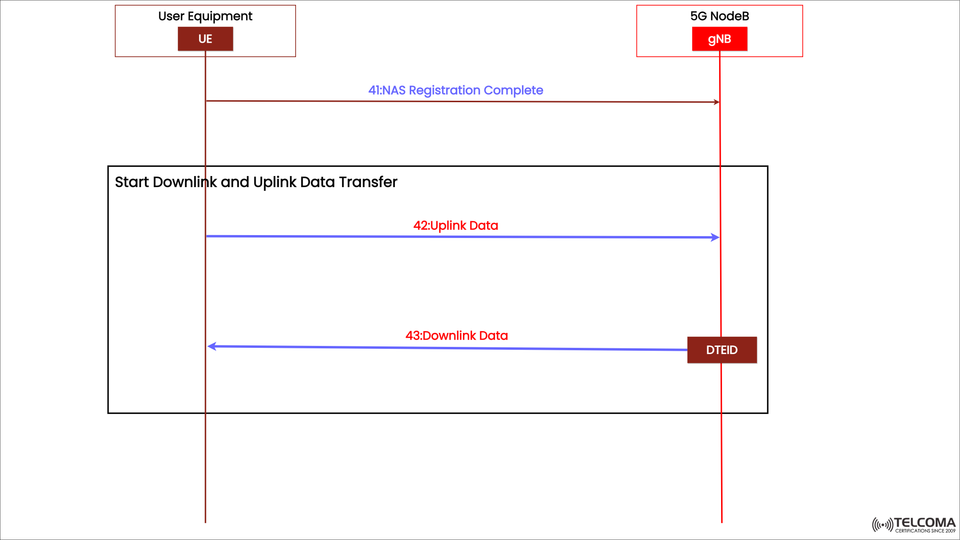

5G NR Data Transfer Procedure: From NAS Registration Complete to Uplink and Downlink Communication
After the RRC Reconfiguration and security establishment are wrapped up, the 5G User Equipment (UE) reaches the final stretch of the registration and connection setup — the start of user data transfer. This is when we shift from signaling to active user-plane communication, meaning real internet, voice, or application data can start flowing.
The diagram provided illustrates this important milestone, showing the sequence of:
NAS Registration Complete message, and
The beginning of Uplink (UE → gNB) and Downlink (gNB → UE) data transfers.
Let’s break this down to see how the 5G system transitions from setup to actual data transmission.
Overview of the 5G Data Transfer Phase
Once all the settings and authentication steps are done, the 5G UE and gNB kick off the exchange of user-plane data through the established PDU sessions.
During the data transfer phase, we'll see:
A final acknowledgment of the NAS registration,
Uplink and downlink bearers turning on, and
Data flow starting over the NG-RAN (Next Generation Radio Access Network).
This whole process ensures the UE is fully connected with the 5G Core (5GC) and can send and receive data in a secure and efficient way.
Message Flow Summary
The image outlines the signaling and data flow between the User Equipment (UE) and gNB:
Step Message / Operation Direction Purpose
41 NAS Registration Complete UE → gNB Confirms successful registration to 5GC
42 Uplink Data UE → gNB Sends user data toward network via established DRB
43 Downlink Data gNB → UE Transmits network or internet data to UE
These three steps finalize the connection establishment and kickstart real-time communication.
Step 41: NAS Registration Complete
Once the RRC Reconfiguration Complete is sent and accepted, the UE shoots off the NAS Registration Complete message to the gNB.
Purpose:
This message shows that:
The UE has successfully registered with the 5G Core Network (5GC).
The NAS (Non-Access Stratum) procedures are completed.
PDU sessions are active, and the device is set for data transmission.
The NAS Registration Complete message also helps sync the Access Stratum (RRC layer) with the Core Network (NAS layer).
Message Path:
The UE sends this message to the gNB, which passes it along to the AMF (Access and Mobility Management Function) in the 5G Core.
The AMF updates the registration status and gives the thumbs up for the UE to start data transfer.
At this point, all radio bearers and security keys are up and running, making it safe to transmit user-plane data.
Role of DTEID in 5G Data Flow
The DTEID (Downlink Tunnel Endpoint Identifier) is key to the GTP-U (GPRS Tunneling Protocol - User Plane) tunnels.
Purpose of DTEID:
It ensures each data packet hitting the gNB is linked to the correct UE and PDU session.
The gNB uses the DTEID to route the data to the right DRB for delivery over the air interface.
This setup accommodates multiple sessions or QoS flows for each UE simultaneously.
Without the DTEID, the gNB wouldn’t be able to properly route user data in a crowded multi-session, multi-user environment.
End-to-End Data Flow in 5G
Once uplink and downlink data transfers are live, the complete user-plane path looks like this:
UE ↔ gNB ↔ UPF ↔ Data Network (DN)
Each part has its specific role:
UE (User Equipment): Sends and receives user data via DRBs.
gNB: Functions as the RAN node handling radio transmission and GTP-U tunneling.
UPF (User Plane Function): Manages IP routing, QoS enforcement, and traffic direction to the Data Network (DN).
DN (Data Network): Provides internet access, IMS services, or private enterprise data networks.
This wraps up the data-plane establishment, paving the way for seamless 5G connectivity.
Key Technical Components at Play
During uplink and downlink data transfers, a number of crucial mechanisms come together to make sure everything runs smoothly:
a. QoS Flows
Each PDU session can support multiple QoS Flows, each assigned to a specific DRB. This ensures priority for services like voice or video over less critical data.
b. Ciphering and Integrity Protection
Both uplink and downlink data are ciphered using encryption keys generated from previous security steps (like K-UP-int and K-UP-enc). This keeps things confidential and secure.
c. Beamforming and BWP Adaptation
In 5G NR, beamforming and Bandwidth Part (BWP) adjustments dynamically enhance data transfer efficiency and signal quality.
d. Scheduling and HARQ
The gNB smartly schedules resources for uplink and downlink transmission, implementing HARQ (Hybrid Automatic Repeat Request) for error correction and retransmission.
Transition from Signaling to Data
This stage is about switching from signaling (control-plane) to data transmission (user-plane).
Before this, all messages were part of RRC and NAS signaling, which was used to set up and verify the connection. After this phase, real user traffic starts flowing through the established PDU sessions under the 5G QoS architecture.
So, the 5G system moves from connection setup to connection usage.
Importance of This Stage in 5G NR
The NAS Registration Complete and Data Transfer phase are crucial since they:
Finalize UE registration with the 5G Core,
Activate all radio and transport layers for user-plane data,
Enable QoS-based, secure data communication,
Mark the start of the real user experience (like browsing, streaming, calling).
If it weren't for this phase, all the previous signaling would just be theory — this is where 5G really kicks in.
Comparison with LTE Data Transfer
Aspect LTE 5G NR
Control Plane Anchor MME (Mobility Management Entity) AMF (Access & Mobility Function)
User Plane Anchor SGW/PGW UPF
Tunneling Protocol GTP-U GTP-U (enhanced for SDN)
QoS Model EPS Bearer QoS Flow with 5QIData Optimization Limited Beamforming, BWP, Massive MIMO
5G brings in network slicing, QoS flow granularity, and a service-based architecture (SBA), allowing operators much more flexibility and performance efficiency.
Conclusion
The 5G NR NAS Registration Complete and Data Transfer procedure signifies the last step in establishing a full 5G connection.
Once this phase kicks off, the UE switches from control signaling to active uplink and downlink data transfer using established PDU sessions and QoS flows. Thanks to the roles of the gNB, UPF, DTEID/UTEID mapping, and DRBs, 5G networks deliver ultra-reliable, high-speed, and low-latency communication.
This is the point where the 5G promise of better mobile broadband, extensive IoT, and highly reliable low-latency communication (URLLC) transforms into reality.