
5G NR Numerology Explained: Transmission Numerologies, Subcarrier Spacing, and Cyclic Prefix in 5G

The Role of Numerology in 5G NR
In 5G New Radio (NR), being flexible and scalable is key to its design. Unlike LTE, which stuck to a set subcarrier spacing of 15 kHz, 5G NR allows for multiple numerologies. Each numerology is defined by its own subcarrier spacing and cyclic prefix configuration.
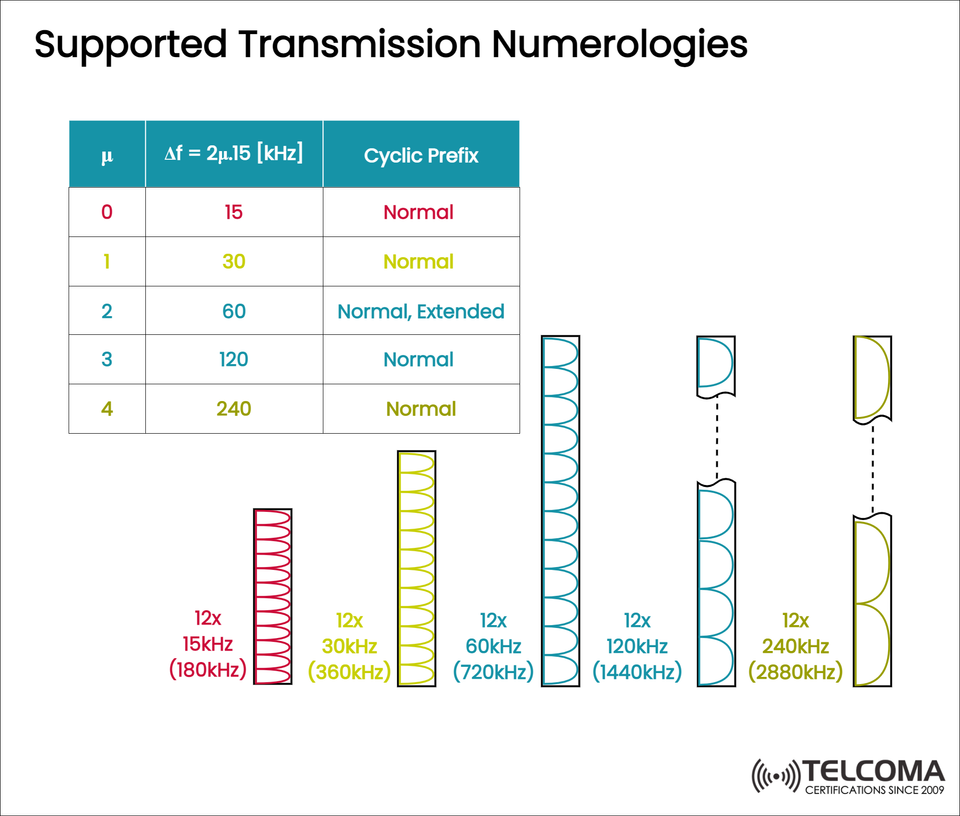
This flexibility means that 5G can adapt to a wide range of frequency spans and use cases — from low-band coverage to mmWave ultra-low-latency communications. The image titled “Supported Transmission Numerologies” brilliantly illustrates this, showing how each numerology (μ = 0 to 4) scales the subcarrier spacing by powers of two, which helps 5G be so adaptable.
What Is Numerology in 5G NR?
In 5G NR, numerology basically defines how the OFDM (Orthogonal Frequency Division Multiplexing) waveform is structured. This includes parameters like:
Subcarrier spacing (Δf)
Slot duration
Symbol duration
Cyclic prefix (CP) length
You can express the subcarrier spacing mathematically as:
Δf=15×2μ kHz
Where:
μ = Numerology index (0 to 4)
Δf = Subcarrier spacing
Each numerology has its own trade-offs when it comes to latency, coverage, and throughput. For instance, a smaller subcarrier spacing (μ = 0) means better coverage and larger cell radii, while a higher spacing (μ = 4) results in shorter symbol durations, which is better for reducing latency — perfect for mmWave operations.
5G NR Supported Transmission Numerologies
The image showcases the five main numerologies defined by 3GPP TS 38.211, which can be summarized as follows:
Numerology (μ) Subcarrier Spacing (Δf) Cyclic Prefix Type Use Case / Frequency Range
0: 15 kHz Normal, FR1 (Sub-6 GHz), LTE coexistence
1: 30 kHz Normal, FR1, low-latency applications
2: 60 kHz Normal / Extended, FR1/FR2 boundary, low-latency
3: 120 kHz Normal, FR2 (mmWave)
4: 240 kHz Normal, FR2 (High mmWave frequencies)
The diagram also shows how bandwidth increases as subcarrier spacing doubles for each μ, emphasizing 5G NR’s scalable bandwidth design.
Subcarrier Spacing and Its Impact
The subcarrier spacing (Δf) affects how tightly OFDM subcarriers fit in the available bandwidth.
Narrower subcarrier spacing = longer symbol duration = better coverage and more resistance to Doppler shifts.
Wider subcarrier spacing = shorter symbol duration = lower latency and better frequency efficiency.
Subcarrier Spacing Relationships
μ Δf (kHz) Symbol Duration (µs) Slots per Frame
0: 15 ~66.7 101
1: 30 ~33.3 201
2: 60 ~16.7 4012
3: 120 ~8.3 804
4: 240 ~4.1 1600
So, when you double the subcarrier spacing, the symbol duration halves, leading to more slots per frame and, ultimately, lower latency.
Cyclic Prefix (CP) in 5G NR
The Cyclic Prefix (CP) is a guard interval that gets added at the beginning of each OFDM symbol to help prevent Inter-Symbol Interference (ISI) from multipath propagation.
In 5G NR:
Most numerologies use a Normal CP.
Extended CP is only available for μ = 2 (60 kHz) in certain cases where longer delay spread handling is needed (like large cells or broadcasting).
Types of Cyclic Prefix
Type Typical Use Case Description
Normal CP: General purpose (urban, dense cells), balances delay spread and spectral efficiency.
Extended CP: High delay spread (rural/macro cells), adds robustness but at some cost to efficiency.
The image clearly marks this distinction, showing “Normal, Extended” for μ = 2, highlighting its dual use.
Frequency Range Mapping: FR1 vs. FR2
5G NR works across two main frequency ranges (FR), each linked with specific numerologies:
Frequency Range Range (GHz) Applicable Numerologies Typical Subcarrier Spacing
FR1: 0 – 6 GHz μ = 0, 1, 2 (15, 30, 60 kHz)
FR2: 24 – 100 GHz μ = 3, 4 (120, 240 kHz)
Key Insights:
FR1 allows for both wide coverage and moderate data rates, using spacings from 15 to 60 kHz.
FR2 (mmWave) takes advantage of 120 to 240 kHz spacings for extremely low latency and high throughput, making up for limited coverage from higher frequency losses.
This setup lets 5G NR efficiently cover urban, suburban, and industrial zones.
Symbol and Slot Structure Scaling
Typically, each 5G NR slot has 14 OFDM symbols (with a normal CP). Slot duration inversely varies with subcarrier spacing:
Slot Duration = 1 ms / 2μ
Examples:
μ = 0 → 1 ms slot (same as LTE)
μ = 1 → 0.5 ms slot
μ = 2 → 0.25 ms slot
μ = 3 → 0.125 ms slot
μ = 4 → 0.0625 ms slot
This scaling allows 5G to meet both high data throughput and ultra-reliable low latency (URLLC) needs. For example, autonomous vehicles could benefit from higher μ values (shorter slots), while IoT sensors might stick with lower μ values for efficiency in power and coverage.
Bandwidth Representation in the Image
At the bottom of the image, you can see each numerology represented as 12 subcarriers multiplied by subcarrier spacing:
12 × 15 kHz = 180 kHz
12 × 30 kHz = 360 kHz
12 × 60 kHz = 720 kHz
12 × 120 kHz = 1440 kHz
12 × 240 kHz = 2880 kHz
This really helps visualize how resource block (RB) bandwidth increases proportionally with μ — which is crucial for how we allocate spectrum and design the network.
Why Multiple Numerologies Matter
Bringing in multiple numerologies is one of the standout features of 5G NR. It means that different services with varying performance needs can operate at the same time on the same carrier using numerology multiplexing.
Key Benefits:
Scalable Deployment: Supports low-band and mmWave all within the same framework.
Reduced Latency: Higher numerologies lead to shorter symbol durations.
Improved Efficiency: Adjusts subcarrier spacing according to propagation conditions.
Service Flexibility: Lets eMBB, URLLC, and mMTC coexist.
Dynamic Scheduling: gNodeB can pick the numerology per service or slice.
Example:
A single 5G base station might schedule:
μ = 0 (15 kHz) for IoT devices that need coverage and power efficiency.
μ = 3 (120 kHz) for AR/VR traffic that requires low latency.
This multi-numerology setup is at the core of 5G network slicing, enabling customized services within a shared infrastructure.
Challenges in Multi-Numerology Operation
Even with its benefits, multi-numerology can get complicated:
Inter-Numerology Interference (INI): Different subcarrier spacings might lead to spectral overlap.
Synchronization Complexity: UEs have to manage symbol alignment across numerologies.
Scheduling Overhead: This needs smart resource coordination from the gNodeB.
Continuous research is looking at windowing, filtering, and guard band optimization to keep INI to a minimum while still being spectrally efficient.
Real-World Implementation
In actual networks:
μ = 0 and 1 are the go-to choices for FR1 deployments focused on coverage and mobility.
μ = 2, 3, and 4 are preferred for FR2 (mmWave) bands to achieve gigabit-speed data and URLLC.
Network vendors are working on adaptive numerology selection, where schedulers dynamically assign numerologies based on channel quality, UE capability, and service type.
This flexibility guarantees top-notch performance across various use cases, from streaming and cloud gaming to autonomous industrial operations.
Conclusion
The 5G NR Supported Transmission Numerologies shown in the image form the foundation of 5G’s flexibility. By varying subcarrier spacing (Δf) and slot duration across numerologies (μ = 0–4), 5G can provide:
Extensive coverage (low μ)
Minimal latency (high μ)
High spectral efficiency
Smooth operation from Sub-6 GHz to mmWave
At the core, numerology dictates how 5G adapts to everything — ranging from remote sensor nodes to self-driving cars. This adaptability is what makes 5G not just an upgrade from LTE but a transformative platform built for a future filled with diverse, dynamic, and data-heavy demands.